- ~ Home
- The Way of St. Francis
- The Way of St. Francis, Rieti, Italy
Jump to Way of St. Francis Stages
Rieti, Italy ~ The Sacred Valley where St. Francis Found Refuge and Inspiration
Rieti, Italy, at the heart of St. Francis' "Sacred Valley" was a perfect place for a respite day, on our Way of St. Francis pilgrimage.
"Francis has sanctified Assisi, his native city, but shone in the province of Rieti to a special fondness and for the splendor of the many miracles." ~ From an ancient text on St. Francis in the Rieti Valley
🙋♀️ Why Trust Us at the Pilgrimage Traveler?
We’re not a travel agency ~ we’re fellow pilgrims! (See About Us)
We've trekked Pilgrimage Routes Across Europe since 2014!
💬 We’ve:
- Gotten lost so you don’t have to. 😉
- Followed waymarks in the glowing sunlight, the pouring rain and by moonlight. ☀️🌧️🌙
- Slept in albergues, hostels & casa rurals. Ate and drank in cafés along the way. 🛌 😴
- Created comprehensive and downloadable GPS maps and eBook Guides, full of must-have information based on real pilgrimage travels. 🧭 🗺️
- Shared our complete journeys, step by step to help YOU plan your ultimate pilgrimage and walk with your own Heart and Soul. 💙✨
Every detail is from our own experiences. Just fellow pilgrims sharing the Way. We have added a touch of spirituality, heartfelt insights and practical guidance from the road ~ offering a genuine connection to the spirit of pilgrimage. Tap into the wisdom of seasoned pilgrims!
Ultreia and Safe Pilgrimage Travels, Caminante! 💫 💚 🤍
Join us in our day tour of Rieti, full of history and cultural monuments, a perfect central location for anyone exploring this Sacred Valley.
Map of Rieti, Italy
For your convenience, I inserted my interactive Google map from our day eighteen here, with all the features I show in the article below. Just zoom into the center, where Rieti lies. I have also included many accommodations on the map, more appropriate for pilgrims.
Accommodations in Rieti, Italy
The only pilgrim-friendly and economical accommodation in Rieti is La Terrazza Fiorita, which I highly recommend. It is close to the cathedral and in the center of town. Below is a photo of its entrance along the Via Pellicceria, just a block east of the main pedestrian street, the Via Roma. The Via Roma is right along the Way of St. Francis pilgrimage route, so it is very conveniently located.
The hostess, Rita, is an author and tour guide, who speaks perfect English. She is ultra-friendly and helpful for all pilgrim-related or Rieti-related questions. The Terrazza Fiorita has a shared kitchen, with breakfast included. The 2nd floor terrace is a lovely and sunny place to hang out with a provided cup of coffee or tea and even dry your hand-washed clothes.
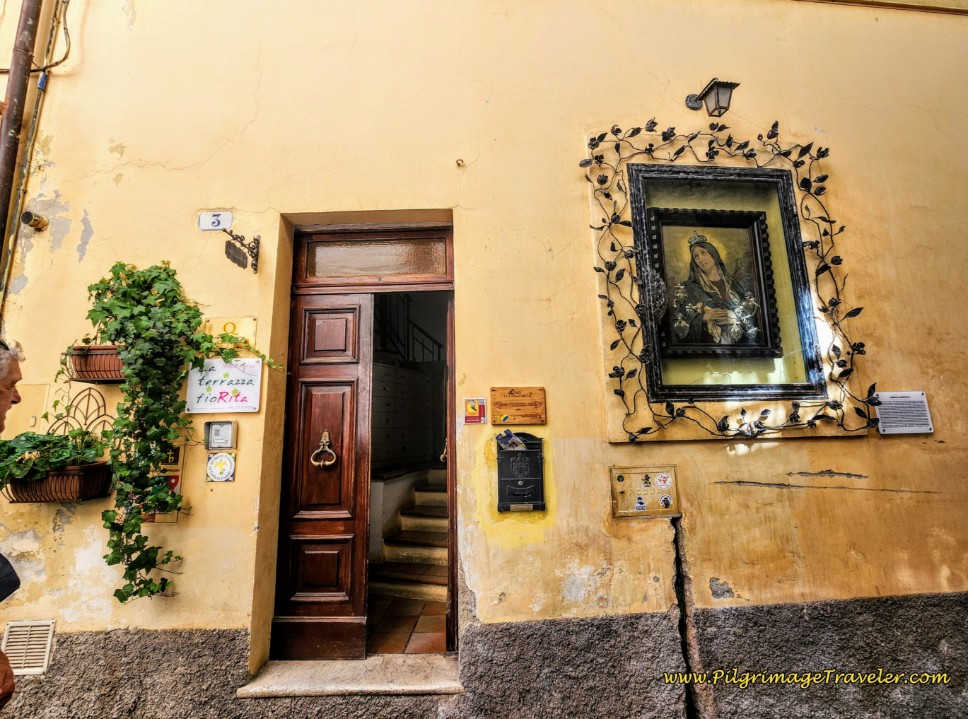 La Terrazza Fiorita Entryway
Rita guides subterranean tours of Rieti, called "Rieti Underground," Rieti Sotterranea. I also highly recommend this tour ~ see farther below for more information and for photos of what to expect.
Of the many places to stay in Rieti, here are some of the more economical ones to check out: Clarissa Guest House in the center, the Hotel Miramonti, along the pilgrimage route on the north of town and Il Capitello, steps from the cathedral.
For additional choices, search under Rieti on Booking.com for the current deals. Sort the results from lowest to highest price for the best result.
Top Sites of Rieti, Italy
Of course, the top site of all is the Duomo di Rieti, the Cattedrale di Santa Maria Assunta. Below is the photo of the entryway on the north side, from the Via di Francesco, as you will see it as you approach from either direction. For a full photo from the Piazza Cesare Battisti on the other side, see day eighteen.
And gracing the approach, before the arches is of course, a statue of St. Francis, also shown below.
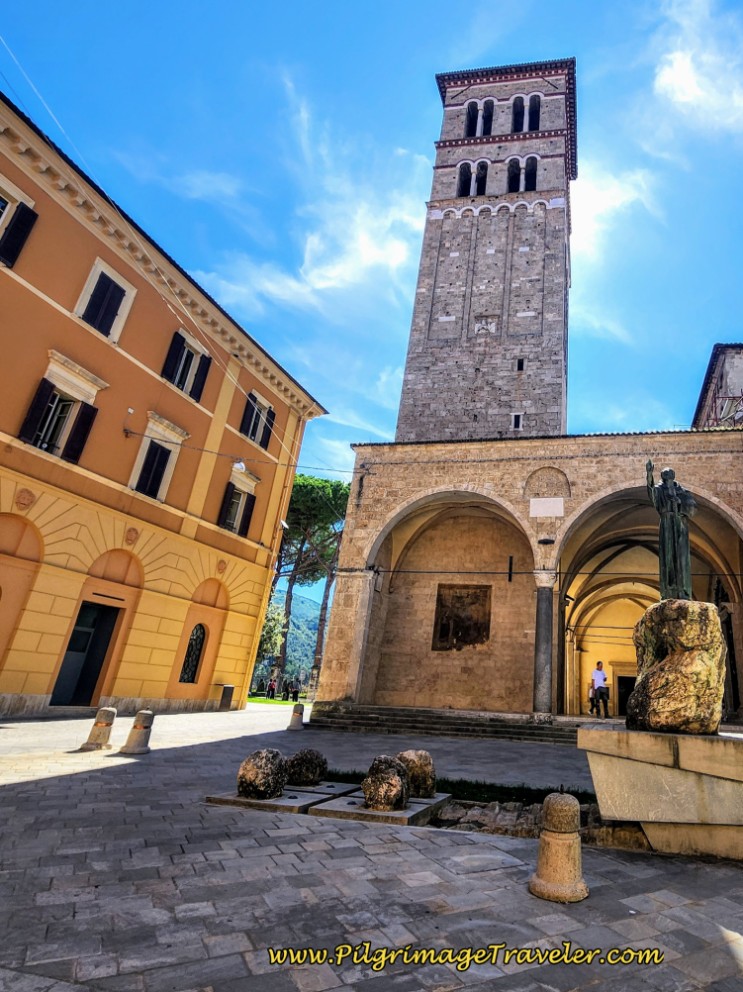 Cattedrale di Santa Maria Assunta, Rieti
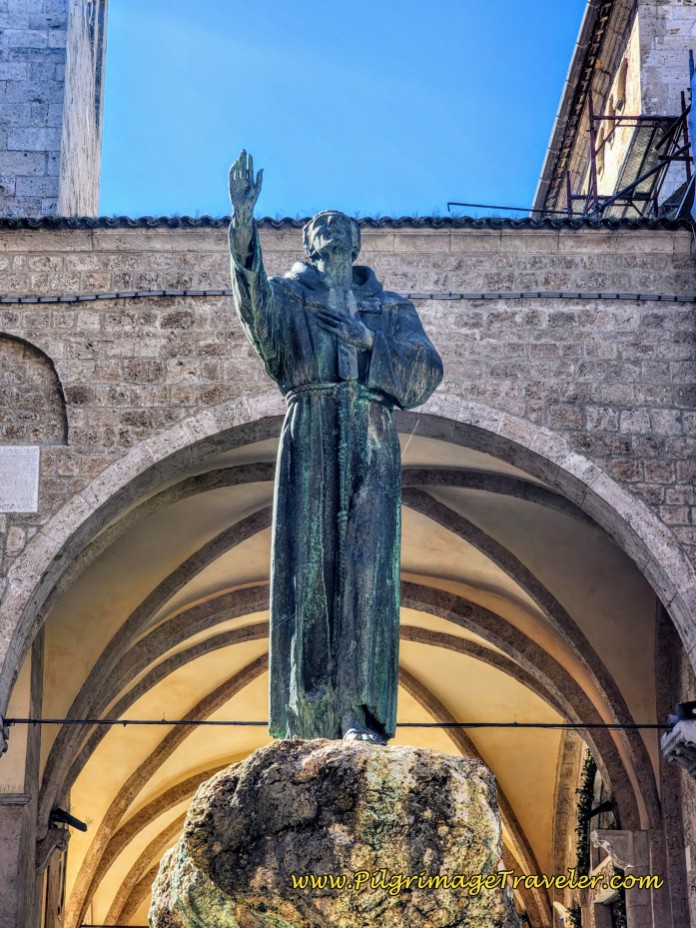 Statue of St. Francis, Duomo di Rieti
This is the 13th century portico of the cathedral, which mostly preserves the earlier Romanesque style.
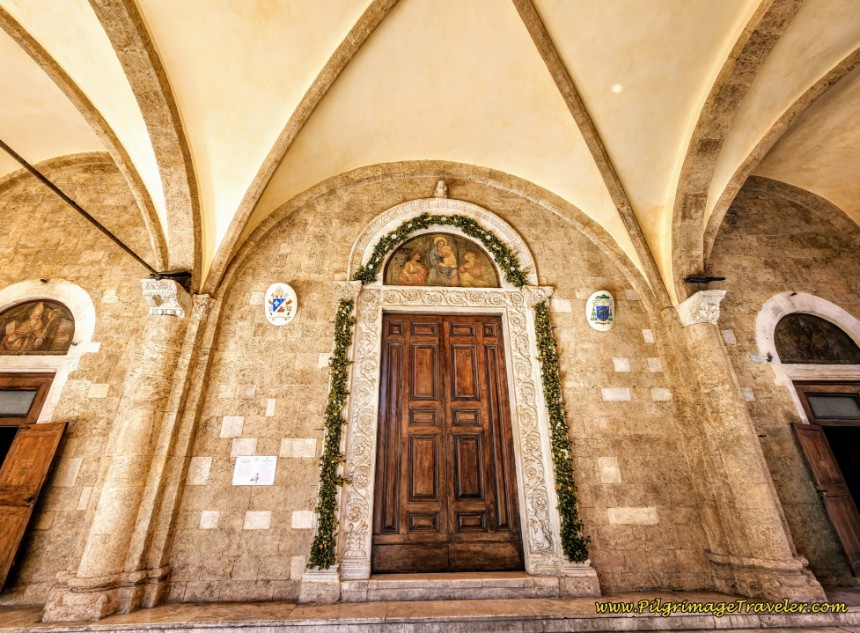 Entryway, Duomo di Rieti
And over the central doorway, is the Assumption of the Virgin Mary (the Assunta), a fresco done by local artist, Marcantonio Aquilio in the late 15th or early 16th century. This "lunette" type of fresco, a fresco done within a half moon shape over a doorway, is seen throughout Rieti.
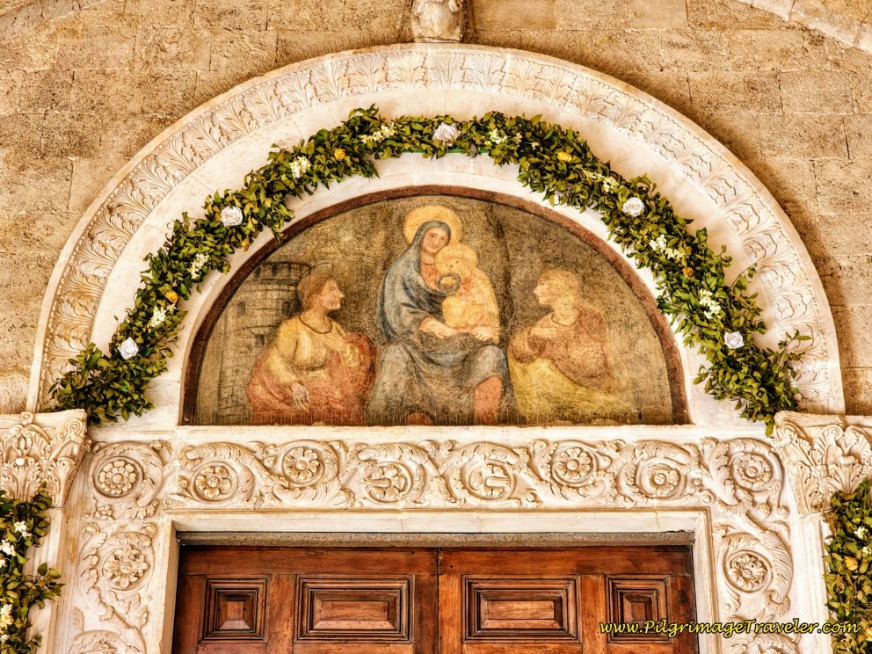 Portal Close-Up, Entryway of the Duomo di Rieti, Italy
As you enter the sanctuary, the style is now Baroque, which replaced the Romanesque interior beginning in the 17th century.
You can see the high altar far in the background, covered with a pillared canopy, called a ciborium, which is also common in Italy and is similar to the famous "Baldaccino" in St. Peter's in Rome.
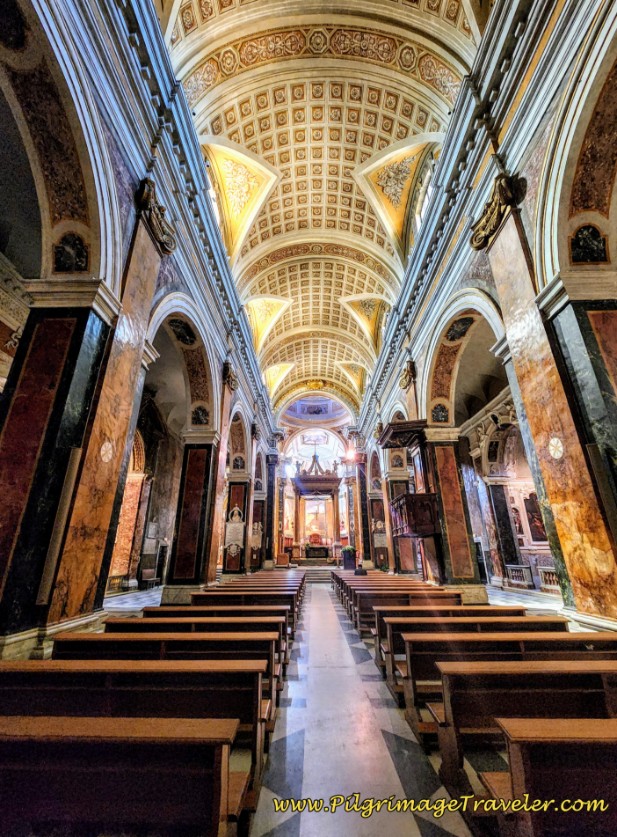 Central Nave, Duomo di Rieti
And here are the lovely details of the choir, behind the high altar.
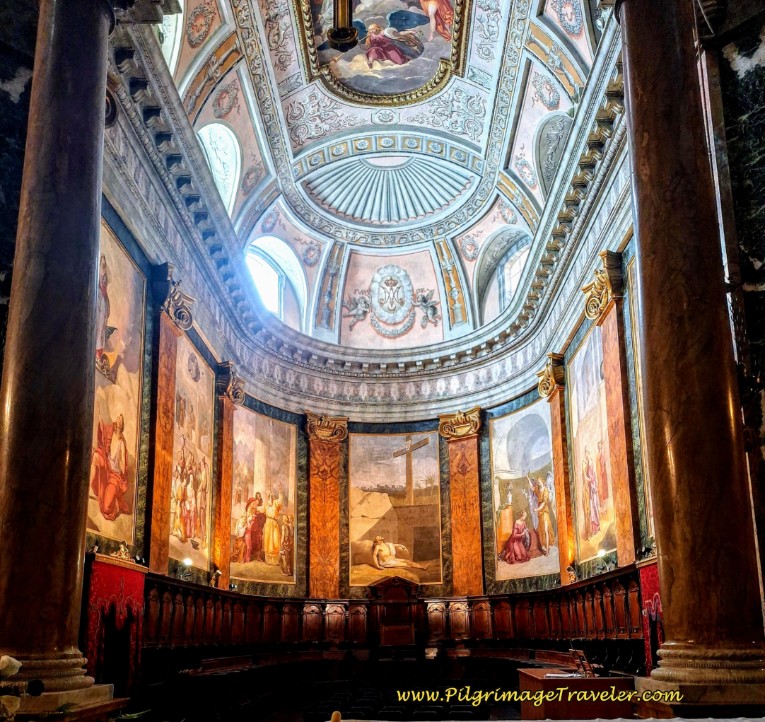 Close-Up of the Choir, Duomo di Rieti
In the 17th and 18th centuries, the cathedral was expanded to make room for twelve side chapels or cappellas. Shown next are two of them that caught my attention.
The Cappella di Madonna del Popolo (Our Lady of the People), shown first, in the left nave, originated from a 14th-century wall painting by an anonymous artist of the Umbrian school. This painted icon was later detached from the old apse, framed and placed in this chapel. The icon became the object of local devotion and processions.
The next chapel is the 17th century Baroque Cappella di Santa Barbara, visually rich and containing a statue in the center of St. Barbara. Santa Barbara, a martyr, is the patron saint of the city and diocese. The 18th century frescoes in the stunning cupola are the "Glory of Santa Barbara" by Giovanni Odazzi, showing her ascension into heaven. The paintings on the side are by Antonio Concioli that depict her martyrdom and death.
Santa Barbara has been venerated in Rieti since at least the 10th century when her relics were brought there (contained within the altar). Her feast on December 4th became an important local celebration, and her chapel later served as a focal point for these devotions.
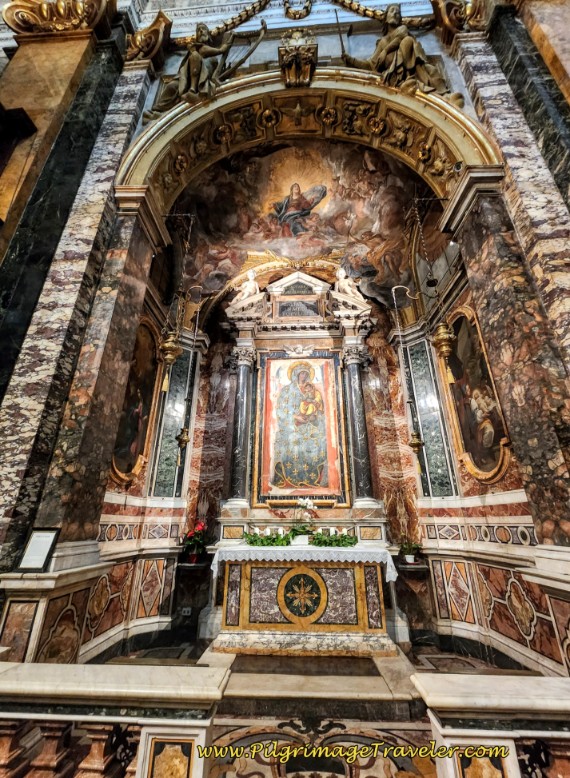 Cappella di Madonna del Popolo
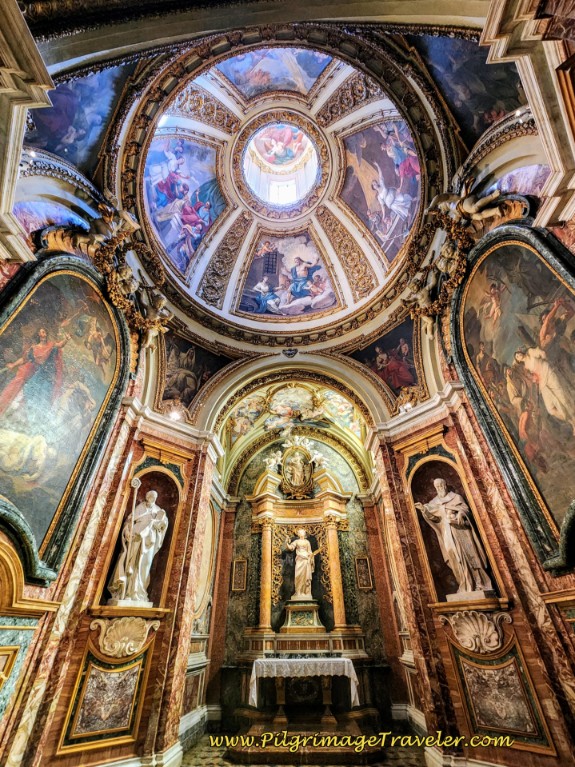 Cappella di Santa Barbara
When you visit the cathedral, don't forget to visit the Crypt, called the Lower Basilica, underneath the main cathedral. The upper cathedral was built on top of this 12th century "lower" church. There are some fragments of 14th frescoes behind the altar. Tradition says that St. Francis prayed here in this original basilica. For more information on the crypt, click on the link here and scroll down.
Next on our agenda, attached to the cathedral is the Palazzo Papale (Papal Palace), shown below, also known as the Palazzo Vescovile (Episcopal Palace). You can tour the lower level only, and it is free of admission.
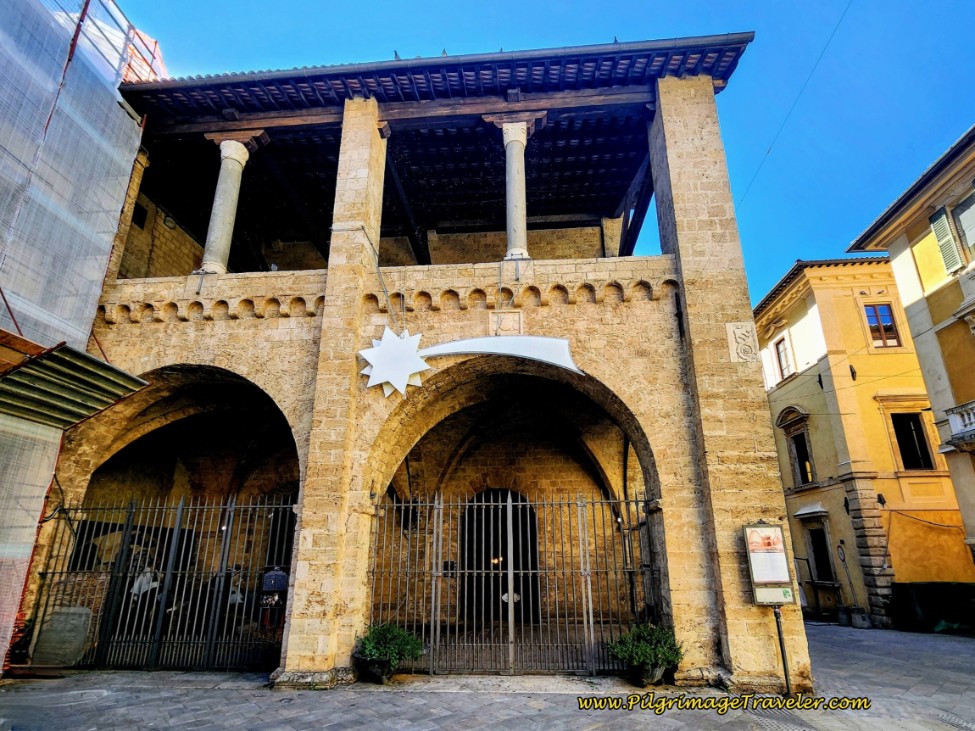 Palazzo Papale, Rieti, Italy
There is nothing to see here really, except for interesting displays in the vaults, one depicting St. Francis and additional unique displays re-creating medieval life. It was difficult to take decent photos with the glare of the acrylic barrier, which you can see in my photo, below. Click here, for much better photos from google of the medieval re-creations in the vaults of this former palace.
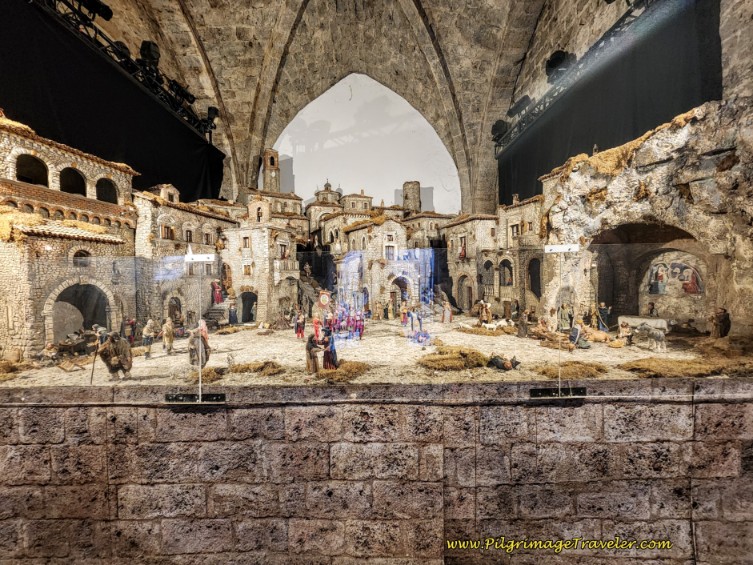 Medieval Scene, Palazzo Papale
On the exterior of the Rieti Cathedral, in front of it is a plaza, called the Piazza Cesare Battisti. On the opposite end of the plaza, from the cathedral is this government building, below, the Rieti Prefecture. In between is the small garden called the Giardini del Vignola.
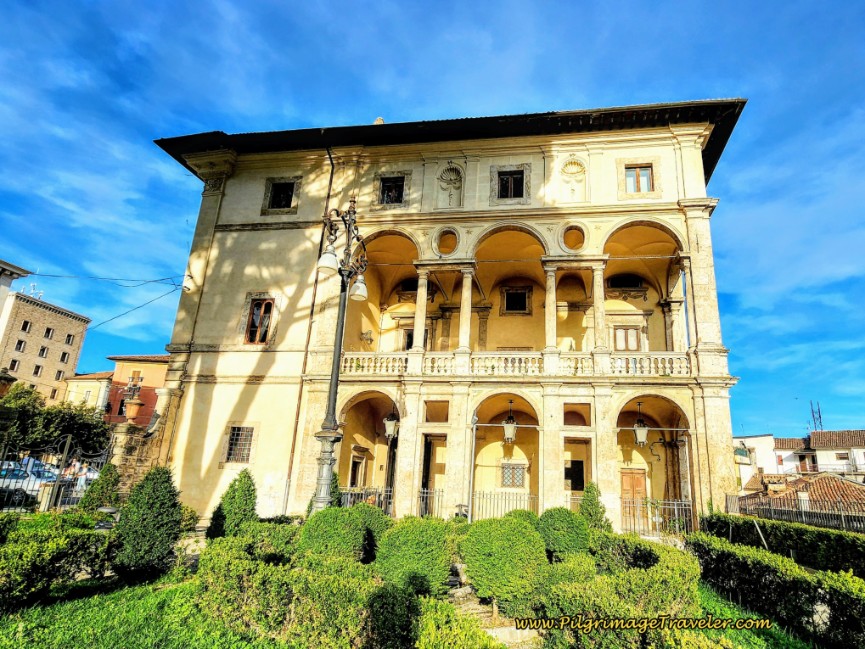 Rieti Prefecture and the Giardini del Vignola
This government building and the garden are on a terrace. It is worth it to take a quick stroll through the garden and look over the city to the right (south). You will see this lovely view of the belltower of the church, below, the Chiesa di Santa Lucia Vergine e Martire.
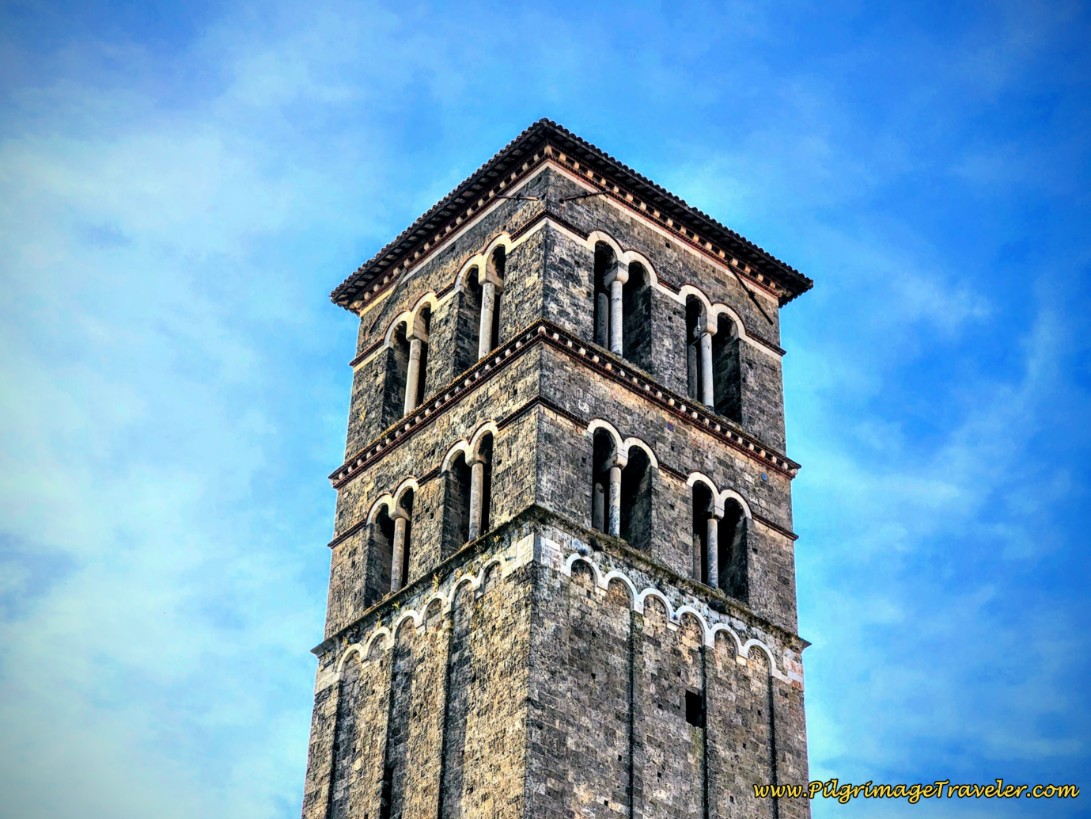
The belltowers of Rieti are quite interesting, all similar, but I don't believe any two are truly alike. Below is one of my favorite photos of Rieti, Italy!
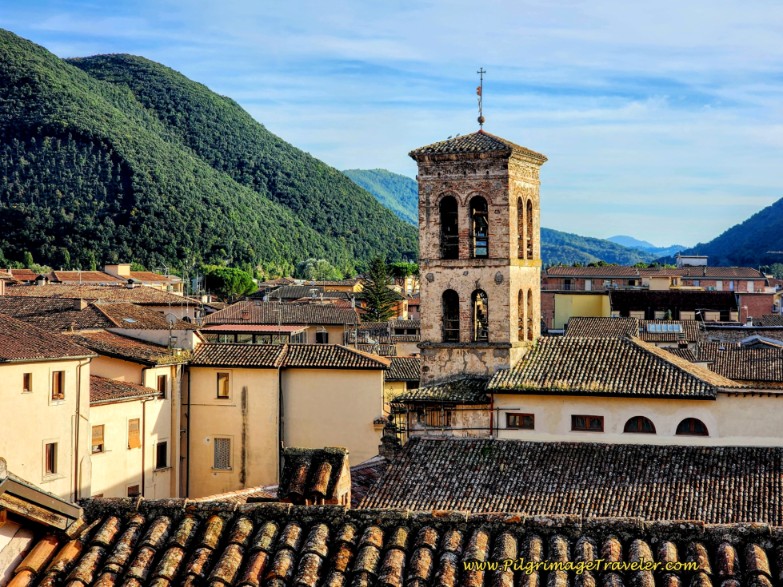 Chiesa di Santa Lucia Vergine e Martire Belltower
The next stop, only a few steps from the Piazza Cesare Battisti and just east of the Town Hall is a very famous place for Italians, the traditionally recognized geographic center of all of Italy, the Umbilicus Italiae, shown below.
This round-shaped, travertine monument, known locally as "La Caciotta," ("the cheese," for its shape like a cheese wheel) is the representation of this "Navel." On the top of the monument is an engraving of the Italian peninsula and on the step around the monument are the words Umbilicus Italiae. This current monument is not old ~ it was built in 1998!
A Roman scholar, Marcus Terentius Varro, who was born in Rieti in the 1st century BC, declared that the Rieti Valley was indeed the "Centro D'italia."
While modern scholars argue over the actual geographic center, as computed by satellite measurements, this is the culturally significant and accepted center!
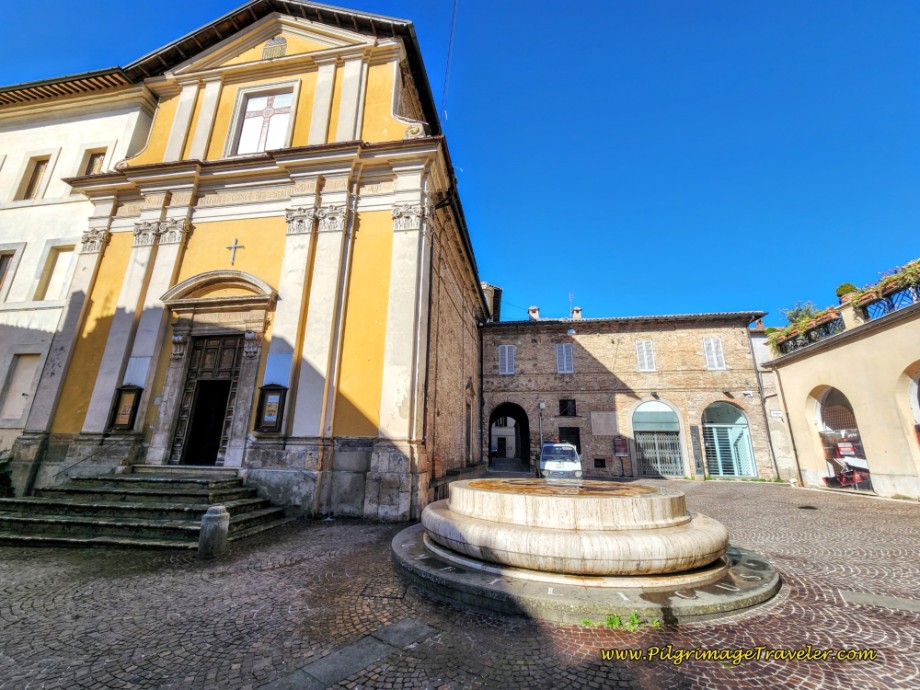 Umbilicus Italiae, Centro D'italia, Rieti
The Umbilicus Italiae lies in the quiet, out of the way, Piazza San Rufo that you see in the photo above. By the church, the Chiesa di San Rufo, also seen in the photo and at the back is a modern, 19th century marble plaque, shown in close-up below. On the plaque, written in 20 different languages, it is confirmed that you are standing at the center of the country. The information board describes its cultural significance.
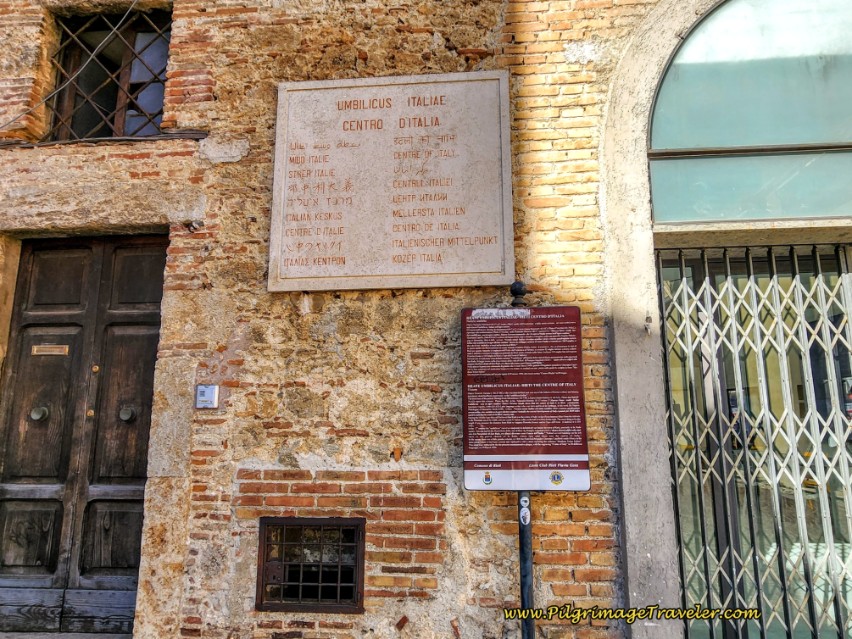 Umbilicus Italiae, Centro D'italia, Plaque
Back on the Via Giuseppe Garibaldi, after the town hall and only one block north of the Navel, is the Teatro Comunale "Flavio Vespasiano," shown next. This is Rieti's main theater, built in the 19th century. It is difficult to get a good overall view of it because it is so massive. This was taken on the west side, seen from Largo Cairoli.
You will see the theatre if you walk in from the north on the Way of St. Francis, on the red alternative route, see day eighteen. It is just above the criss-crossing pedestrian ramp that you can see from the Piazza Guglielmo Oberdan.
If you get a chance to attend a concert or an event here, it would be a fabulous venue. Click on the link above to see photos of the interior - which we did not see.
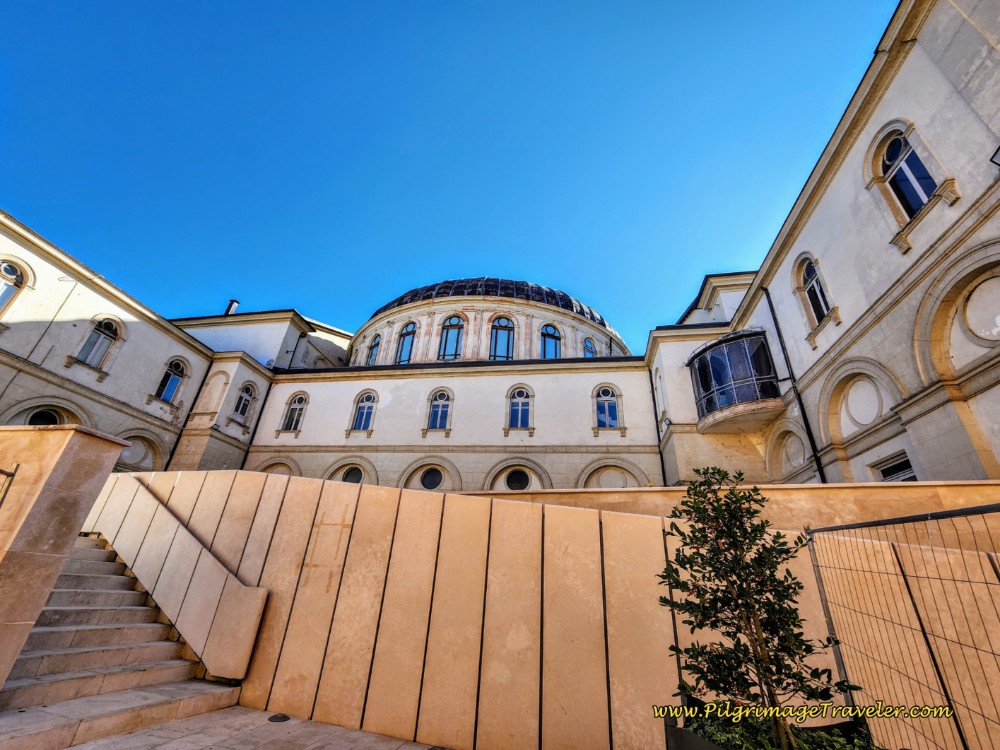 Teatro Comunale Flavio Vespasiano
Heading northward around the theater, you can walk down the above-mentioned criss-crossing pedestrian ramp into the plaza below, and towards the next stop, the Piazza Giuseppe Mazzini.
As you approach this central plaza, if you look up, you will see this belltower, of the Basilica di Sant'Agostino, above its walls. Another wonderful Rieti belltower!
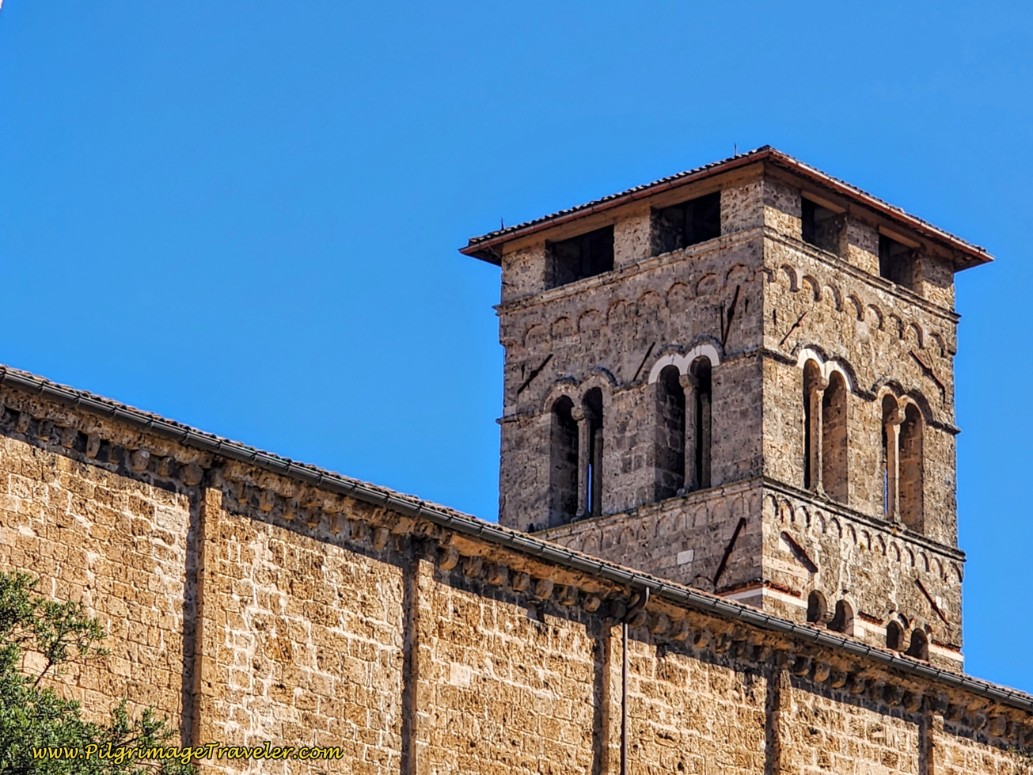 Belltower, Basilica di Sant'Agostino
And as you enter the piazza, here is the front façade of the church. Unfortunately, the church was closed and we did not see inside. The link I supplied above, with the opening hours listed, states that it is open on Saturday mornings. But we were there on a Saturday ~ bummer!
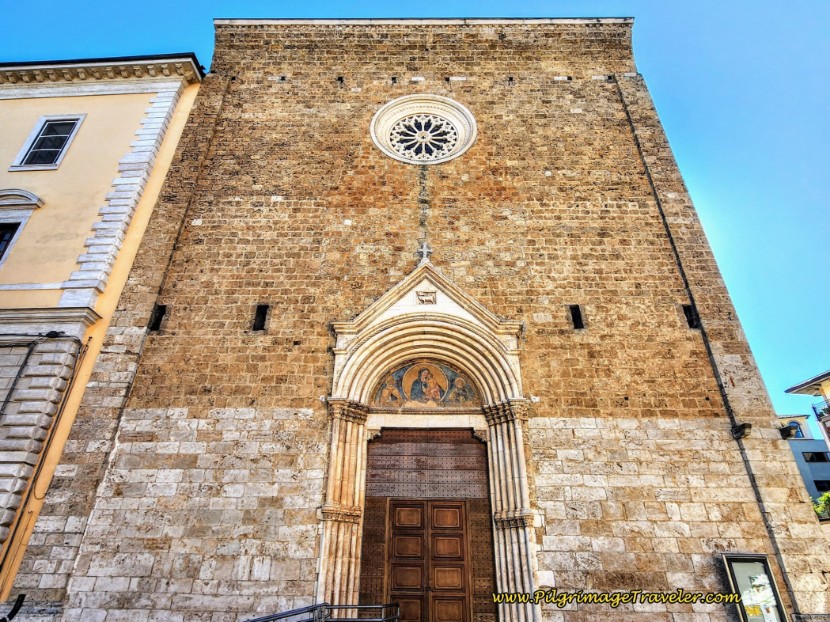 Basilica di Sant'Agostino
And above the doorway, is another wonderful lunette fresco, seen below, dating all the way back to 1354, making it one of the oldest visible outdoor artworks in the city. This 14th-century masterpiece depicts a traditional "Holy Conversation" (Sacra Conversazione) artistic style arrangement, popular at the time.
In the center is the Madonna and Child. Joining in the silent "conversation," is Saint Augustine to the left, the patron of the church and the order, usually depicted in his bishop’s robes and to the right is Saint Nicholas of Bari, another highly venerated figure in Rieti (the church was originally built near a site dedicated to him).
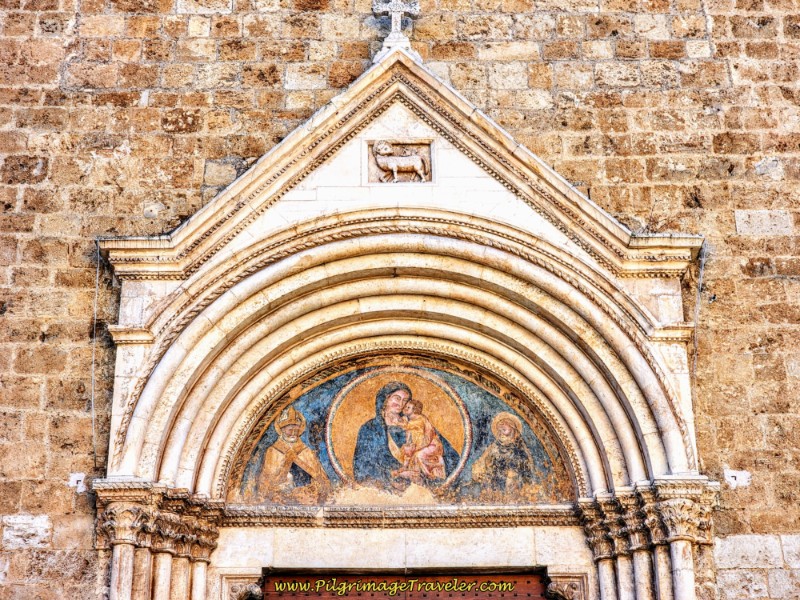 Lunette Fresco, Basilica di Sant'Agostino
Moving on, you can walk backwards along the Way of St. Francis, past the Basilica, through the piazza and past the war memorial at the northern end of the Mazzini Square Here you can admire the massive medieval walls of the city.
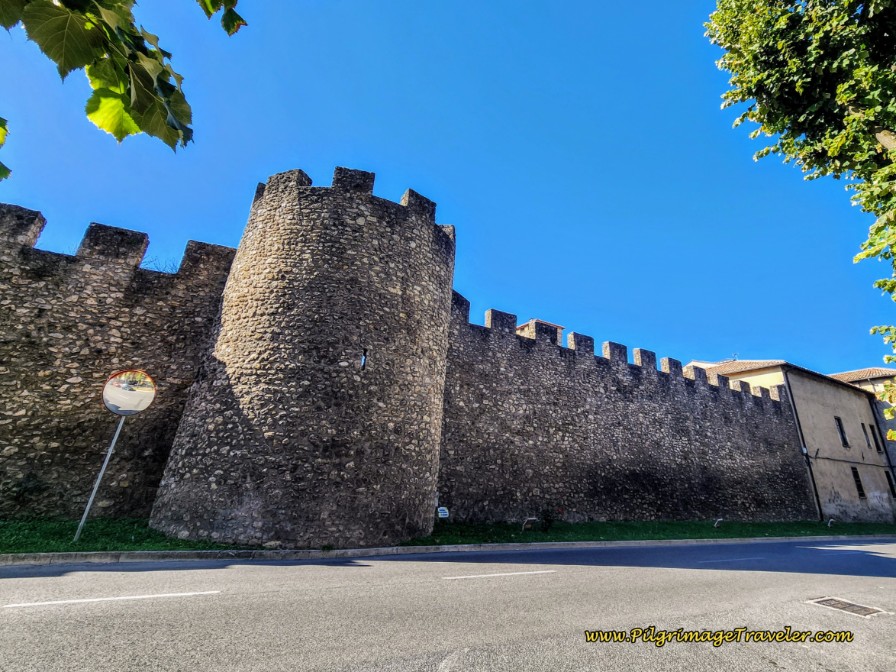 Medieval Walls of Rieti, Italy
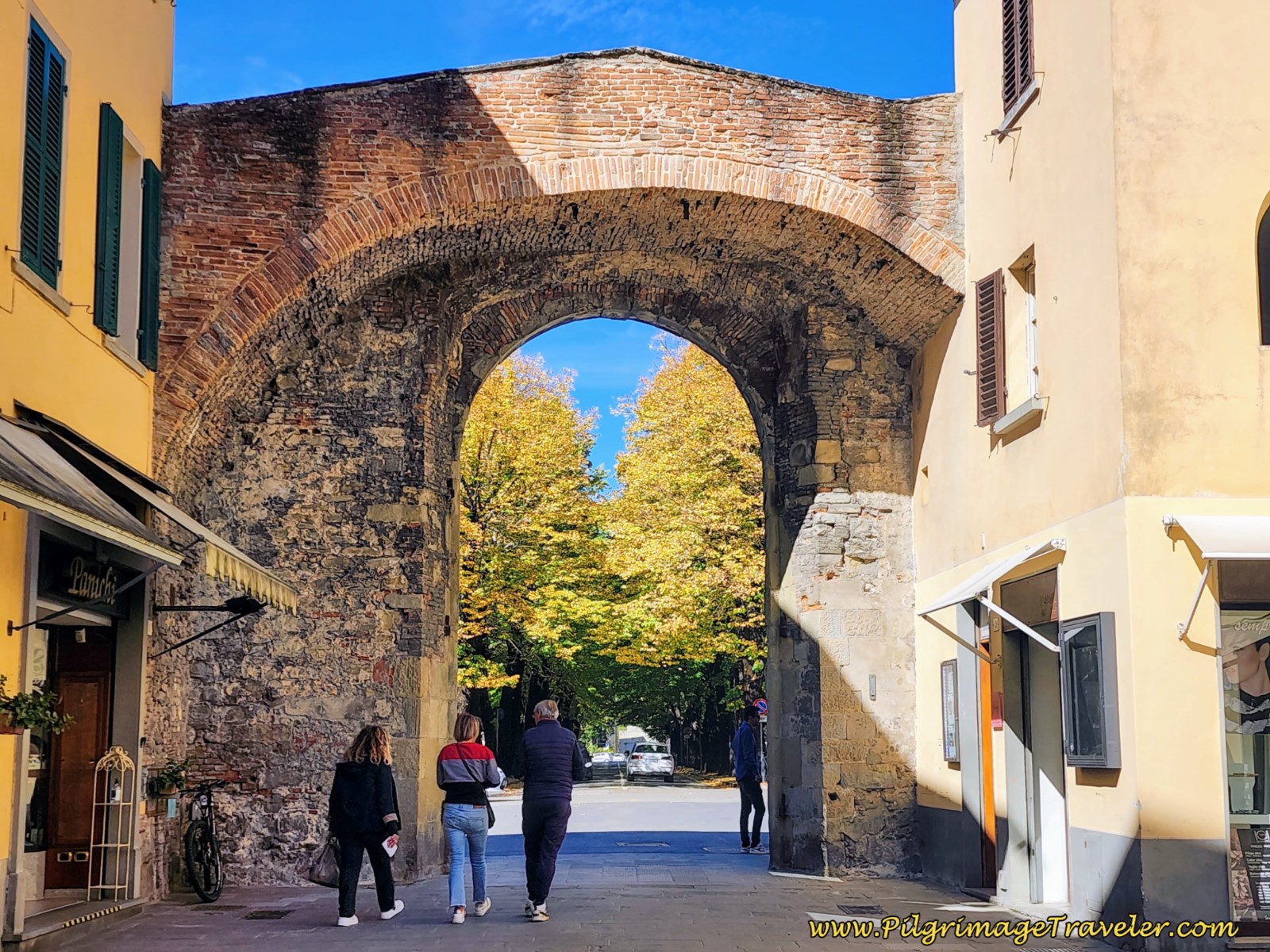
As you walk eastward along the wall, you will arrive at one of the five gates, the Porta Conca, shown from the inside, below.
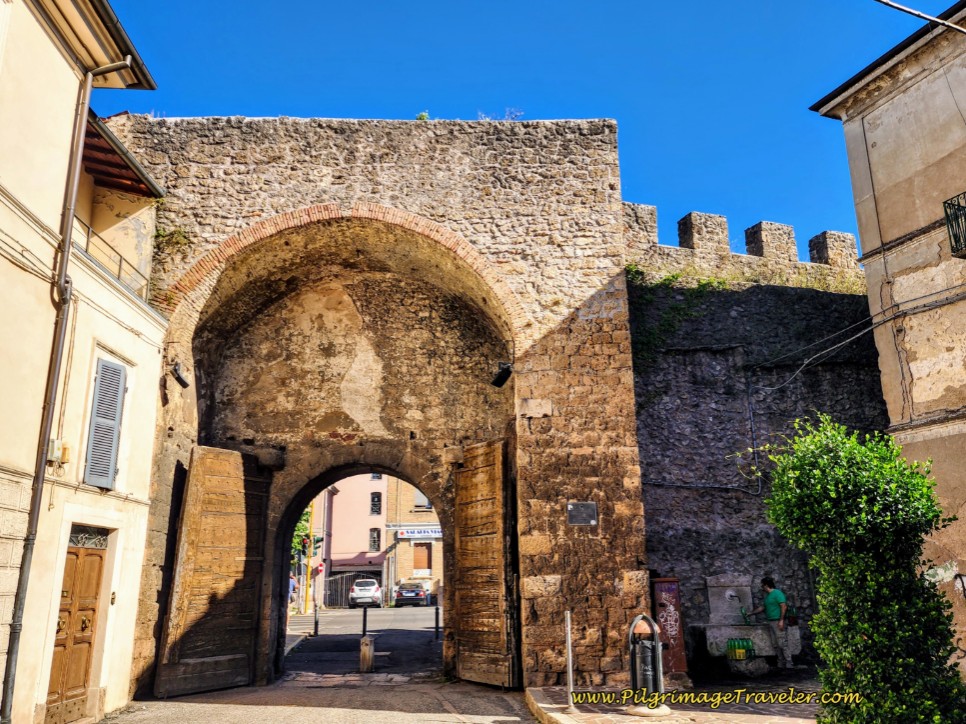 Porta Conca, Northern Gate on the Medieval Wall, Rieti, Italy
And just outside the Porta Conca, is more of the wall. This wall was only built on three sides of the city; the north, east and west. The southern side was left open because the Velino River acted as a natural moat!
There are at least 30 remaining watchtowers along this massive wall! Wow!
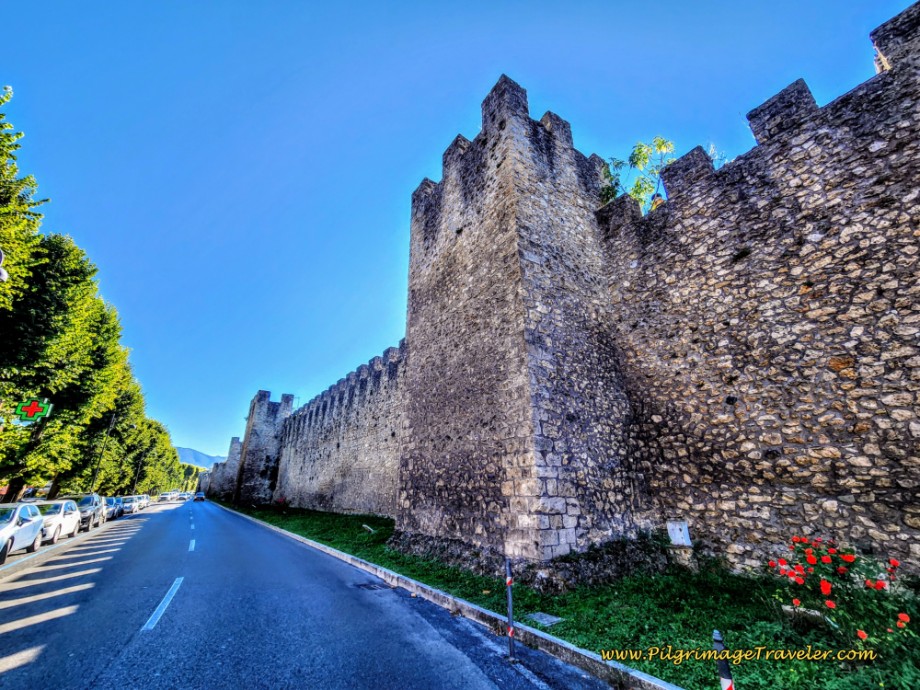 Medieval Walls of Rieti, Italy
And below is an eastward view of the Velino River, on the south side, with the Chiesa di San Francesco seen in the background and a view of Mount Terminillo.
For a photo of the remains of the Roman bridge across this river, see day nineteen. There is not much of it left and it is essentially submerged below the current level of the river.
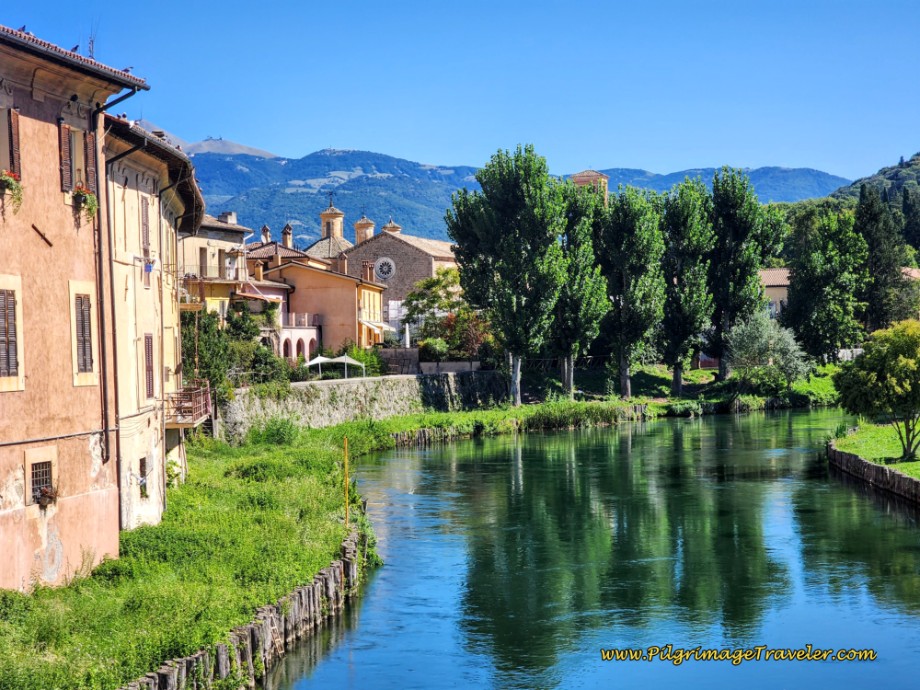 Velino River, View of the Chiesa di San Francesco
We did wander by the 13th Chiesa di San Francesco, shown below, but it too was closed. This church was built on the same foundation as a small oratory, originally built in 1210 by St. Francis himself. The oratory was beside the pre-existing hospital of Santa Croce, intended for the care of the sick, a perfect location for St Francis who loved to minister to the needy.
As the Franciscan influence grew in Rieti, a bigger church was built in its place and consecrated in 1253. It was the second church dedicated to St Francis, only after the Basilica of St. Francis in Assisi which was the first!
The current structure is in the Romanesque Gothic style. The lunette over the portal features a fresco depicting the Madonna and Child with St. Francis and St. Anthony, on either side, painted by Vincenzo Manenti in 1640. Above the portal is a rose window, designed by Angiolo Mazzoni in 1926 when it underwent recent renovations.
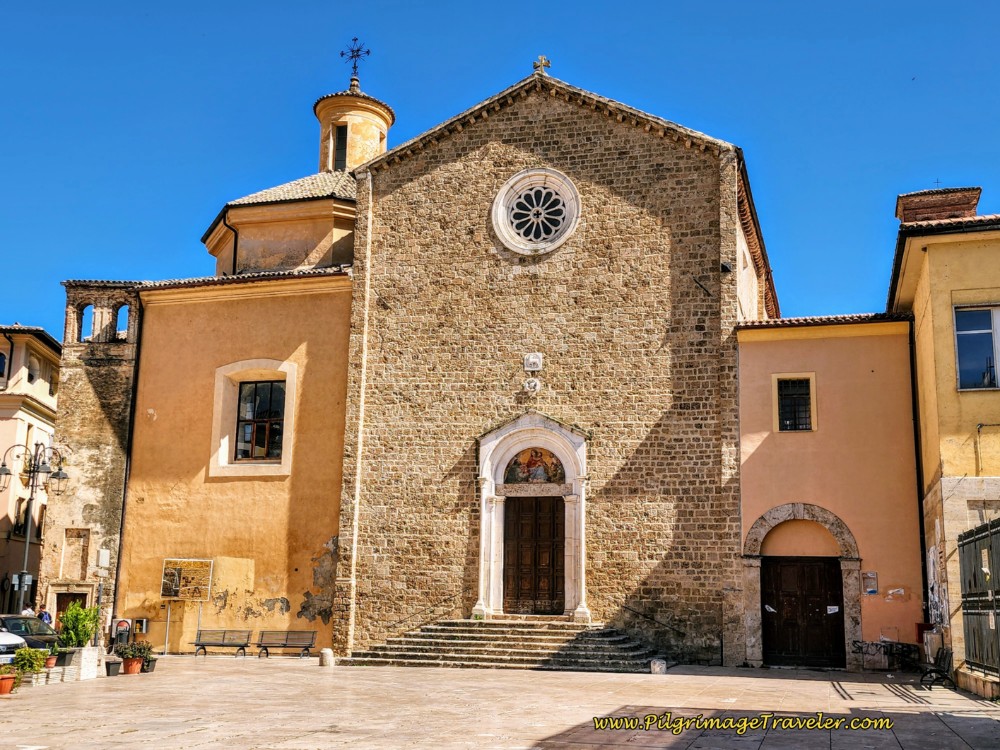 Chiesa di San Francesco, Rieti
Walking southward after crossing the Velino River, here is a photo of the only gate along the southern side, the Porta Romana, standing all by itself with no walls. The Way of St. Francis does not walk through this gate.
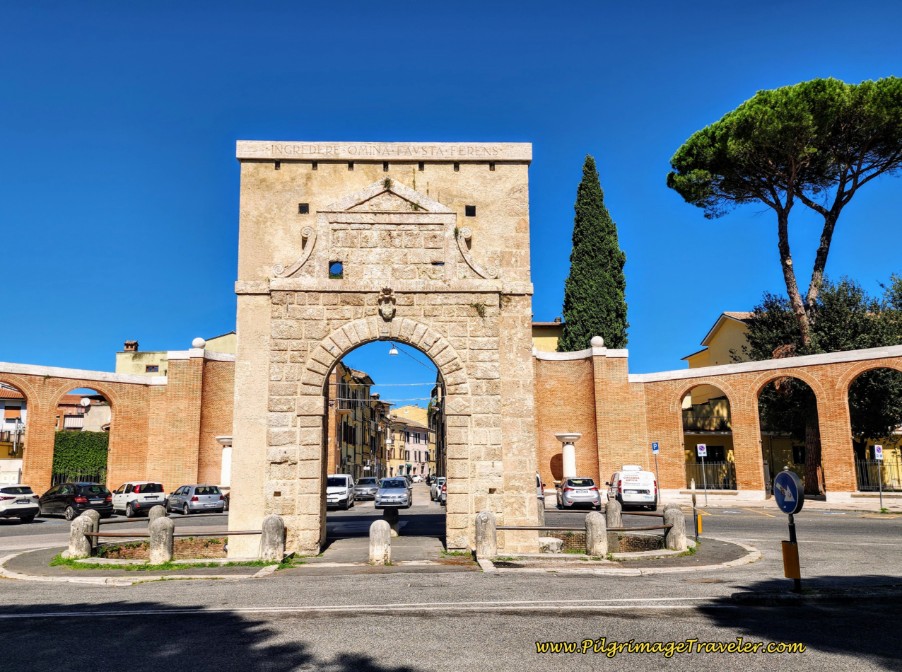 Porta Romana, Rieti, Southern Gate
And finally, I will cover the most unique and fascinating piece of history surrounding Rieti, the Sotterranea, or Rieti Underground. This historic site is only possible to see with a pre-scheduled tour, which we took, led by Rita, the hostess of the Terrazza Fiorita. And it is amazing!
I would highly recommend taking this tour if you spend any additional time here. The tour takes about an hour and a half. In the off season it is only offered on the weekends, unfortunately. Good thing our exploration day of Rieti was on a Saturday afterall!
The engineering history of this town is fascinating. On the tour, you will see the underground remnants of the massive 3rd century Roman viaduct built to elevate the road, the Via Salaria over the Velino River. The land around the river was low and marshy and would frequently flood, causing a silting-up of the road. You can see this viaduct in the illustration below, of a re-creation of what Rieti looked like in Roman times.
The Via Salaria, the famous Salt Road was a very important trade route, where salt was transported from Rome to the Adriatic Coast. It was imperative to keep the road open, despite the frequent flooding.
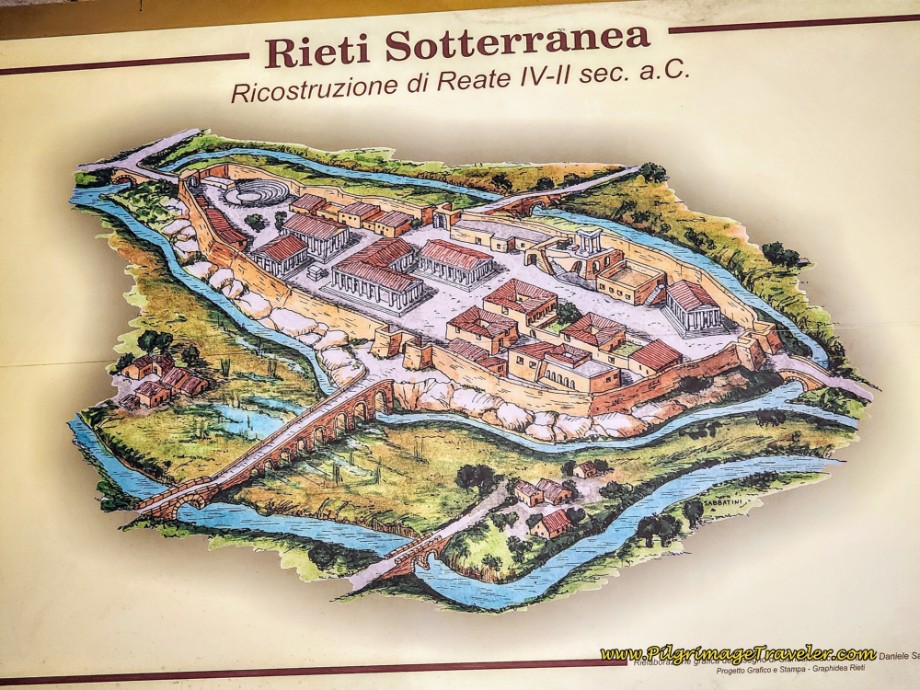 Rieti Sotterranea Map
Like in all deeply historic cities, as the city grew over the centuries, the ground level rose and new buildings were constructed around and over the top of the massive viaduct. The arches provided such strong support that instead of removing them, engineers incorporated them into the foundations of other buildings and palaces like the Palazzo Vecchiarelli, see farther below. The vaults created by the archways became the basements! The basements were used for workshops and storage.
The tour begins by walking from the site of the old Roman bridge on the south side of the river, where there is an informational plaque. Then we crossed the river heading northward, turned left, down the Via della Verdura, to the hidden entrance to the vaulted underground rooms. Rita used a key to enter through the doorway. Below is a photo of our tour group.
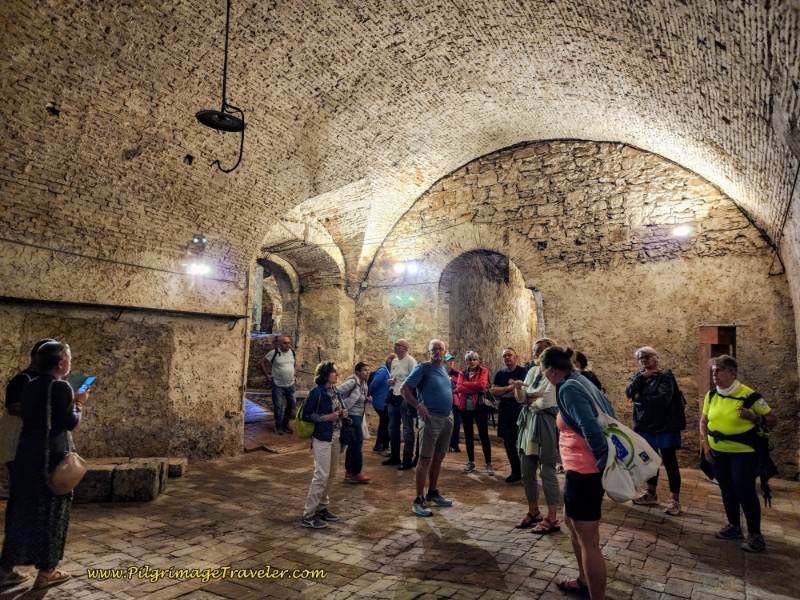 Rieti Sotterranea Tour Group
The maze of tunnels and rooms is extensive. You will see an old well, cisterns and wine cellars. Olive oil was also stored here, in the basements of the Palazzo Napoleoni and the Palazzo Vecchiarelli.
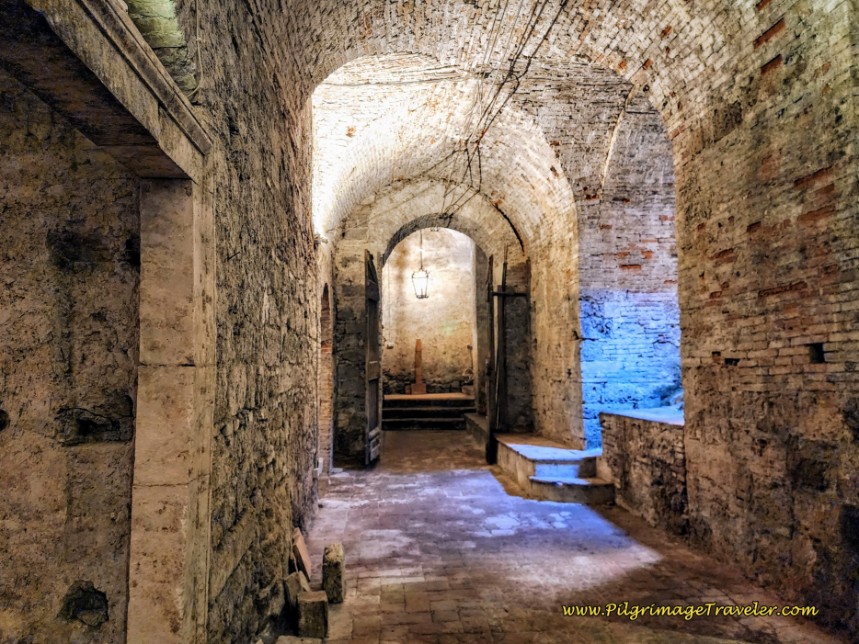 Rieti Sotterranea Tunnel
Here is a remnant of a fresco in one of the rooms.
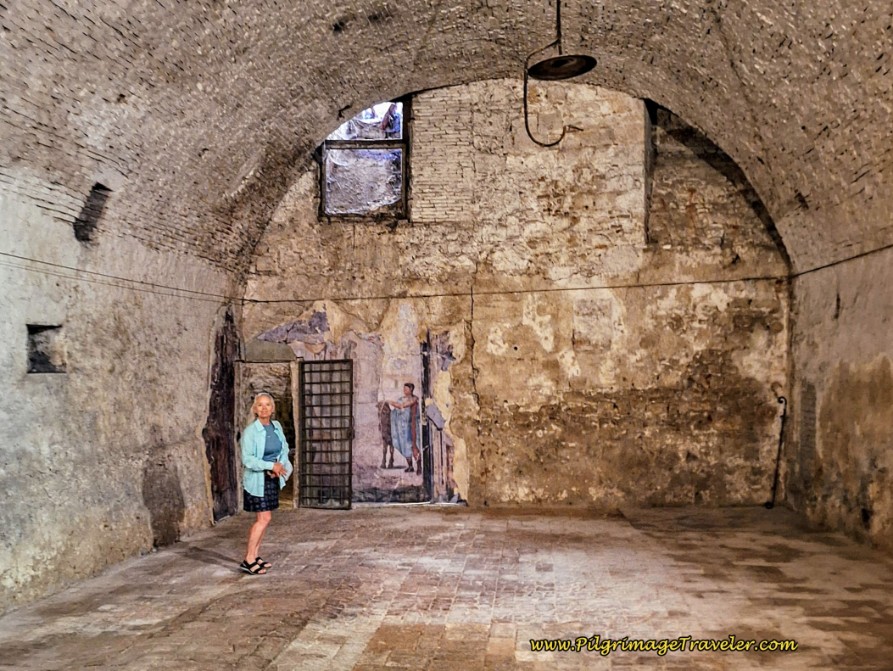 Rieti Sotterranea Room with Fresco
We ended the tour by taking a staircase up and into the courtyard of the Palazzo Vecchiarelli, from the basement vaults below.
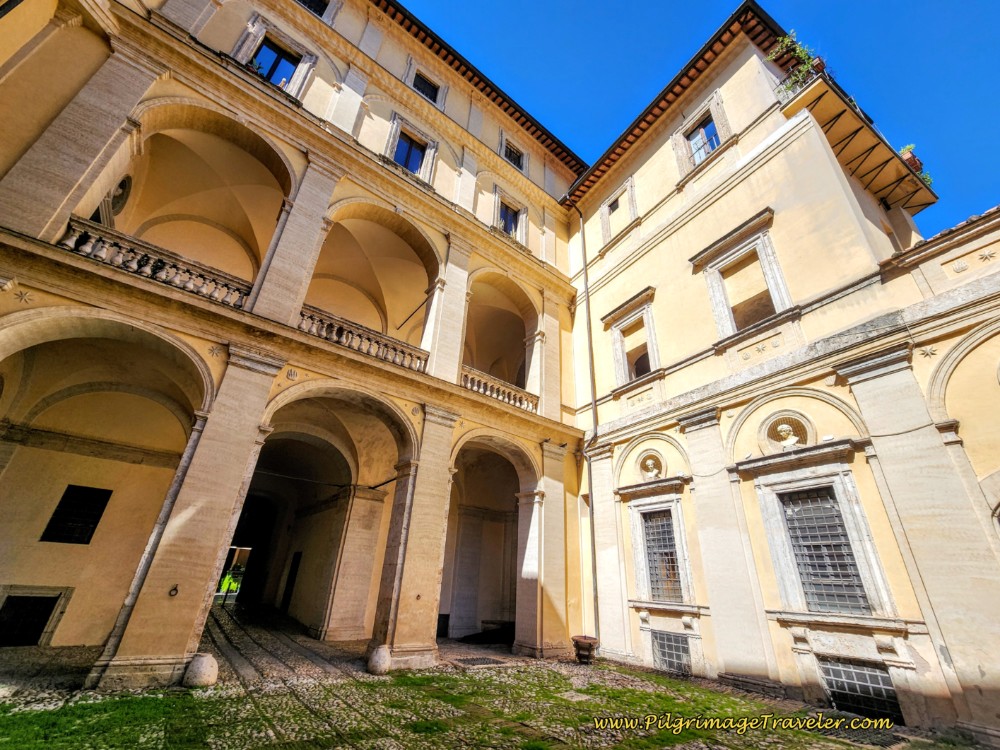 Palazzo Vecchiarelli Courtyard
From the courtyard, we exited the palace to the outside street, the Via Roma. You can see the palace entryway from the street, below.
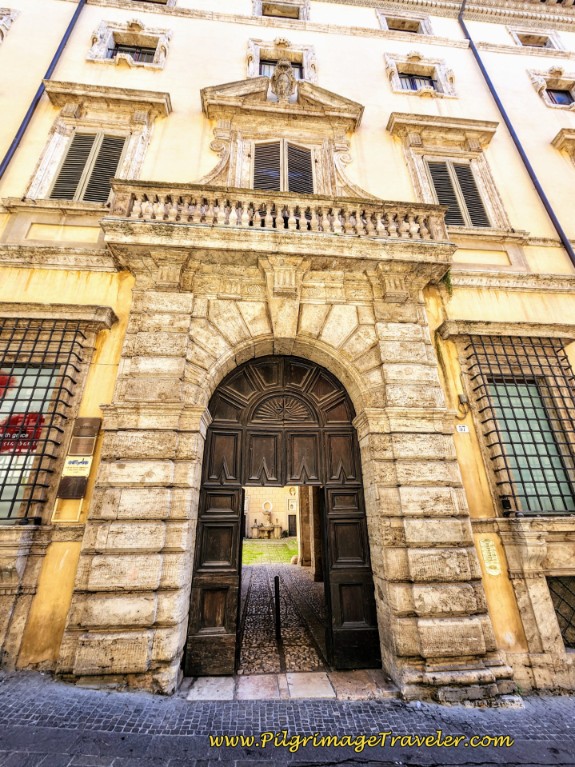 Palazzo Vecchiarelli Street Entryway
And thus we concluded our day's tour of Rieti! We ended our day with a lovely meal at the Trattoria la Volta, recommended by Rita, along the Via Cintia between the cathedral and the town hall. They have a pilgrim's menu, but you must ask for it! They will bring you a separate paper menu for pelligrini.
Their eggplant parmesan was to die for! This is my favorite Italian dish, but it wasn't on the pilgrim's menu. It was listed as an appetizer, but I had it as my main meal - the secondi. Rich had one of the meals on the pilgrim's menu and it was really very good. He had the gnocchi as the primi and unfortunately, I don't recall what meat dish he had for his secondi.
Salutation
May your own exploration of Rieti, Italy, in the heart of the Sacred Valley be filled with new wonders and discoveries as you step back in time and walk in the footsteps of St. Francis!
Way of St. Francis EBook Guides
Walk smarter with our ad-free, beautifully formatted Way of St. Francis eBook Guides, in PDF format ~ perfect for offline use in mountainous and remote areas along this Way. Includes daily stage details, alternative routes and stunning photos. Our eBook Guide is unique because we also immerse you with our story.
Don't carry a heavy paper book, but use our digital eBooks on your mobile device instead! You can walk with clarity and confidence, deeply connect to nature, following in the footsteps of St. Francis, through the Italian countryside!
📲 Instant download. 💸 Money-back guarantee. 🔄 Free updates for 1 year.
👉 Click here for more information! OR BUY NOW ~ La Verna to Assisi, OR BUY NOW ~ Assisi to Rome. OR BUY BOTH HERE
Way of St. Francis Stages
La Verna to Assisi
Assisi to Rome
Please Consider Showing Your Support
Many readers contact me, Elle, to thank me for all the time and care that I have spent creating this informative website. If you have been truly blessed by my efforts, have not purchased an eBook, yet wish to contribute, I am exeedingly grateful. Thank you!
Search This Website:
The Pilgrimage Traveler Digital Guides
Our Guides Help You:
~ Know what to expect each day!
~ Locate historic sites along the Way!
~ Know where you are in your journey!
~ Discover a quote from the sages, for your daily reflection on the journey!
Click on a Photo Below to Get Your Copy.
A most popular alternative on the Central Route of the Camino Portugués!👇
The Portuguese Routes are rapidly gaining in popularity, especially the section from Lisbon! Plan to walk this one soon, before it is no longer a quiet experience!👇
Our most popular Portuguese guide! 👇
The most historic of the Portuguese Caminos ~ not to be missed!👇
The spiritual adventure of a lifetime, following in the footsteps of St. Teresa of Ávila!👇
The amazing mountain route alternative, the Camino Sanabrés, from Granja de Moreruela on the Vía de la Plata!👇
The most incredible mountain scenery on this camino from Leon to Oviedo!👇
The shortest of the caminos, but not easy!👇
The very first, Original Way from Oviedo to Santiago!👇
The pilgrimage to the "End of the World" ~ The perfect add-on to your camino!👇
All Banners, Amazon, Roamless and Booking.com links on this website are affiliate links. As an associate of these companies, the Pilgrimage Traveler website will earn from qualifying purchases when you click on these links. We have used and love all of our product recommendations and believe you will too! We sincerely thank you!

🙋♀️ Why Trust Us at the Pilgrimage Traveler?
We’re not a travel agency ~ we’re fellow pilgrims! (See About Us)
We've trekked Pilgrimage Routes Across Europe since 2014!
💬 We’ve:
- Gotten lost so you don’t have to. 😉
- Followed waymarks in the glowing sunlight, the pouring rain and by moonlight. ☀️🌧️🌙
- Slept in albergues, hostels & casa rurals. Ate and drank in cafés along the way. 🛌 😴
- Created comprehensive and downloadable GPS maps and eBook Guides, full of must-have information based on real pilgrimage travels. 🧭 🗺️
- Shared our complete journeys, step by step to help YOU plan your ultimate pilgrimage and walk with your own Heart and Soul. 💙✨
Every detail is from our own experiences. Just fellow pilgrims sharing the Way. We have added a touch of spirituality, heartfelt insights and practical guidance from the road ~ offering a genuine connection to the spirit of pilgrimage. Tap into the wisdom of seasoned pilgrims!
Ultreia and Safe Pilgrimage Travels, Caminante! 💫 💚 🤍
Follow Me on Pinterest:
Find the Pilgrimage Traveler on Facebook:

Shroud Yourself in Mystery, along the Via de Francesco!
Walk in the Footsteps of St. Francis, and Connect Deeply with the Saint and to Nature in the Marvelous Italian Countryside!
Need suggestions on what to pack for your next pilgrimage? Click Here or on the photo below!
Carbon Trekking Poles ~ My Favorites!
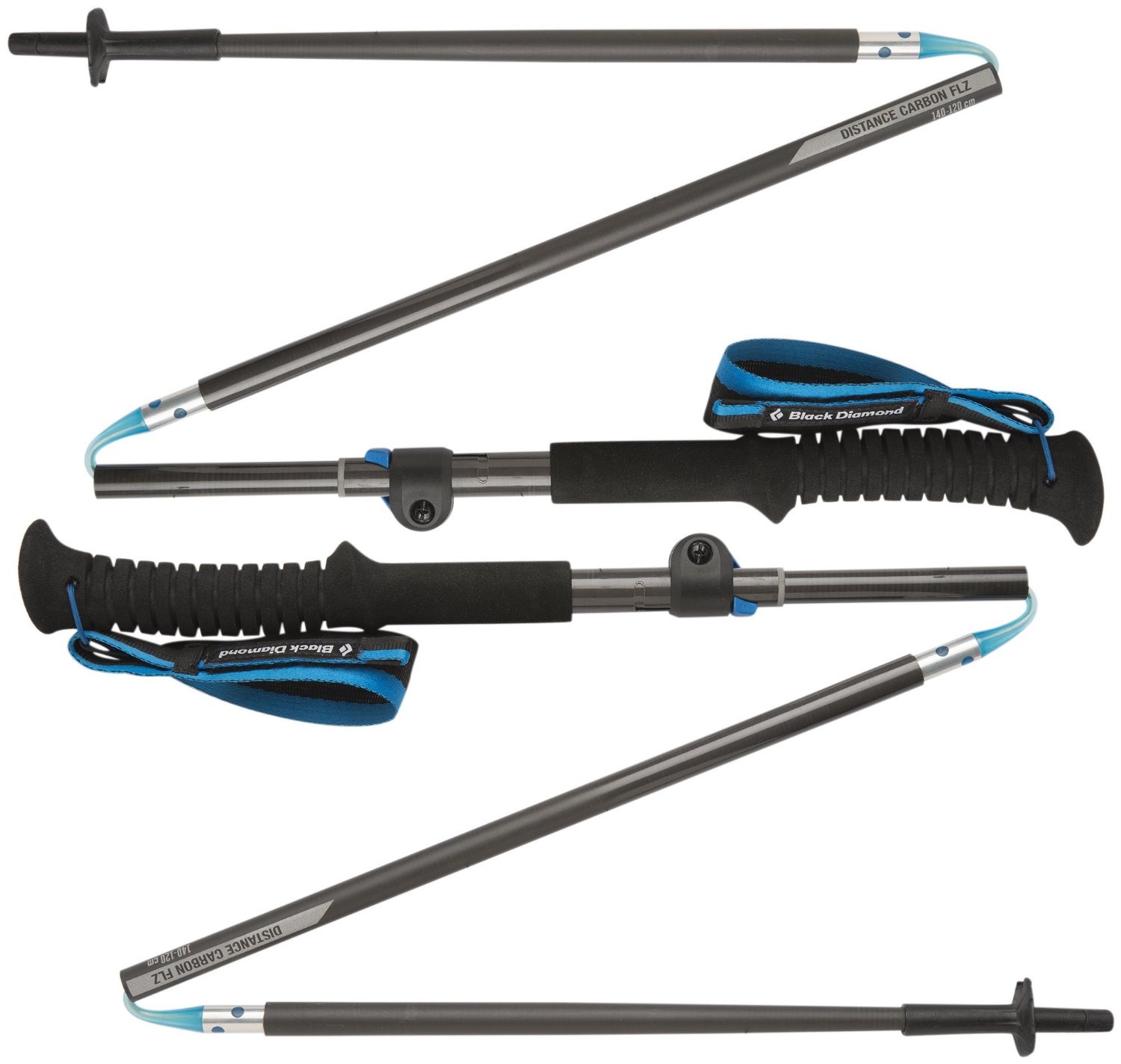
Carbon fiber construction (not aluminum) in a trekking pole makes them ultra lightweight. We like the Z-Pole style from Black Diamond so we can hide our poles in our pack from potential thieves before getting to our albergue! There are many to choose from! (See more of our gear recommendations! )
Gregory BackPack ~ My Favorite Brand
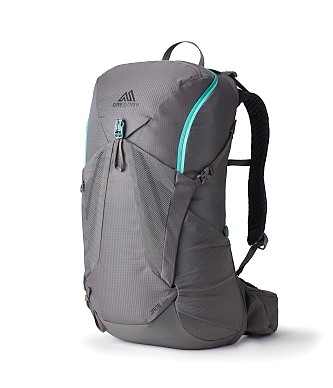

Do not forget your quick-dry microfiber towel!