- ~ Home
- The Way of St. Francis
- The Way of St. Francis, Spoleto, Italy ~ Umbria's Hidden Jewel
Jump to Way of St. Francis Stages
Spoleto, Italy ~ Our Walk Through Umbria’s Hidden Jewel
Spoleto, Italy, with its timeless allure, stands out as perhaps my favorite destination among all the towns we passed through on the Way of St. Francis. This captivating medieval town is perched on the slopes of Monte Luco, offering a perfect blend of rich history, cultural sights, and authentic Umbrian life, all without being overrun by tourists.
Join us as we take an extra day to wander through the charming cobblestone streets and uncover the hidden secrets of Umbria's true "hidden jewel."
🙋♀️ Why Trust Us at the Pilgrimage Traveler?
We’re not a travel agency ~ we’re fellow pilgrims! (See About Us)
We've trekked Pilgrimage Routes Across Europe since 2014!
💬 We’ve:
- Gotten lost so you don’t have to. 😉
- Followed waymarks in the glowing sunlight, the pouring rain and by moonlight. ☀️🌧️🌙
- Slept in albergues, hostels & casa rurals. Ate and drank in cafés along the way. 🛌 😴
- Created comprehensive and downloadable GPS maps and eBook Guides, full of must-have information based on real pilgrimage travels. 🧭 🗺️
- Shared our complete journeys, step by step to help YOU plan your ultimate pilgrimage and walk with your own Heart and Soul. 💙✨
Every detail is from our own experiences. Just fellow pilgrims sharing the Way. We have added a touch of spirituality, heartfelt insights and practical guidance from the road ~ offering a genuine connection to the spirit of pilgrimage. Tap into the wisdom of seasoned pilgrims!
Ultreia and Safe Pilgrimage Travels, Caminante! 💫 💚 🤍
"I love medieval cities; they do not clamor for attention; they possess their souls - their riches - in quiet; formal, courteous, they reveal themselves slowly, stone by stone, garden by garden; hidden treasures wait calmly to be loved and yield to introspective wandering." ~ Barbara Grizzuti Harrison, American journalist, Essayist and Memoirist and Travel Writer
Map of Spoleto, Italy
For your orientation to the town, I inserted our day thirteen/fourteen Google interactive map, below. Spoleto is the town at the end of the stage, and you can zoom in on the city to see all the historic places on the map. (For a map of the entire Via di Francesco, click here.)
Accommodations in Spoleto, Italy
Also on the map above, are the available accommodations in and near Spoleto, Italy.
There is only one donation-based accommodation, the Centro di Pastorale Giovanile "Giovanni Paolo II," (+39 331 34 87 043, contact Don Pierluigi, +39 392 58 87 677, or Suor (Sister) Lorella), on the northwest side of town and significantly out of the way from the pilgrimage route. It is open June 1st to September 15th, with a stay consisting of sleeping bags on the ground.
If you want the parochial experience and don't mind walking down the hill to the west of town, there is the economical Casa Religiosa Di Ospitalità Nazareno.
On the south end of town you may want to consider the economical B&B Istituto Bambin Gesu, who serve guests in the spirit of St. Francis, fostering self-reflection and contemplation on the "reason for living, loving and serving God."
I can highly recommend La Bracceschina apartments where we stayed. The economical one we booked was a studio apartment, a few steps down the hill from the Duomo di Spoleto and in the thick of everything! Since we were there an extra day we appreciated the kitchenette to make breakfast and light meals.
Some more economical apartments to check out near the Roman theater ruins on the western side of the medieval center are La Suite and the Dimora del Teatro.
The Hotel Clitunno, the Ospitalità Collicola and the Hotel Charleston are the only economical hotels I could find near the center: the others are quite expensive for a pilgrim.
There are so many more places to stay in Spoleto, that it may be wise to search on booking.com for Spoleto, Italy, to see more choices and to find current deals. Be sure to sort the search result by price - lowest to highest. There is always someone reducing their prices close to upcoming dates.
Just realize the farther from the center and the duomo, the more economical and the closer to the duomo the more expensive!
Highlights of Spoleto, Italy
On our day off, we saw the top sites of this historic town. There are many more places that we were not able to see, but that was perfectly OK with us.
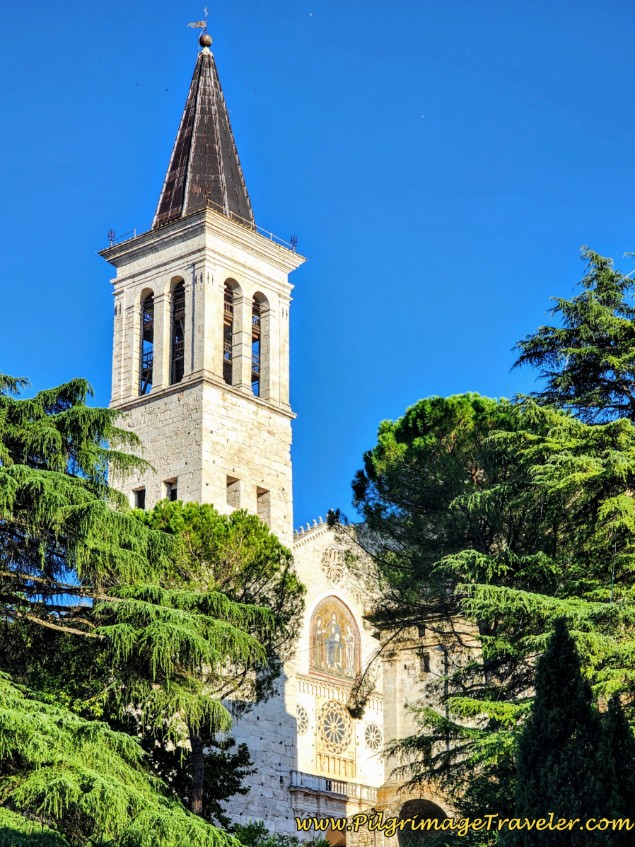 Walking Along the Via degli Scaloni
Instead of rushing around to try to see everything, we actually spent time in the plazas and cafés, enjoying the Umbrian ambiance.
For our tourist day, we walked out of our apartment, La Bracceschina, picking up the Via degli Scaloni. And this is the view, shown here as we climbed up towards the cathedral.
We arrived at the cathedral soon after opening hours at 08:30.
The Duomo di Spoleto, below, is a masterpiece of Umbrian Romanesque architecture that has undergone many renovations since it was first known to exist in the 10th century. The photo below was taken in the late afternoon when the sun is most favorable, to light up the cathedral.
For a link to a complete history of the duomo, especially the early years, the Key to Umbria is an exhaustive source for all things regarding the Duomo di Spoleto.
 Duomo di Spoleto
The magnificent mosaic on the upper façade of the exterior of the cathedral was first completed in 1207. According to the Key to Umbria, Duomo Exterior, this mosaic, "depicts Christ the Redeemer with the Virgin and St John the Baptist. In this Byzantine iconography, known as the Deesis (Greek for prayer), the Virgin and St John intercede with Christ on behalf of mankind."
The mosaic was restored in 1927 (John the Baptist's head was replaced) and again in 1976.
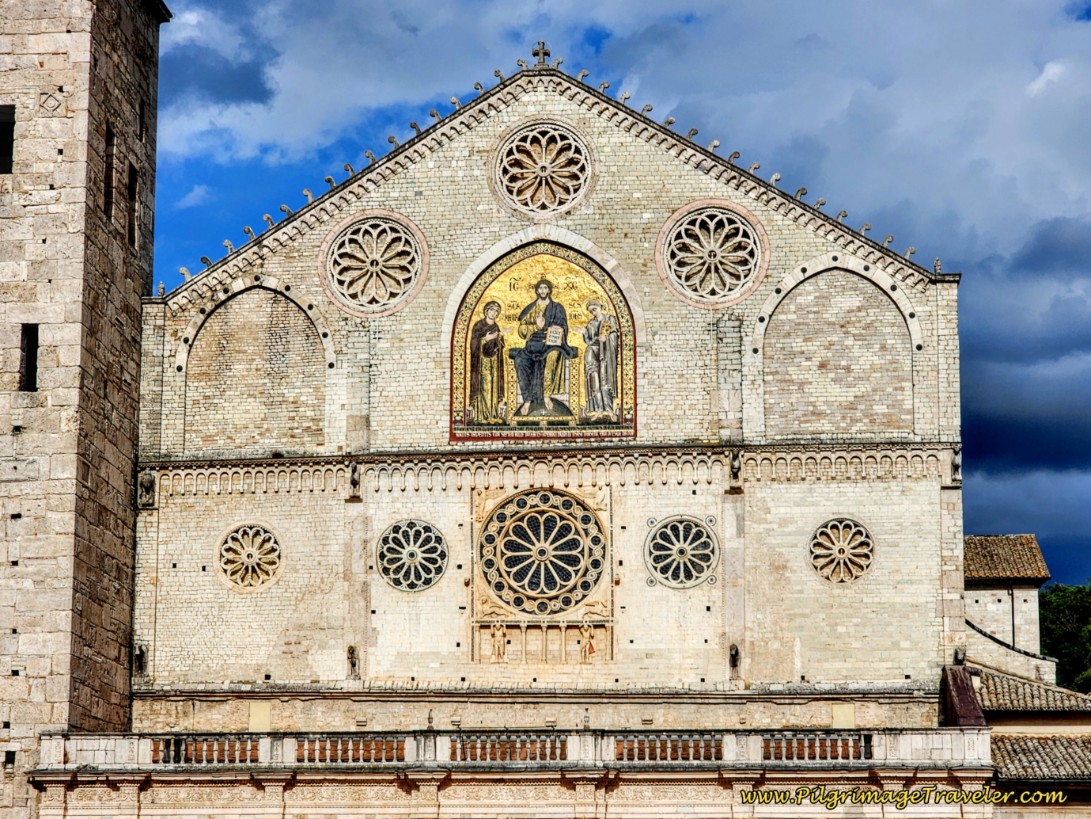 Close-Up of the Mosaic Façade, Duomo di Spoleto
Also described in the link above, is the central rosette, which was also completed in 1207, is four meters in diameter and supported by an architrave of columns.
The entrance to the cathedral alone is free. There is a separate section called the "Art of the Spirit" and it is an additional tour you can purchase. According to the official Duomo di Spoleto website the Art of the Spirit" includes the upper part of the Cathedral, the Bell Tower, the Sala della "Grande Bellezza," Diocesan Museum and Church of Sant'Eufemia." We did not take this tour, but if you are interested, click on the link for information.
Next I show the high altar and the wonderful frescoes by Filippo Lippi in the 15th century.
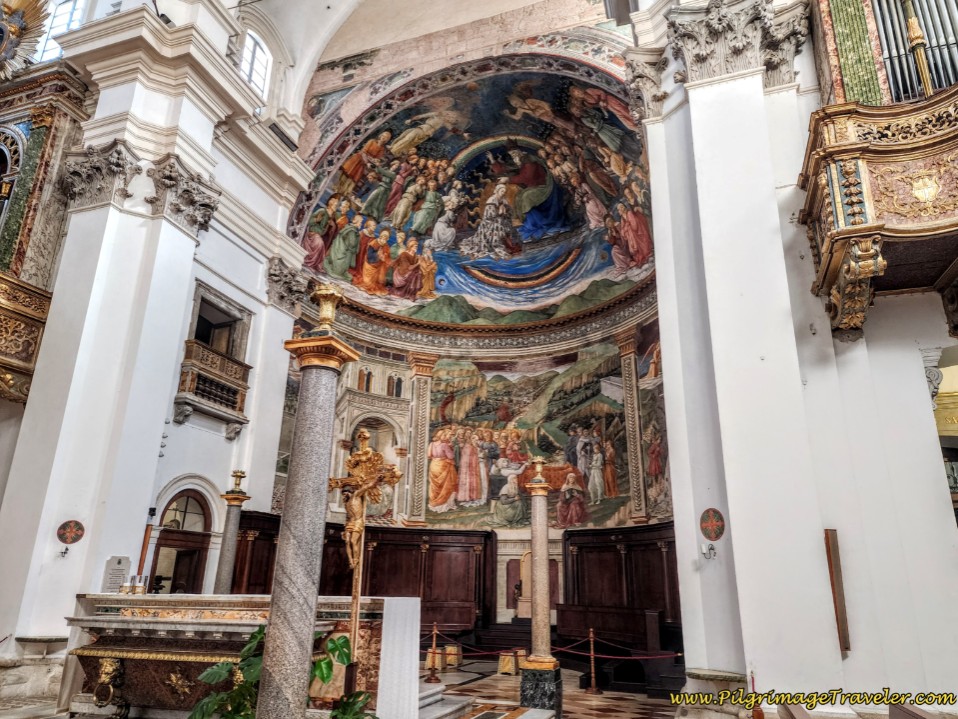 High Altar, Duomo di Spoleto
According to the Key to Umbria, Duomo Apse Frescoes, the upper scene in the apse, in closer-up, pictured below, is of the Coronation of the Virgin. "The Virgin is shown in Heaven after her Assumption. God the Father crowns her in a mandorla formed by a rainbow, surrounded by a heavenly choir. The figures in the bottom row, which are identified by inscription, are mostly prophets: the innermost two are Adam (on the left) and Eve."
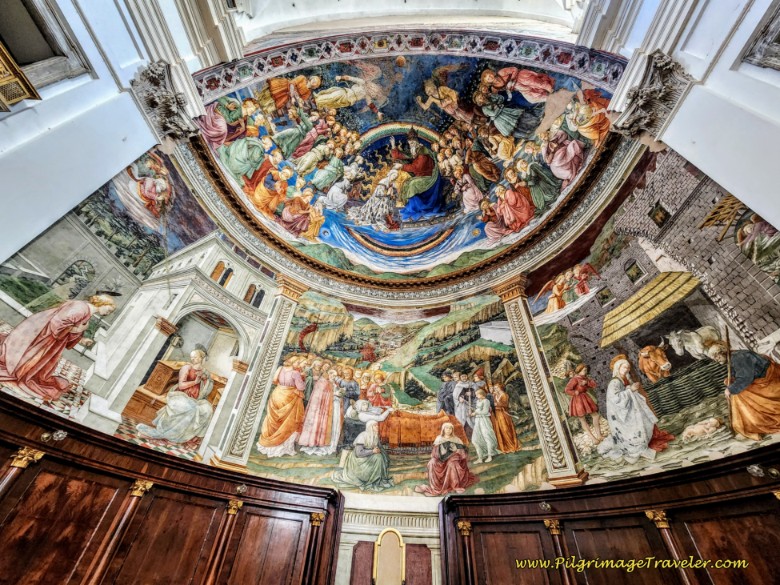 Close-Up of Frescos, High Altar
The three scenes in the apse below the Coronation of the Virgin, from left to right, is the Annunciation of the Virgin, the Virgin on her death bed and the Nativity. For more detailed descriptions, click on the link in the previous paragraph.
Next is a photo of a dome that must have been in one of the side altars. It caught my eye. I was unable to find any description of this, because most likely it is only for decorative purposes, but to me it was fascinating. If you open the photo you will notice that no two of the rosettes in the design are alike! Plus the design gives the optical illusion of the rosettes diminishing as they get closer to the top. I could have stared at this for a long time! But a longer-lasting picture had to suffice.
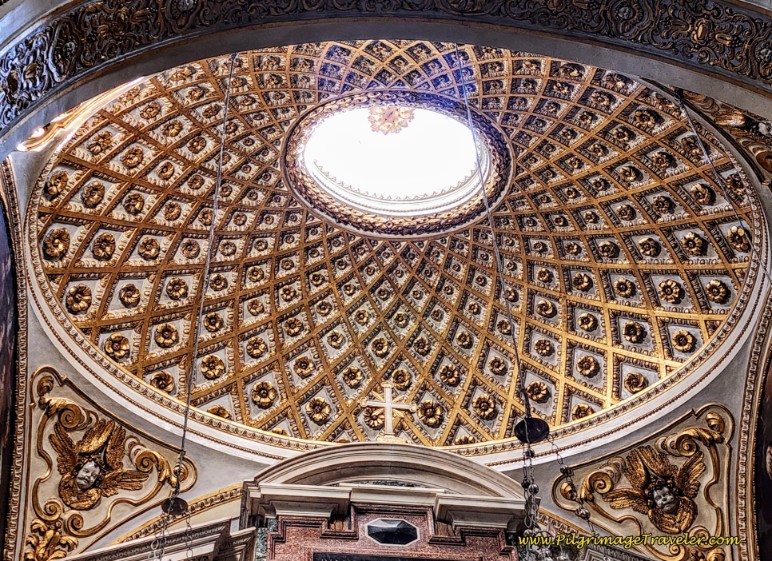 Side Dome, Duomo di Spoleto
The Chapel of the Blessed Sacrament, to the left of the apse, shown below, was my favorite place within the cathedral. It is surrounded by angels, my favorite spiritual beings.
Here is the perfect description of La Cappella del Santissimo Sacramento, from the official duomo website: "Located at the end of the left nave, on the opposite side of the main altar with respect to the chapel of the Most Holy Icons (Cappella della Santissima Icone);
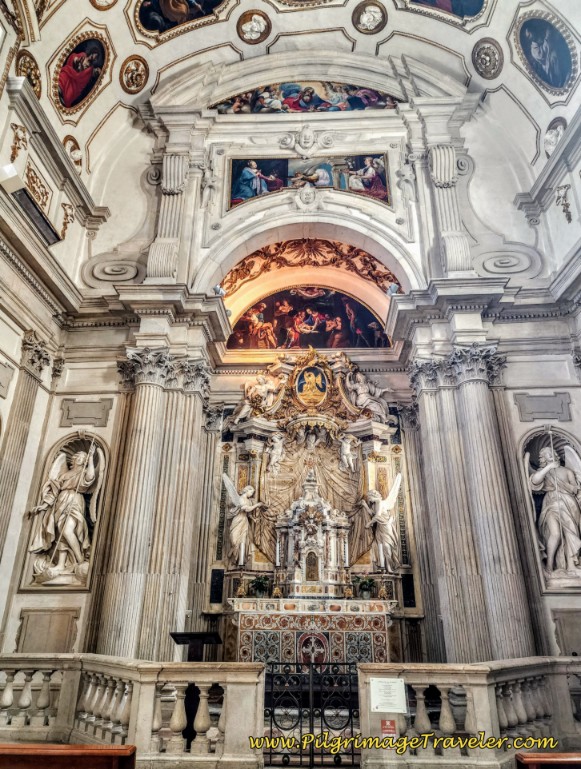 Cappella del Santissimo Sacramento
"It was begun during the time of Bishop Paolo Sanvitale (1591-1600) and the decorative parts were completed at the end of the 18th century. The chapel is enriched internally by eight niches with angels, oil paintings and stuccoes. On the altar wall we find: Nativity, Annunciation and Eternal Father, all depicted on canvases. The beautiful tabernacle, made of alabaster, is the work of Francesco Giovannelli da Volterra (1741)."
And next is a wonderful close-up of the altar in the Blessed Sacrament Chapel. It is just gorgeous.
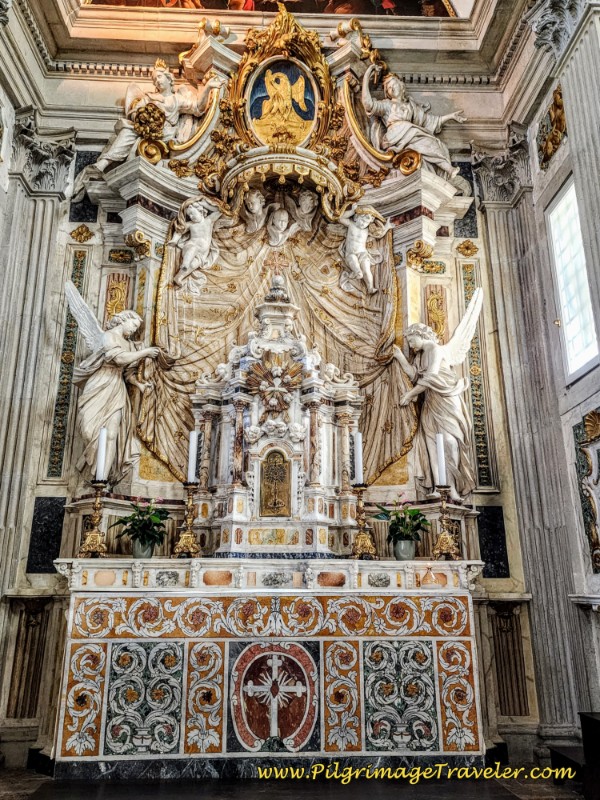 Close-Up of the Altar
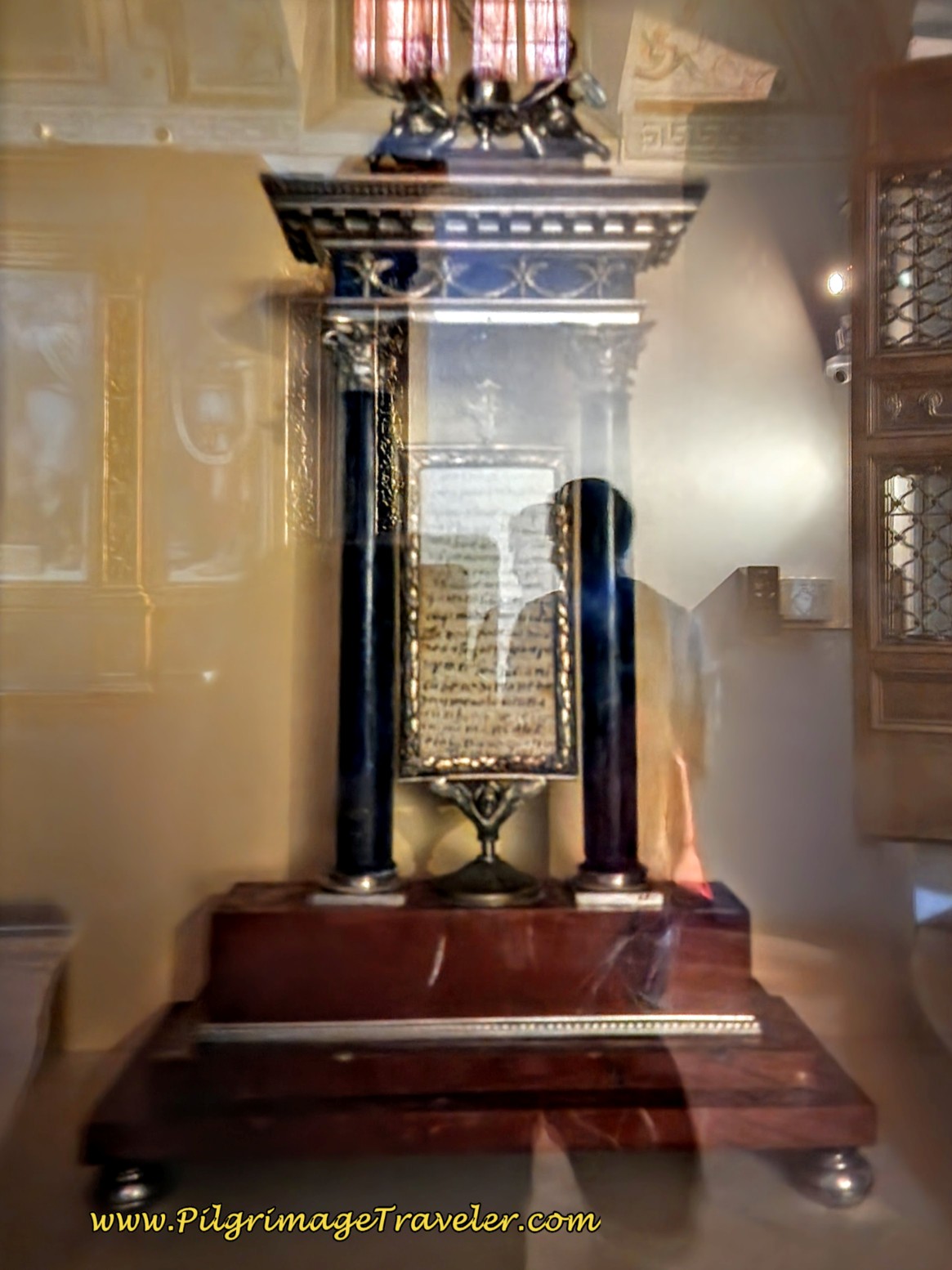 Signed Letter by St. Francis to Brother Leo
In the left aisle of the cathedral is the Cappella delle Reliquie, the Relics Chapel.
On a wall in a glass case is an original signed letter written in 1222 on parchment of goatskin by St. Francis of Assisi for one of his beloved followers, Brother Leo. (My apologies for the lousy photo, with reflections on the glass!)
For more incredible photos of the interior of the Duomo, click here, if you wish to have a preview before your own visit.
Our next destination was the Spoleto fortress on the hill above the cathedral, the Rocca Albornoz, below.
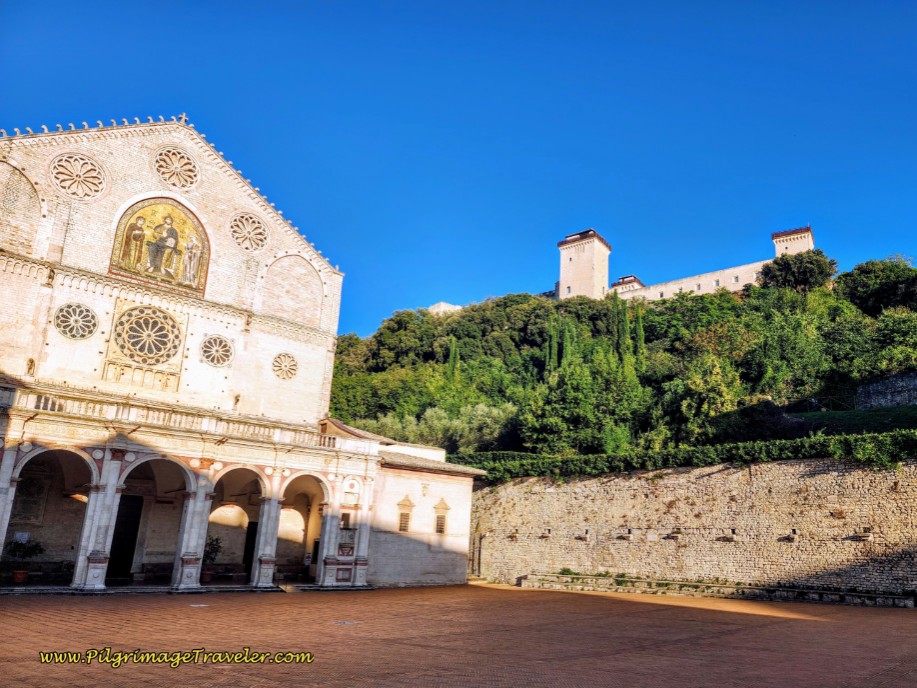 Rocca Albornoz from the Duomo di Spoleto
We took the pedestrian stairway across the plaza from the cathedral to walk up the hill towards the fortress. This is the identical path of the Way of St. Francis. At the top of the stairs, we turned left onto another pedestrian walkway, the Via Aurelio Saffi. This is a lovely street that walks through multiple archways. The one below is just great, with the arched walkway above.
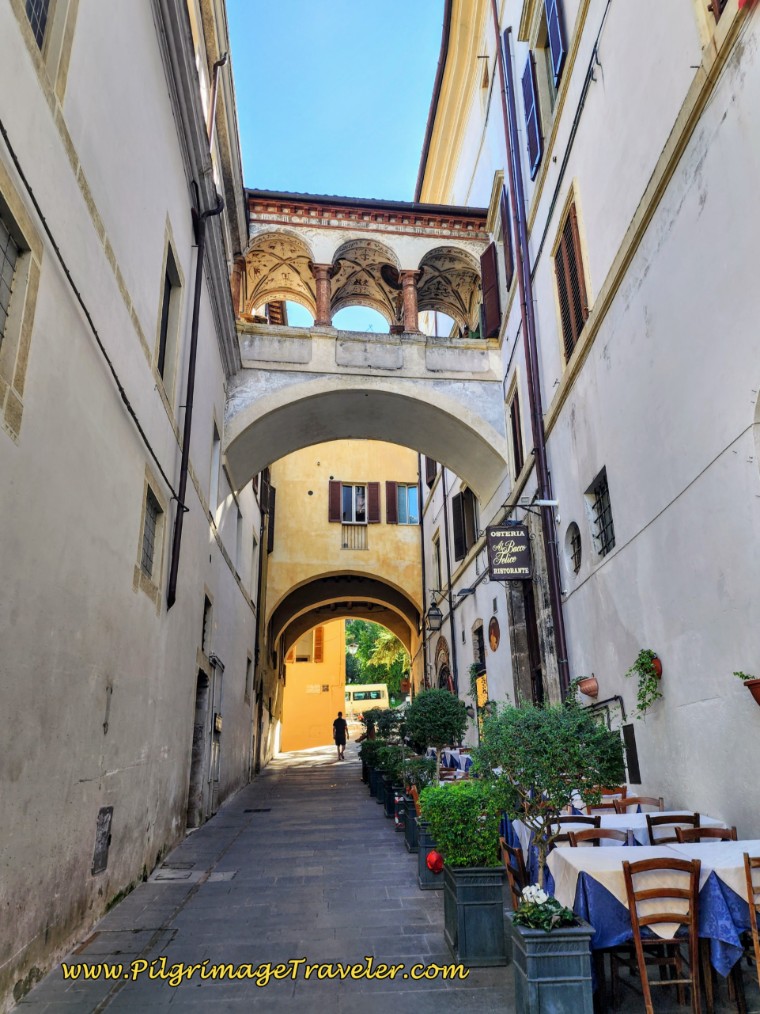 Via Aurelio Saffi, Spoleto
As you climb, passing the war memorial and historic fountain on your right, there is an ascending road to the left with a gate, pictured below. This is the entrance to the fortress, the Rocca Albornoz. (This is where the Via di Francesco stays to the right.)
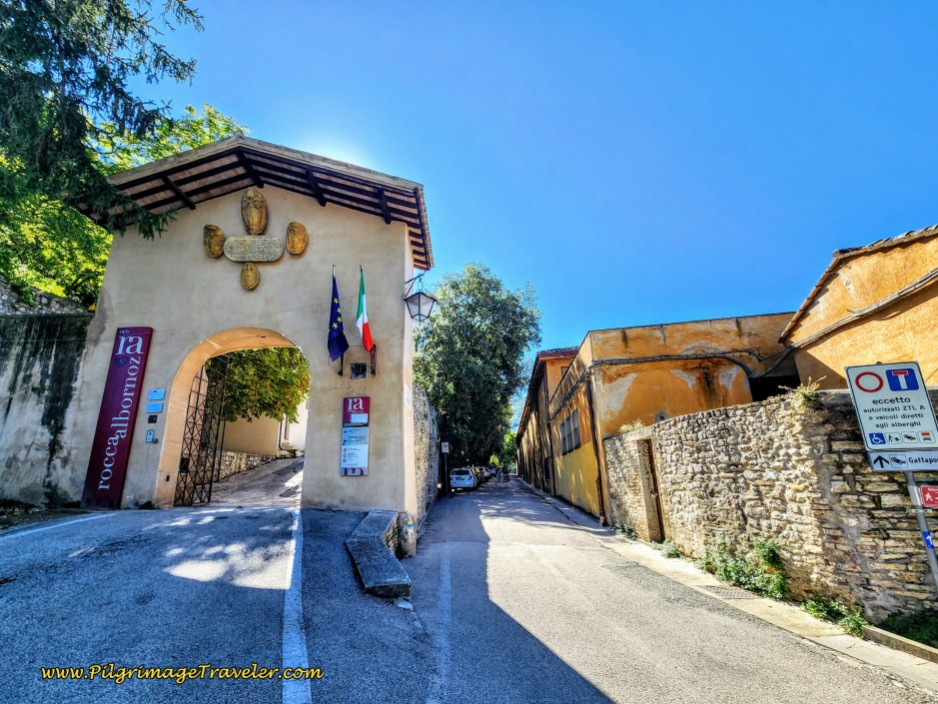 Entrance to the Rocca Albornoz
After the entrance gate, continue to walk up the hill another 100 meters or so and come to the next gate, the Porta del Bastione, pictured below.
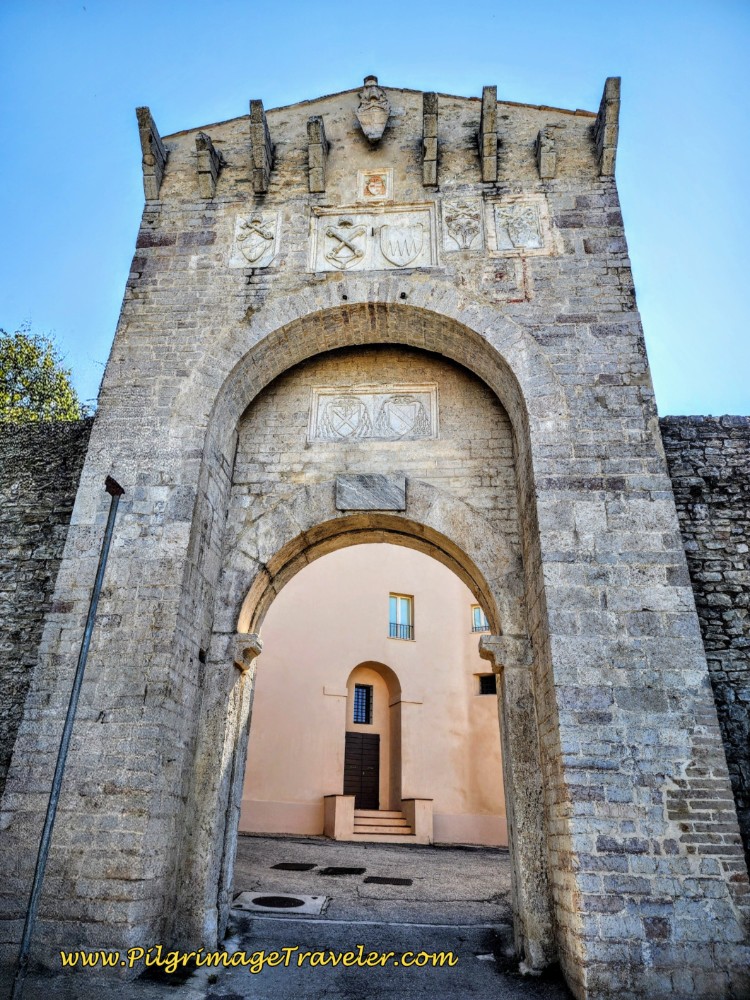 Porta del Bastione, Rocca Albornoz
This fortress is massive. After walking through the Bastion Gate, this is the view you see, below, of the castle as you wind your way up. For a comprehensive history, see the Key to Umbria, Rocca Albornoz website.
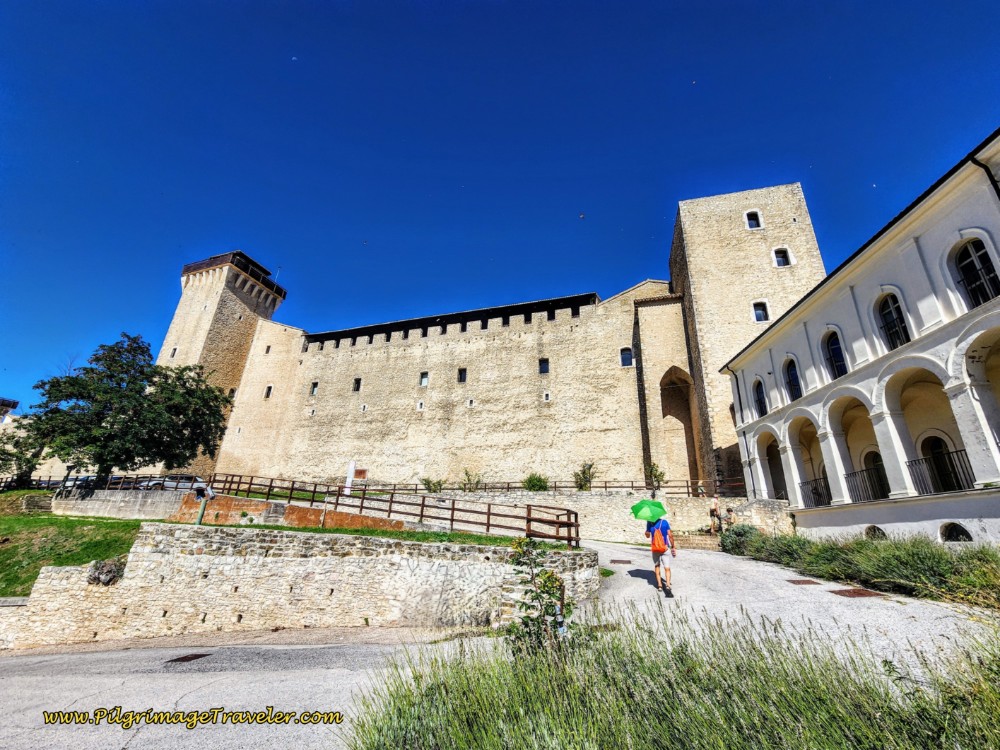 Rocca Albornoz, Spoleto Fortress
As you walk up to the fortress, look over the wall to your right, and fabulous views of the historic bridge, the Ponte delle Torri can be seen. The Way of St. Francis walks over this bridge on day fifteen.
 Ponte delle Torri
The fortress houses the Museo Nazionale del Ducato di Spoleto, the National Museum of the Duchy of Spoleto. Click on the link for information on the current hours and entry fee.
You can also purchase a special panoramic tour along the upper walkways and towers. Click the link here for all this entrance information. This panoramic tour only runs on the weekends and requires a reservation. We were disappointed that we were unable to do this tour.
All the newly constructed stairways and walkways you see in the photo below are unaccessible with just the entry ticket. You must have the special tour in order to go onto the ramparts! Click this link, Panoramic Tour of the Towers for more information.
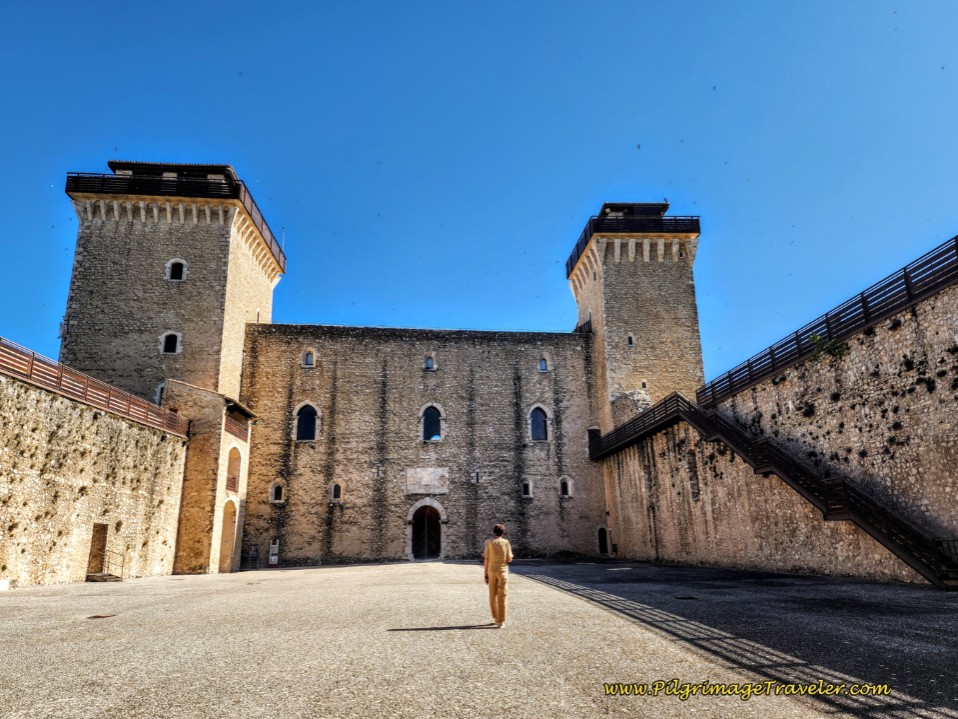 Interior of the Rocca Albornoz
While I love a good castle, this one turned out to be more of a museum, indeed, just like the name says! It does have an art exhibit, and some poorly preserved original frescoes within it. For me, it did not have much of a castle feel. I know it would have felt different if we were able to climb up to the ramparts! What a shame.
You may want to skip this one, if you are low on time. You can see quite a bit anyway by just walking up to the castle and walking around the public walkways outside. If I had known, that is what I would have done and saved myself some money.
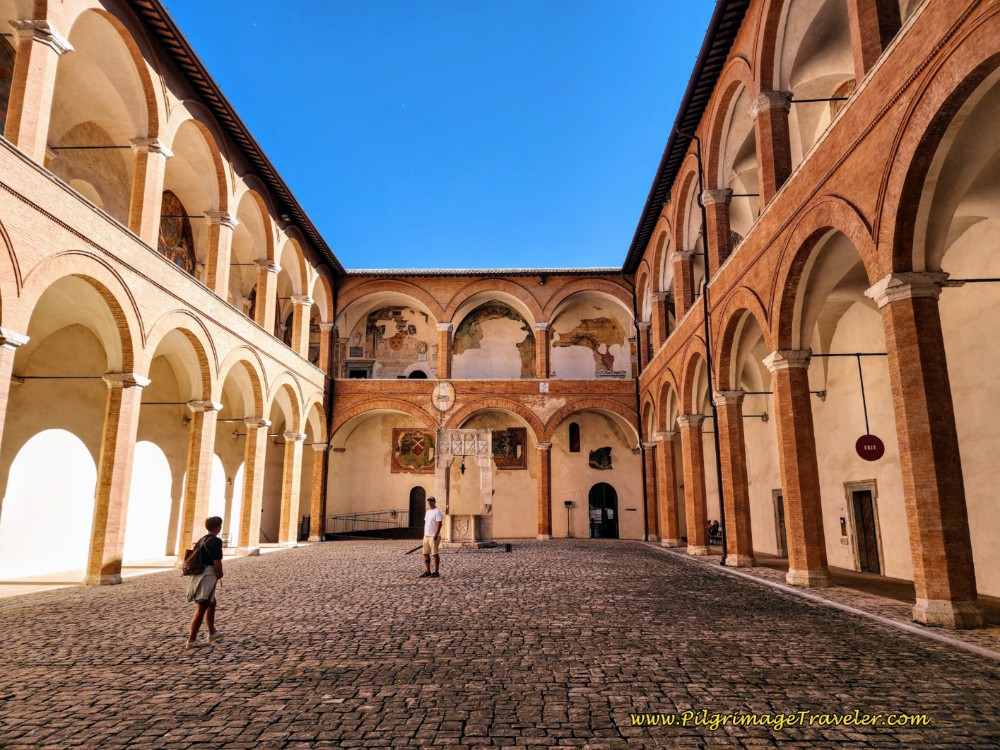 Inner Courtyard, Rocca Albornoz
The frescoes in the fortress are not in very good condition, but this vault has some of the better ones.
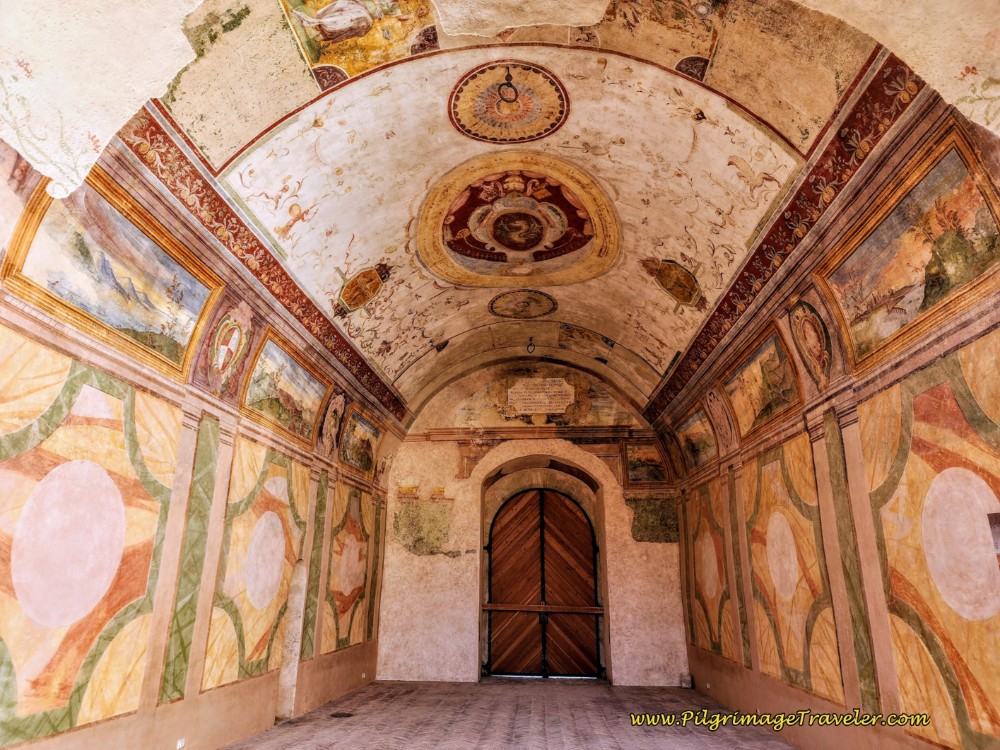 Interior Vault with Frescoes, Rocca Albornoz
Inside one of the towers is the Camera Pinta, the "Painted Room," with historically significant frescoes, uncovered in the latest restoration. Click on the link for photos and more information. Again, for me personally, they were not interesting enough or preserved enough to justify the admission price.
After the fortress visit, we walked down the hill and explored a few of the other sights in the medieval city center.
First up is the church, the Convento Parrocchia San Ansano, built in the 18th century neo-Classical style. Unfortunately, it was not open to visitors when we were here. It is most interesting in that there is a 12th century Crypt of Sant'Isacco (St. Isaac of Monteluco, a Syrian monk that settled near Spoleto in the 6th century) below the church, which was in turn built within a Roman temple! This church personifies the many layers of history that exist in this town, if you literally dig deep enough!
The crypt contains some of Spoleto's oldest surviving frescoes, dating from the 11th-12th centuries, recently restored. Hopefully this fascinating place will be open when you visit.
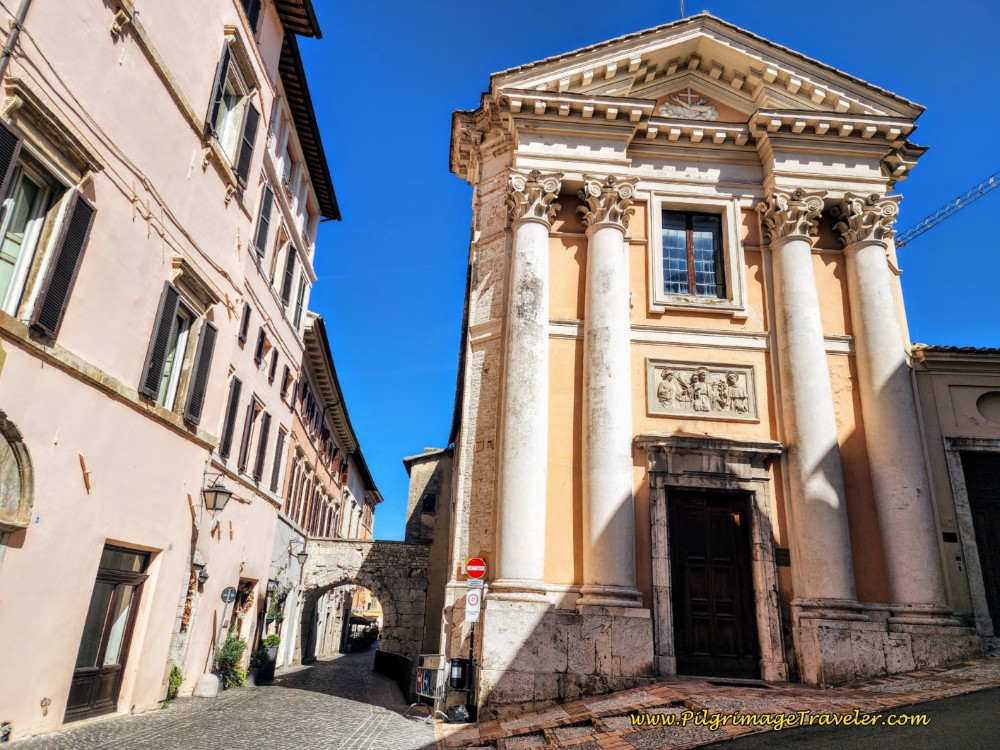 Convento Parrocchia San Ansano
Seen in the photo above to the left side of the church, is the Roman Arco di Druso, built in 23 CE. Below is the same arch from the other side. This free-standing arch was built in honour of Drusus and Germanicus, the son and adopted son of the Emperor Tiberius. This arch provided an imposing entrance to the Roman Forum.
To the left of this arch, and down a set of stairs you can see the result of excavations from 1955-7, exposing part of the temple wall, mentioned above, and the adjoining Roman forum.
There are some wonderful information boards here with reconstruction drawings of what this area would have looked like in Roman times. It helps get a picture of the grandeur of it all.
If you are interested in this fascinating history, click on the link above and scroll down until you see the information on the Arco di Druso. So many layers of history!
 Roman Arco di Druso
If you walk through the Roman Arco di Druso and head north, you will walk through the Piazza del Mercato, Market Square, a great place to hang out, people watch and imbibe in something.
However, just a few short steps to the north and east of the Piazza, we wanted to see one more site before hanging out ~ the Casa Romana, historic Roman House. This amazing home takes only a few minutes to see, but in my opinion is worth the admission price.
This Roman noble house was excavated in 1885-1914, from under a building. According to the Key to Umbria website, (link above), "The house dates to the time of the Emperor Augustus and was renovated in the 2nd century AD. It is thought to have once belonged to Vespasia Polla, the mother of the Emperor Vespasian (69-79 AD)." A noble house indeed! Wow!
Here is a photo of the first room that you enter from the street, the atrium.
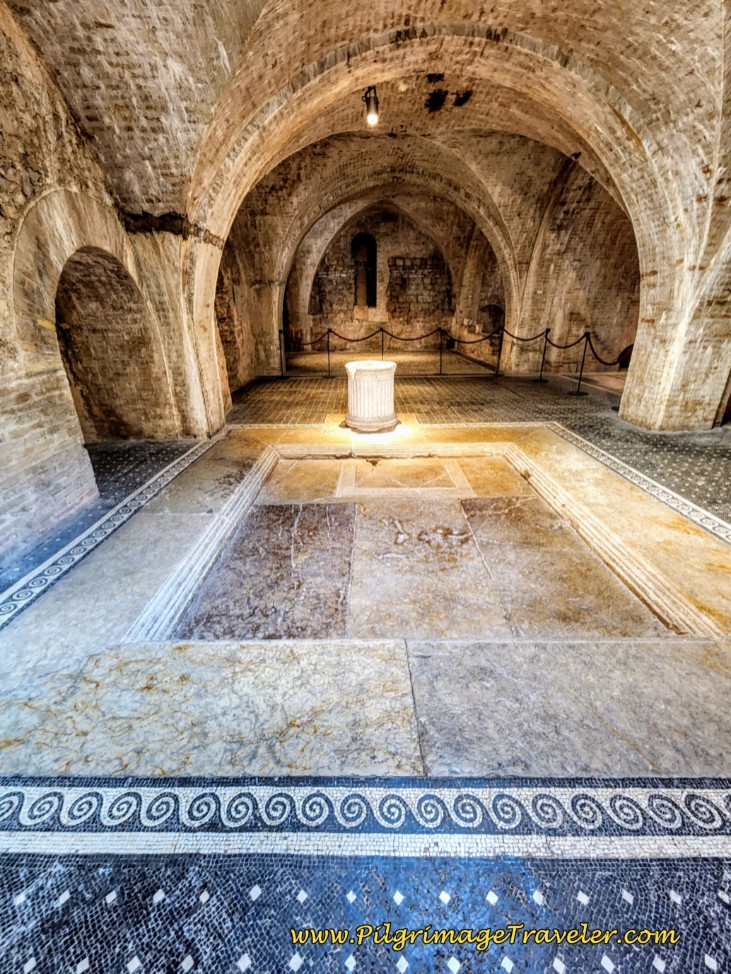 Casa Romana Atrium with Mosaic Floors
The mosaic floors are well-preserved and oh so beautiful! The main reception room (tablinum) is behind the atrium and in the left foreground of the photo below.
And in the left background with the fragments of a fresco, is the living room, and on the right background is perhaps a bedroom.
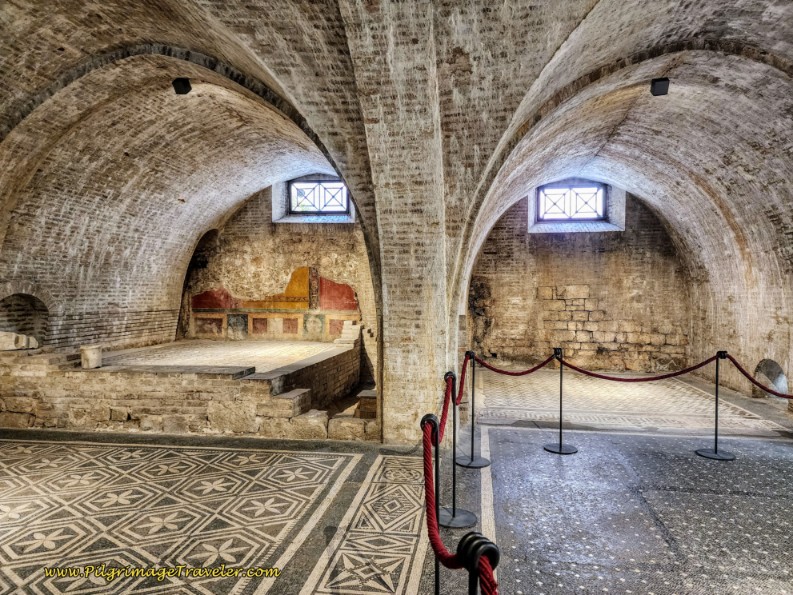 Casa Romana Living Room and Bedroom
And finally, one last site was on my wishlist. Another Roman ruin, the Roman Theater, Teatro Romano. Below is the entryway along the almost-hidded arched alleyway called the Via Sant'Agata. And unfortunately, the theater was also closed!! Bummer!
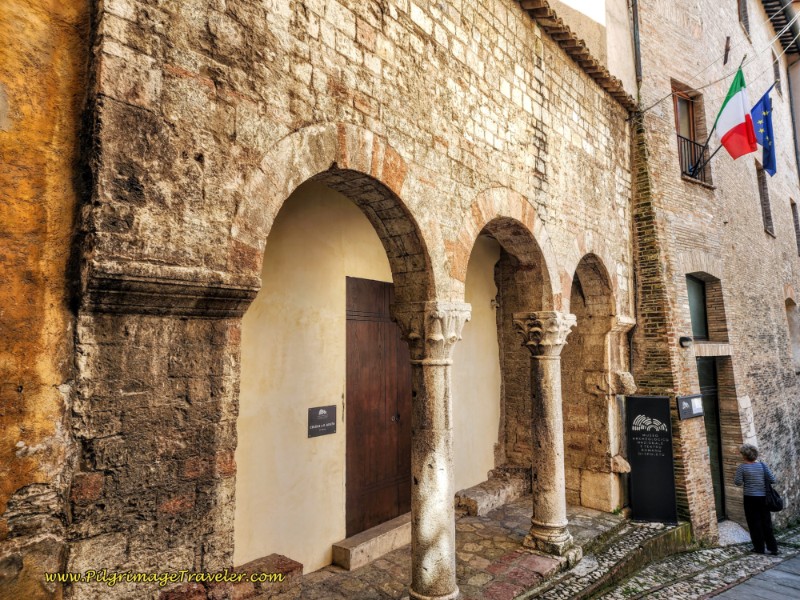 Entrance to the Teatro Romano
However a friendly local told us (in Italian, which I actually could figure out due to my elementary Spanish skills) that we could see everything there was to see from the outside, if we went around the side, and used the alleyway by the Canasta bar and climbed up along the fenceline that runs along the eastern side of the teatro. And indeed she was right.
While we couldn't stand inside the theater itself, we could peer through the fenceline and still get this lovely view, below. It was definitely better than nothing!
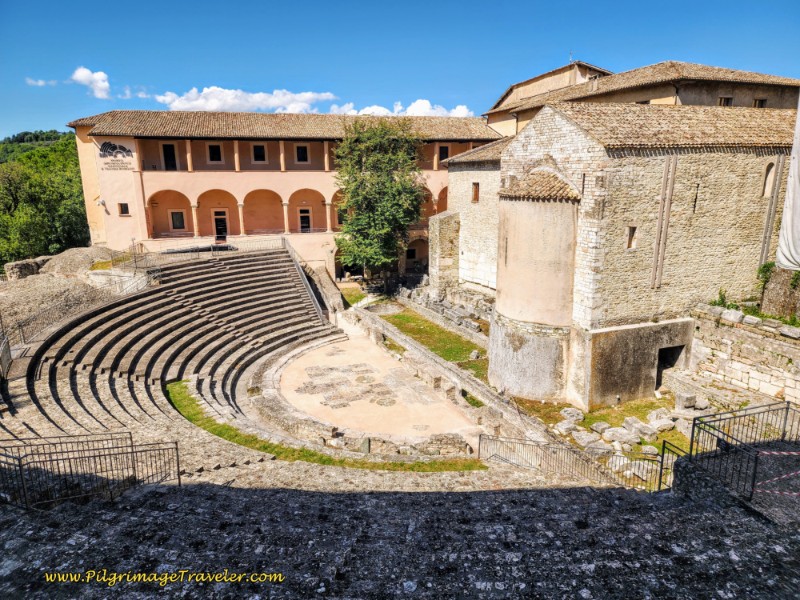 Teatro Romano
And finally, it was time to relax and go back to the main square, the Piazza del Mercato, shown below. There is a really good pizza restaurant here which we went to for an early supper, by Italian standards, but normal for us! It's a good thing that pizza restaurants in Italy are usually open any time during the day!
After all our running around, pizza and beer in the square was all we had energy for. I knew if I tried to wait until a "proper" Italian dinner hour, I most likely would not make it. But then, I am an early bird afterall!
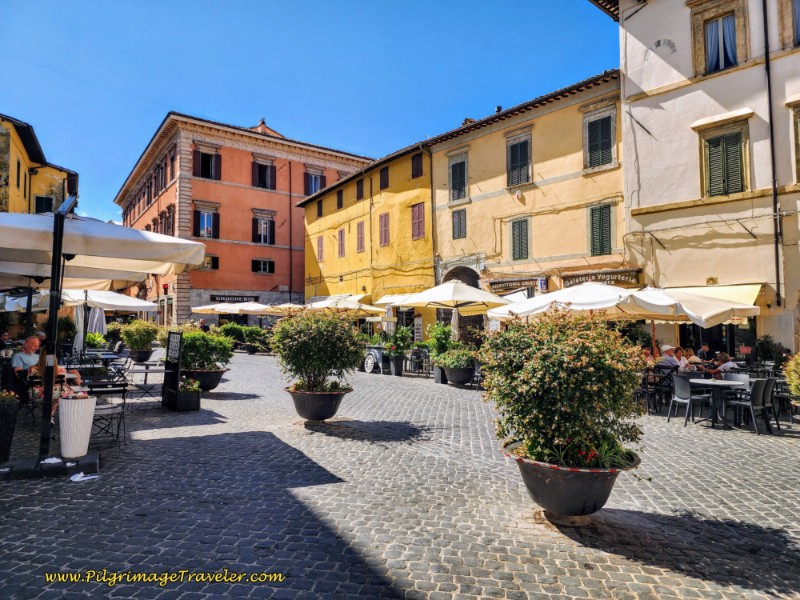 Piazza del Mercato
Despite the early hour, there were lots of folks hanging out in the square, most of them enjoying the happy hour, but some also eating, especially at the pizza place. Pizza, from what I can tell, is an acceptable food at anytime from about 11:00 until well after dinnertime! Yay for that!
And at the northern end of the Market Square is the Fontana di Piazza del Mercato. What you see now was constructed in the 18th century, after the previous fountain that existed since the 13th century was demolished.
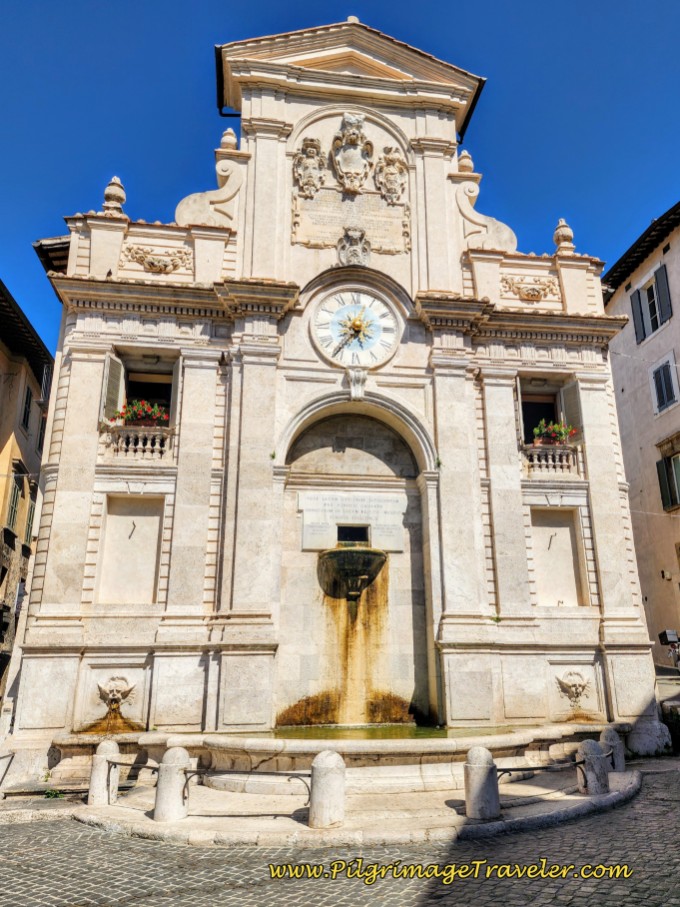 Fontana di Piazza del Mercato
And thus, our touring day had ended and after we had our fill of the Piazza del Mercato, we could relax in our Bracceschina apartment and get physically and mentally prepared for day fifteen on the Way of St. Francis! While the next day would be short, it was going to be strenuous! Relaxing and reading was the anecdote.
Salutation
May your own day in Spoleto, Italy be discovered "stone by stone and garden by garden." May the "hidden treasures wait calmly to be loved" by you and may you "yield to introspective wandering" within its walls! Ultreia!
Way of St. Francis EBook Guides
Walk smarter with our ad-free, beautifully formatted Way of St. Francis eBook Guides, in PDF format ~ perfect for offline use in mountainous and remote areas along this Way. Includes daily stage details, alternative routes and stunning photos. Our eBook Guide is unique because we also immerse you with our story.
Don't carry a heavy paper book, but use our digital eBooks on your mobile device instead! You can walk with clarity and confidence, deeply connect to nature, following in the footsteps of St. Francis, through the Italian countryside!
📲 Instant download. 💸 Money-back guarantee. 🔄 Free updates for 1 year.
👉 Click here for more information! OR BUY NOW ~ La Verna to Assisi, OR BUY NOW ~ Assisi to Rome. OR BUY BOTH HERE
Way of St. Francis Stages
La Verna to Assisi
Assisi to Rome
Please Consider Showing Your Support
Many readers contact me, Elle, to thank me for all the time and care that I have spent creating this informative website. If you have been truly blessed by my efforts, have not purchased an eBook, yet wish to contribute, I am exeedingly grateful. Thank you!
Search This Website:
The Pilgrimage Traveler Digital Guides
Our Guides Help You:
~ Know what to expect each day!
~ Locate historic sites along the Way!
~ Know where you are in your journey!
~ Discover a quote from the sages, for your daily reflection on the journey!
Click on a Photo Below to Get Your Copy.
A most popular alternative on the Central Route of the Camino Portugués!👇
The Portuguese Routes are rapidly gaining in popularity, especially the section from Lisbon! Plan to walk this one soon, before it is no longer a quiet experience!👇
Our most popular Portuguese guide! 👇
The most historic of the Portuguese Caminos ~ not to be missed!👇
The spiritual adventure of a lifetime, following in the footsteps of St. Teresa of Ávila!👇
The amazing mountain route alternative, the Camino Sanabrés, from Granja de Moreruela on the Vía de la Plata!👇
The most incredible mountain scenery on this camino from Leon to Oviedo!👇
The shortest of the caminos, but not easy!👇
The very first, Original Way from Oviedo to Santiago!👇
The pilgrimage to the "End of the World" ~ The perfect add-on to your camino!👇
All Banners, Amazon, Roamless and Booking.com links on this website are affiliate links. As an associate of these companies, the Pilgrimage Traveler website will earn from qualifying purchases when you click on these links. We have used and love all of our product recommendations and believe you will too! We sincerely thank you!

🙋♀️ Why Trust Us at the Pilgrimage Traveler?
We’re not a travel agency ~ we’re fellow pilgrims! (See About Us)
We've trekked Pilgrimage Routes Across Europe since 2014!
💬 We’ve:
- Gotten lost so you don’t have to. 😉
- Followed waymarks in the glowing sunlight, the pouring rain and by moonlight. ☀️🌧️🌙
- Slept in albergues, hostels & casa rurals. Ate and drank in cafés along the way. 🛌 😴
- Created comprehensive and downloadable GPS maps and eBook Guides, full of must-have information based on real pilgrimage travels. 🧭 🗺️
- Shared our complete journeys, step by step to help YOU plan your ultimate pilgrimage and walk with your own Heart and Soul. 💙✨
Every detail is from our own experiences. Just fellow pilgrims sharing the Way. We have added a touch of spirituality, heartfelt insights and practical guidance from the road ~ offering a genuine connection to the spirit of pilgrimage. Tap into the wisdom of seasoned pilgrims!
Ultreia and Safe Pilgrimage Travels, Caminante! 💫 💚 🤍
Follow Me on Pinterest:
Find the Pilgrimage Traveler on Facebook:

Shroud Yourself in Mystery, along the Via de Francesco!
Walk in the Footsteps of St. Francis, and Connect Deeply with the Saint and to Nature in the Marvelous Italian Countryside!
Need suggestions on what to pack for your next pilgrimage? Click Here or on the photo below!

Carbon Trekking Poles ~ My Favorites!
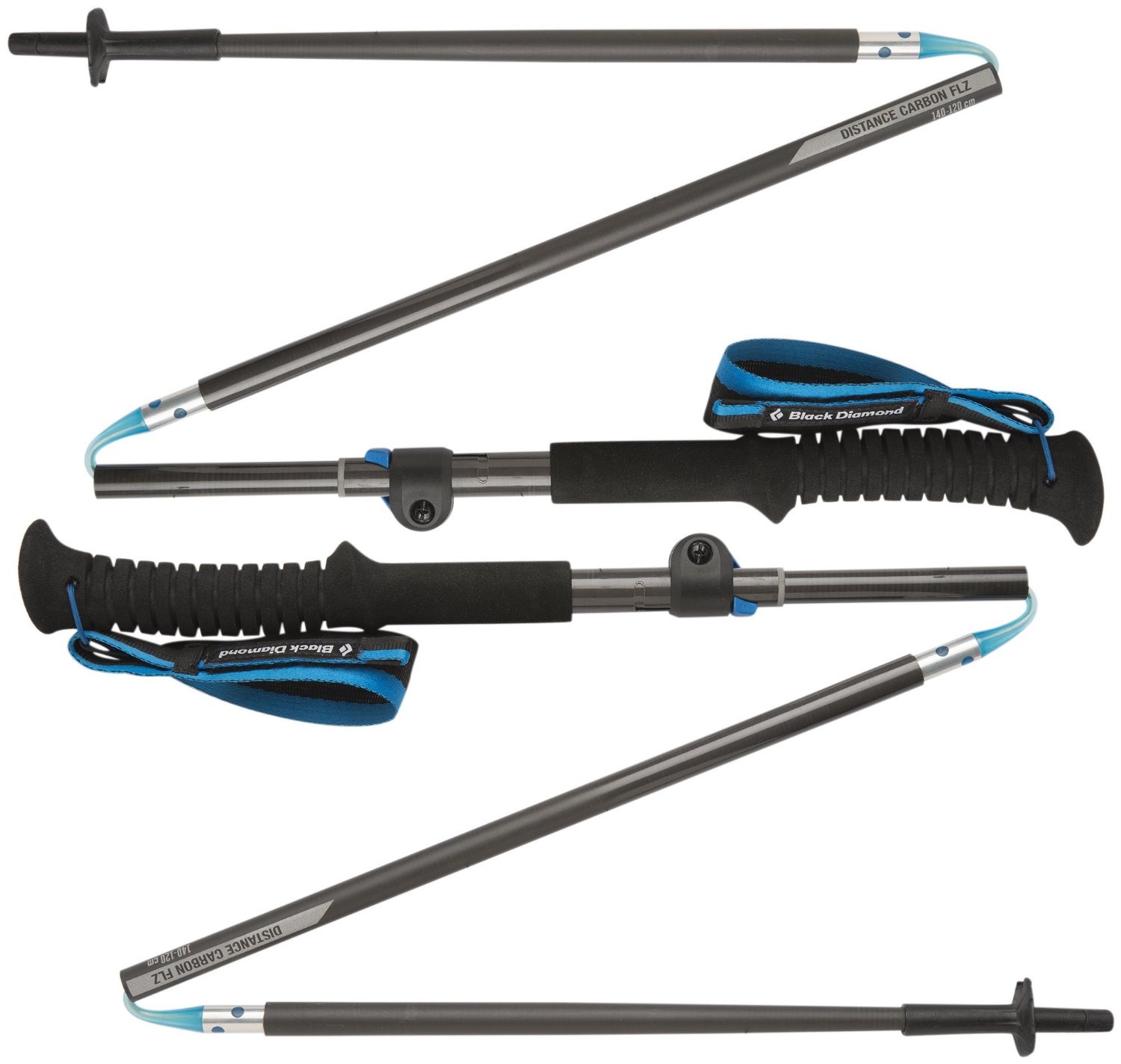
Carbon fiber construction (not aluminum) in a trekking pole makes them ultra lightweight. We like the Z-Pole style from Black Diamond so we can hide our poles in our pack from potential thieves before getting to our albergue! There are many to choose from! (See more of our gear recommendations! )
Gregory BackPack ~ My Favorite Brand


Do not forget your quick-dry microfiber towel!