- ~ Home
- The Way of St. Francis
- The Way of St. Francis, Poggio Bustone to Rieti, Day Eighteen
Jump to Way of St. Francis Stages
Day Eighteen on the
Way of St. Francis ~
Poggio Bustone to Rieti, 17.7 Kilometers (11 Miles)
Our day eighteen on the Way of St. Francis from Poggio Bustone to Rieti was a pleasant descent into the famous Rieti Valley where St. Francis spent a significant amount of time and received inspiration. He considered this "Sacred Valley," (as it is known), one of his three homes, along with La Verna and Assisi.
Three of the most important works of St. Francis were completed in this valley; creating the first living Nativity in Greccio, the completion of the final Franciscan Rule in 1223, and the Canticle of the Creatures.
"Do few things but do them well, simple joys are holy." ~ St. Francis of Assisi
🙋♀️ Why Trust Us at the Pilgrimage Traveler?
We’re not a travel agency ~ we’re fellow pilgrims! (See About Us)
We've trekked Pilgrimage Routes Across Europe since 2014!
💬 We’ve:
- Gotten lost so you don’t have to. 😉
- Followed waymarks in the glowing sunlight, the pouring rain and by moonlight. ☀️🌧️🌙
- Slept in albergues, hostels & casa rurals. Ate and drank in cafés along the way. 🛌 😴
- Created comprehensive and downloadable GPS maps and eBook Guides, full of must-have information based on real pilgrimage travels. 🧭 🗺️
- Shared our complete journeys, step by step to help YOU plan your ultimate pilgrimage and walk with your own Heart and Soul. 💙✨
Every detail is from our own experiences. Just fellow pilgrims sharing the Way. We have added a touch of spirituality, heartfelt insights and practical guidance from the road ~ offering a genuine connection to the spirit of pilgrimage. Tap into the wisdom of seasoned pilgrims!
Ultreia and Safe Pilgrimage Travels, Caminante! 💫 💚 🤍
Additionally, while St. Francis was in the Sacred Rieti Valley he founded the Sanctuaries of Greccio, La Foresta, Poggio Bustone, and Fonte Colombo.
Two of these sanctuaries are found on the orange alternative route from Greccio to Rieti, see the interactive map just below.
On this stage we will see the third sanctuary at La Foresta and on day seventeen, we saw the fourth, the Santuario Poggio Bustone. I was eagerly looking forward to seeing more of the places which inspired St. Francis so much!
Maps and Stats, The Way of St. Francis, Poggio Bustone to Rieti
Below is the interactive map, with services and features for this stage. I have also included the orange alternative day three from Greccio to Rieti, from the Via di Francesco Italian website, for your convenience.
For the entire alternative route from Marmore to Rieti, you can use my Entire Way of St. Francis interactive map.
On the orange Greccio route there are plenty of services in Contigliano, after about 7.5 kilometers, Piani Poggio Fidoni after 12 kilometers and scattered from there until Rieti.
On the blue route from Poggio Bustone there are fewer services, only in Cantalice after a bit more than six kilometers, but nothing after that. You may want to plan for a picnic lunch from your pack at La Foresta sanctuary after 12 kilometers. That's what we did and it worked out well. Of course, we also stopped for a coffee break in Cantalice!
As you can see if you compare the elevation profiles below, the stage from Greccio is more difficult than the stage from Poggio Bustone. Not only is the elevation gain difference more, by about 167 meters (550 feet), but it is longer by five kilometers.
We continued our blue route from Poggio Bustone. I was looking forward to an easier and shorter day after the difficult day seventeen!
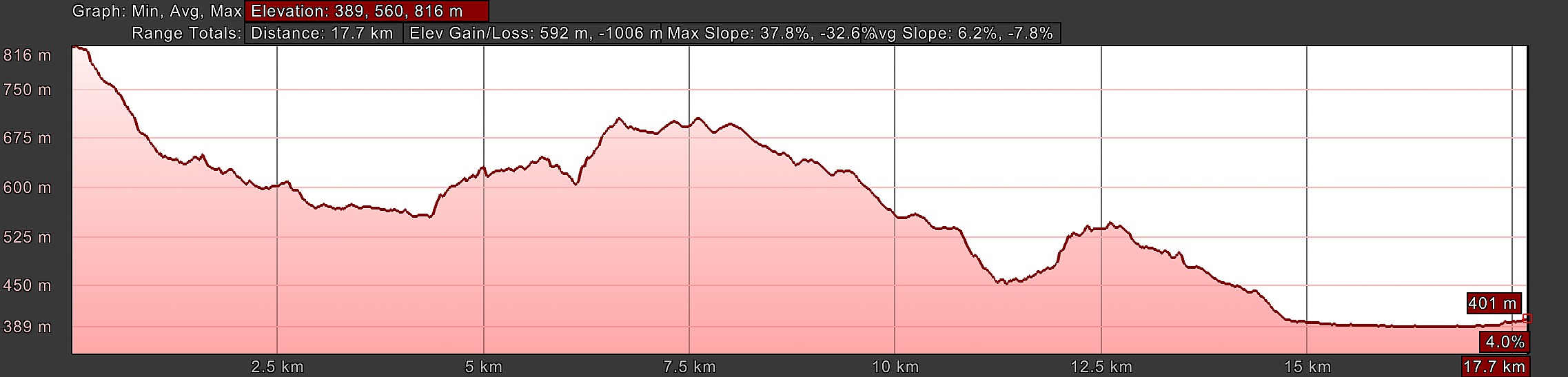 Elevation Profile, Way of St. Francis, Poggio Bustone to Rieti, Day Eighteen
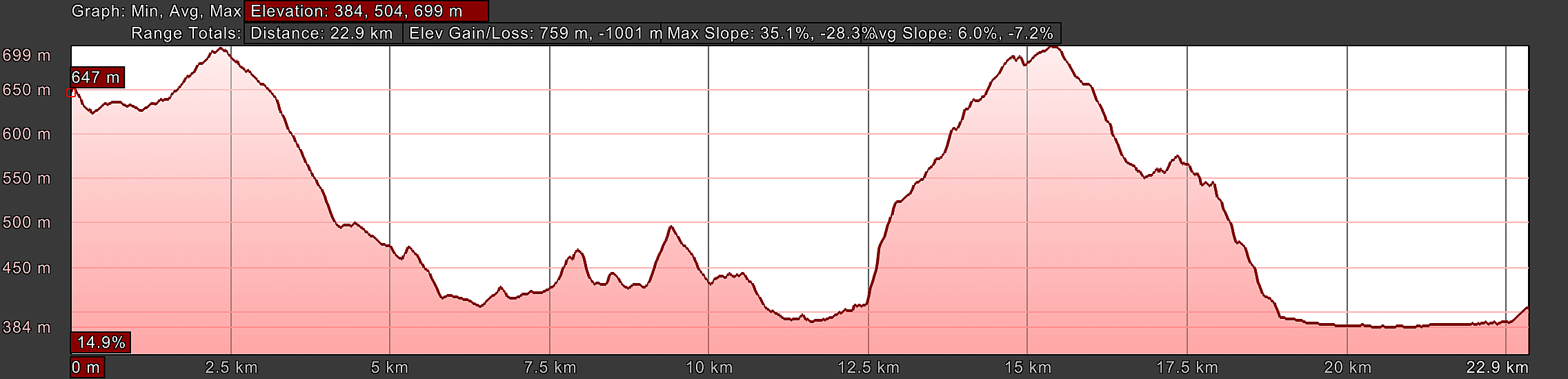 Elevation Profile, Way of St. Francis, Greccio to Rieti, Day Eighteen
Photo-Rich Travelogue, The Way of St. Francis, Poggio Bustone to Rieti
The day's pilgrimage begins with a very long, 4.3 kilometer walk downhill!
From the start of this stage at the Convento San Giacomo, (Poggio Bustone), stay left at the first Y-intersection. Head down the hill into Poggio Bustone. (The sanctuary is donation-based with 20 pilgrim beds.)
You will see this view, below, as you walk back toward town along the Via San Giacomo.
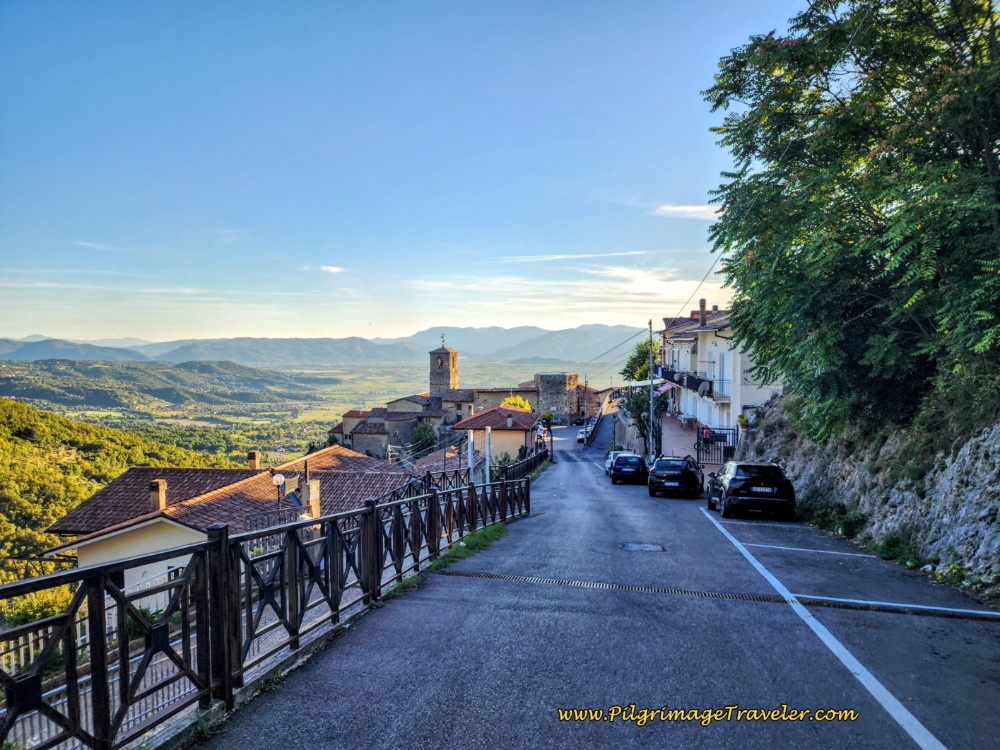 Along the Via San Giacomo
After not quite 1/2 kilometer, come to this church, the Chiesa di San Giovanni Battista, or St. John the Baptist, below. The tower that you see all around town and from the santuario belongs to this church.
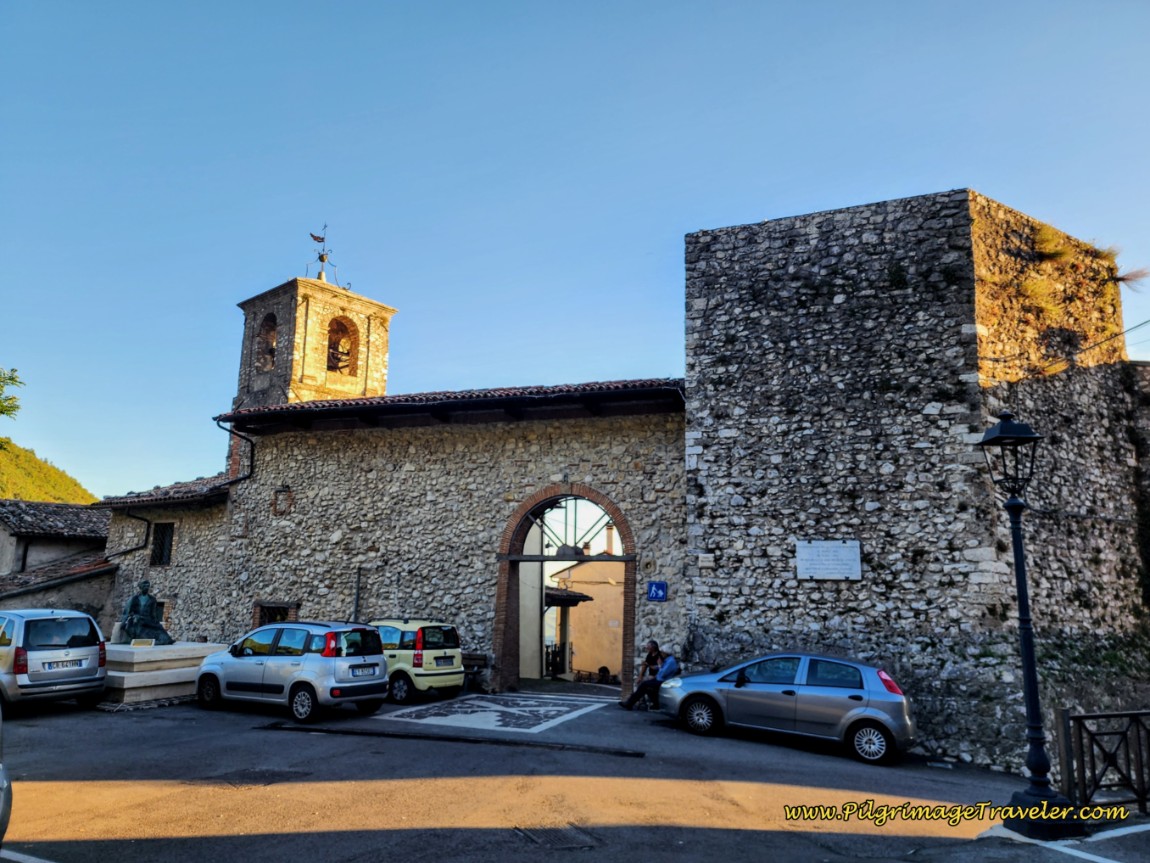 Parrocchia San Giovanni Battista
In front of the church is where the Way makes a hairpin turn to the left to descend on the Via Bezzeca, below. This is a wonderfully quaint street.
It was near the church, where we began our day from the apartment, La Casetta dei Desideri. (There are many more private places in this area. Click the Booking.com link for Poggio Bustone to see them and to see who is offering the current deals.)
You can see the santuario on the hill straight ahead, and will continue to see it as you descend the many steep hairpin turns as you exit the town.
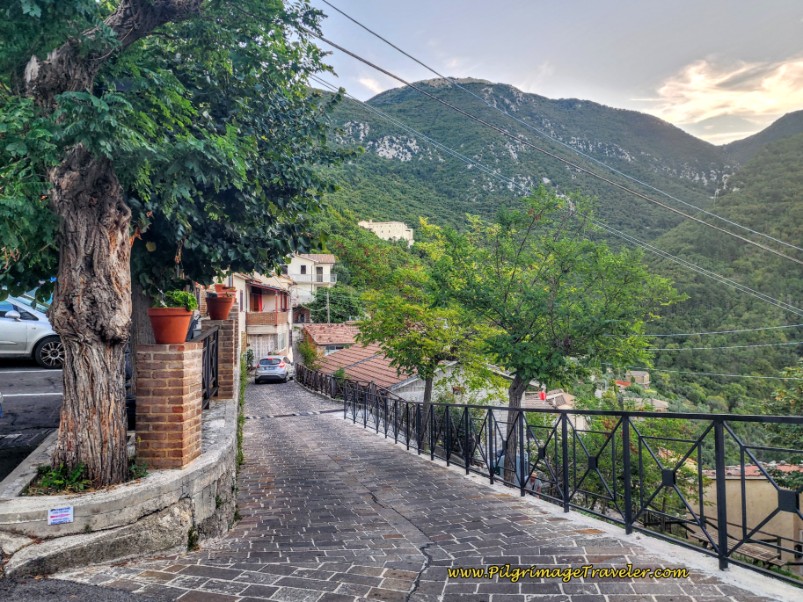 Walk Down the Via Bezzeca, Views of the Santuario Above
Pictured next is one of the switchbacks after it turned westward, with lovely views of the Rieti Valley below. The sunrise over the valley was gorgeous.
While this valley may be more populated and less peaceful and inspirational as the time of St. Francis, nonetheless the early morning stillness was very serene!
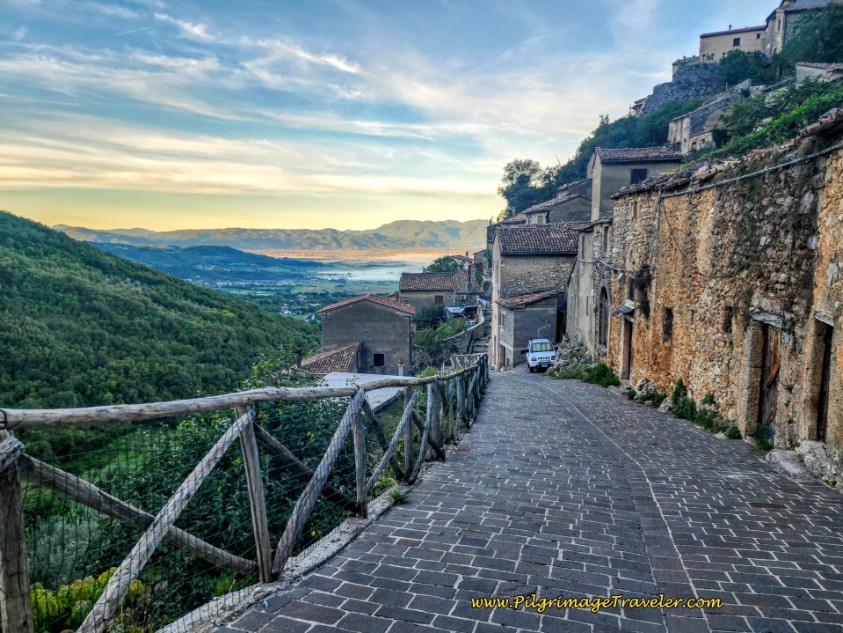 Continue Along the Via Bezzeca
Lower down, the steep Via Bezzeca becomes stair steps and is even more narrow as it continues its descent. The steps end at this lovely Tau painted on the cobblestone.
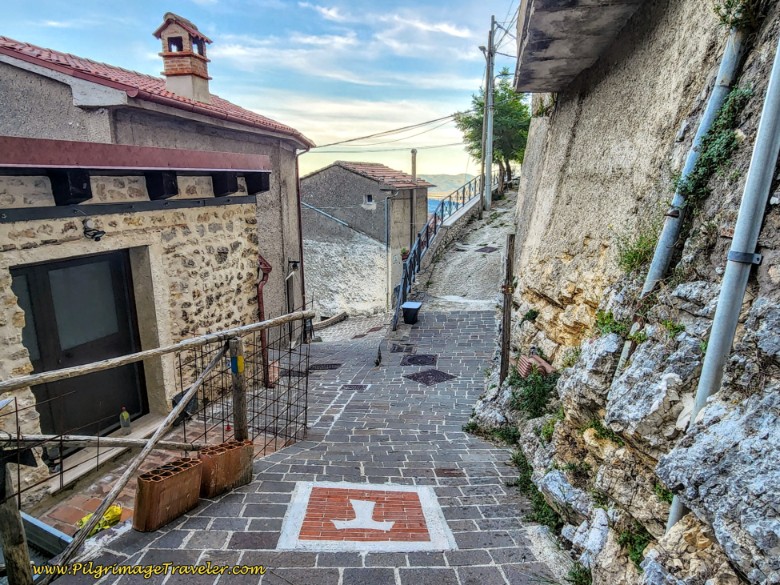 Painted Tau Waymark on the Pavement
Just beyond the Tau painted on the pavement is the donation-based Accoglienza Casa dei Nonni Frate Jacopa, (+39 366 90 29 139 or +39 380 890 4231) with eight beds. [Don't forget there is also the donation-based Casa del Pellegrino "Da Dina" (+39 347 513 3030), with six beds, also near this area.]
The buildings get more dilapidated as you near the edge of town. The paved Way turns to a trail as you walk by the last buildings.
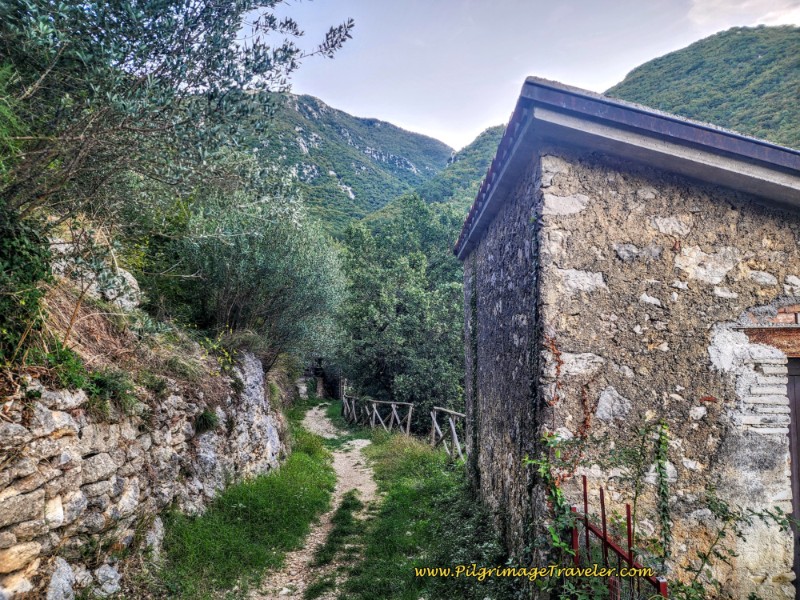 Road Becomes a Trail at the Edge of Town
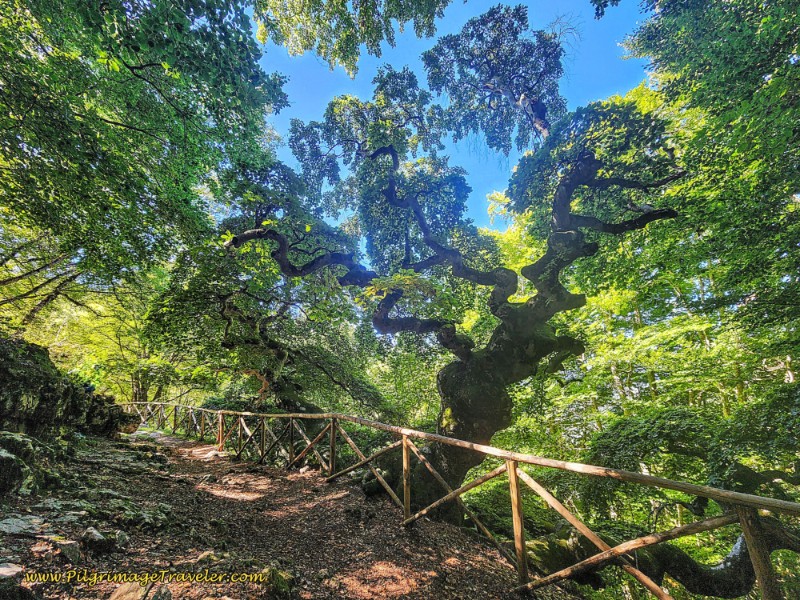
As you can see in the photo above, there is a nice split-rail fence that lines this part of the trail as you head into the forest.
Next, the Way drops down to a drainage and crosses it on a bridge, then takes a large bend to the right. As you walk through this bend, take a last look up at Poggio Bustone and the descent you have made after only one kilometer!
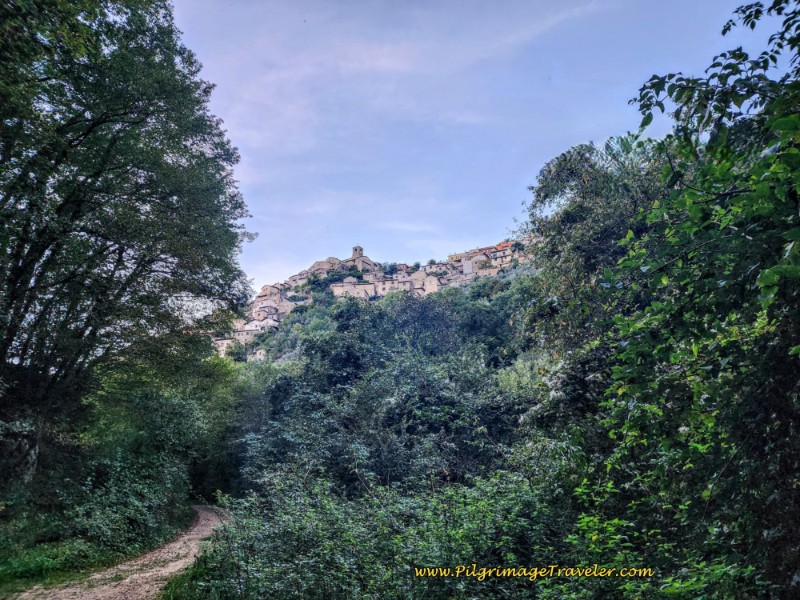 Final Look Back to Poggio Bustone
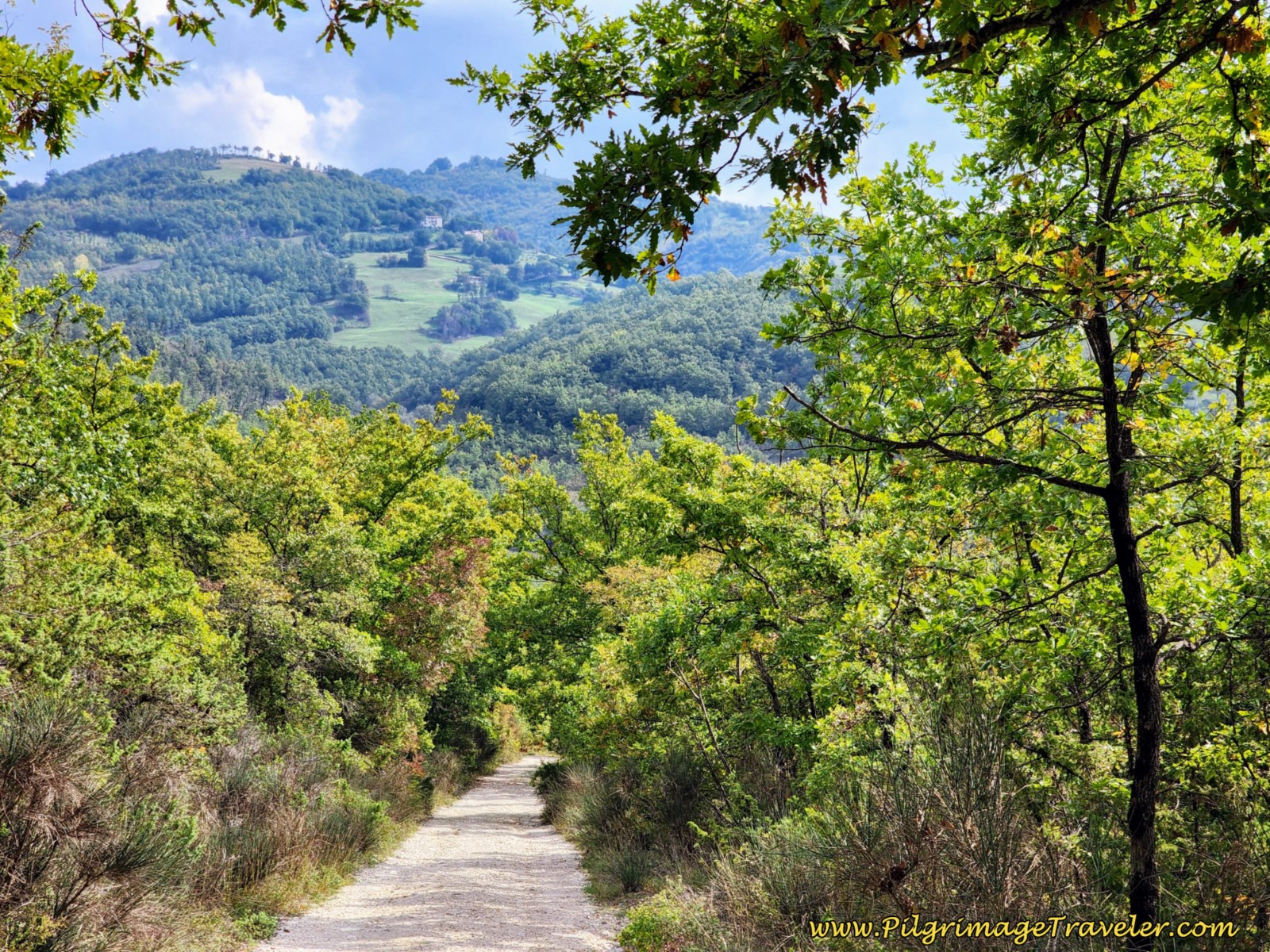
The Way ahead is on a nice wide gravel lane through the forest. The descent also levels off a bit and isn't as steep as the descent from town. The walk on the lane through the forest continues for the next two kilometers.
About 100 meters after the drainage crossing, arrive at a Y-intersection, and stay to the left. The split rail fence appears again for a short distance.
Continue until another gravel road joins from the right, after about 2.5 kilometers total distance from the start, with signage that says San Liberato 1.9 kilometers, the next town, Cantalice 3.7 kilometers and Rieti 14.8. It was going to be an easy day.
Only a few steps beyond this merge, a trail breaks off to the right from the gravel lane. Take it. This is a brief shortcut trail that rejoins the same gravel lane a few meters later.
After just under 3.0 kilometers, the lane comes out of the forest at this T-intersection with a narrow and quiet paved road, below. Turn right here. This is the road that will take you to the next town of San Liberato a bit more than one kilometer down the road.
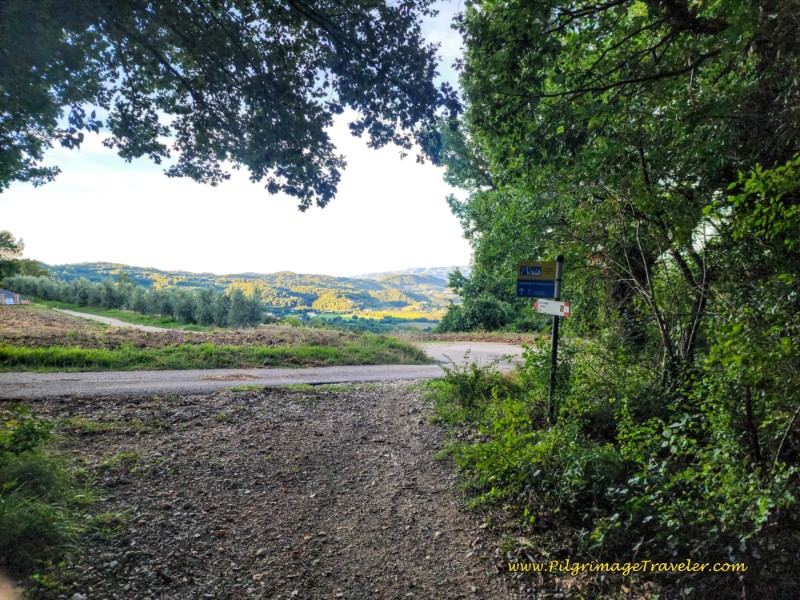 Leave Forest for the Pavement
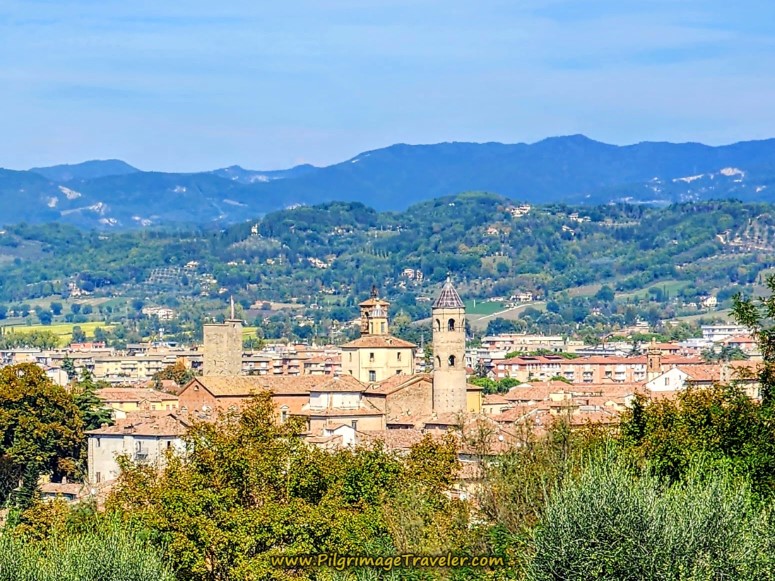
Within a few steps along this paved road, views of the whole of the Rieti Valley unfolds before you.
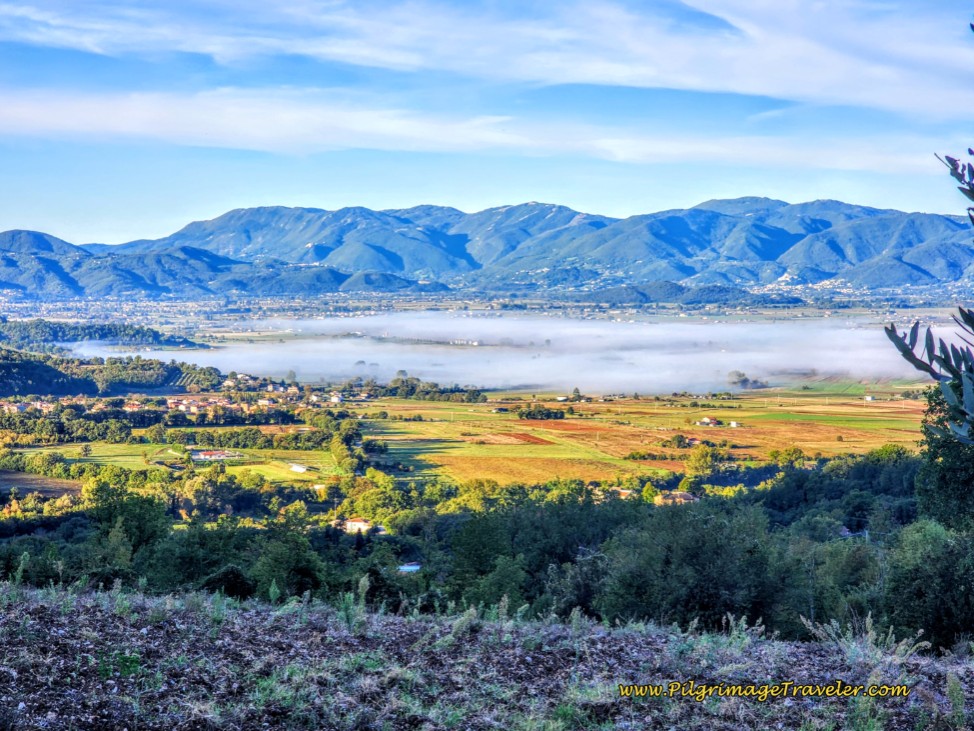 Rieti, Sacred Valley, Way of St. Francis: Poggio Bustone to Rieti
The next town of San Liberato is a long strip of buildings which you will begin to encounter after about 1/2 kilometer along this paved road.
As you approach the center of town, the town church is visible on the small hill ahead, see photo below. And that ridge ahead? It is your next destination!
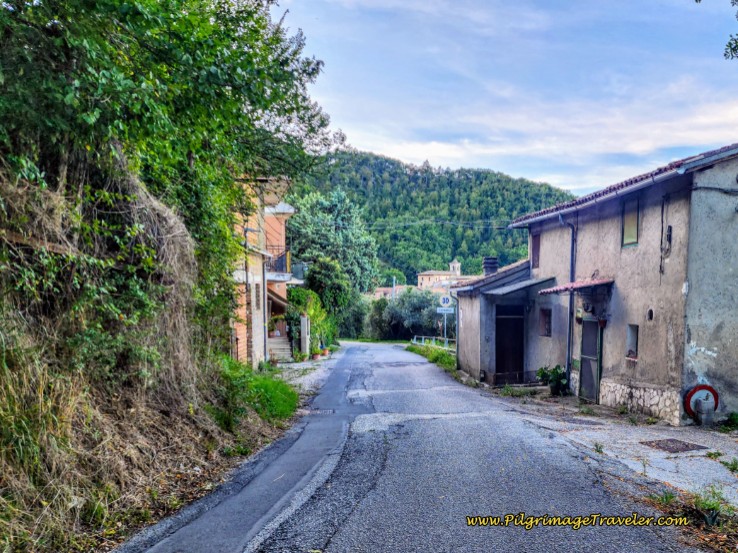 Entering the Town of San Liberato
You will come to the center of town at a nice water fountain on your left and benches to take a rest. The town has no services.
Across from the fountain is a road to the west that leads to the church of San Liberato Martire, the martyred Saint Liberato. It is only a few steps off-route to the right. This church and a nearby hermitage were established by the Benedictines and boasts nine centuries of history. The first settlement of Cantalice grew up here next to the church.
After the water fountain, you will descend a few more meters to the next landmark, a historic grist mill or "Antico Mulino," on your left. There is a water channel along it, and a road leaving the main road, just after the channel to the left.
Take this left at this intersection, followed by an immediate right, onto a narrow paved lane between the white buildings that you see in the next photo. You have accomplished approximately 4.3 kilometers total at this juncture.
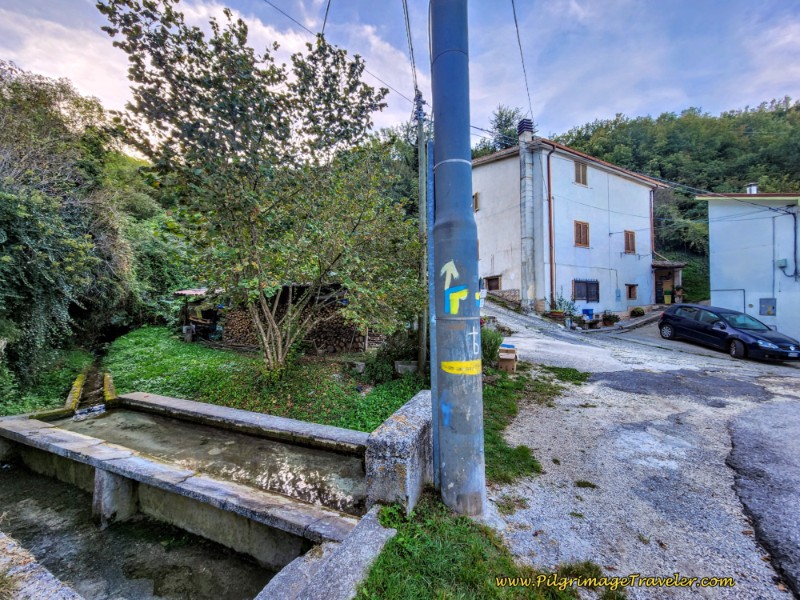 Leave Town on Lane after Mill
The lane immediately becomes a nice path through the woods. The long descent has now ended and you will be climbing the ridge ahead toward Cantalice. It is only about a 100 meter climb over the next 1.5 kilometers.
Climb quite steeply for the first 1/4 kilometer, when you come to this Y-intersection, below. The Way leaves the wider road ascending to the left, and picks up a well-developed path with a split rail fence to the right.
The steepness of the climb eases when you reach this fenceline.
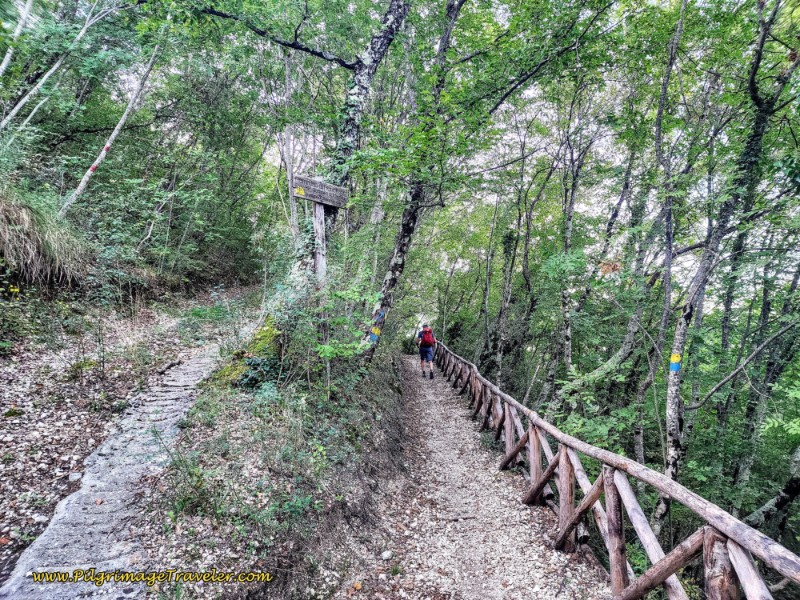 Fork in Road at Split Railing Fence
This high path is quite nice, with gorgeous views towards the valley along the way.
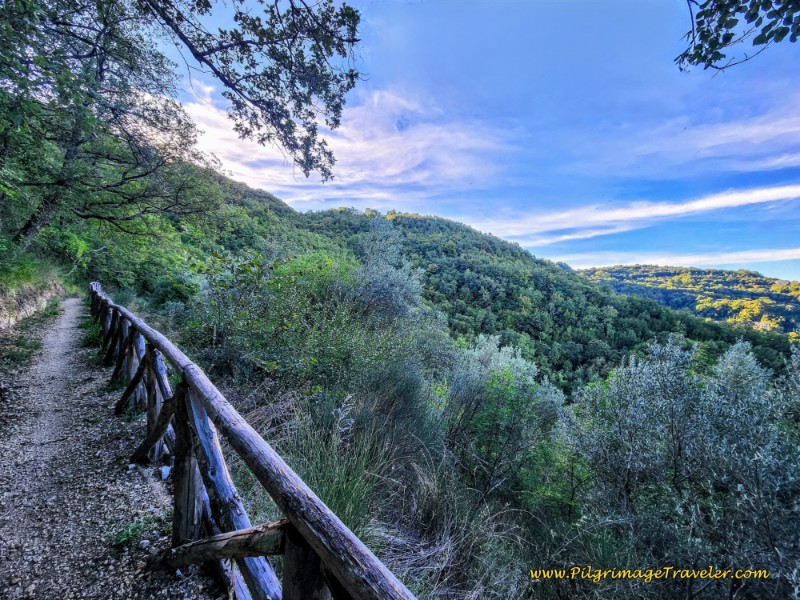 Trail to Cantalice
After 5.0 kilometers, the rail-lined path takes a hairpin turn to the right to cross a drainage as it continues its mild ascent.
About 1/2 kilometer later, after a bend around the ridge, a town becomes visible on the hillside ahead. This is Cantalice!
A few hundred meters later, the path ends at this house shown below, with wonderful gardens. This is the top of the first climb, after 5.75 kilometers from the start.
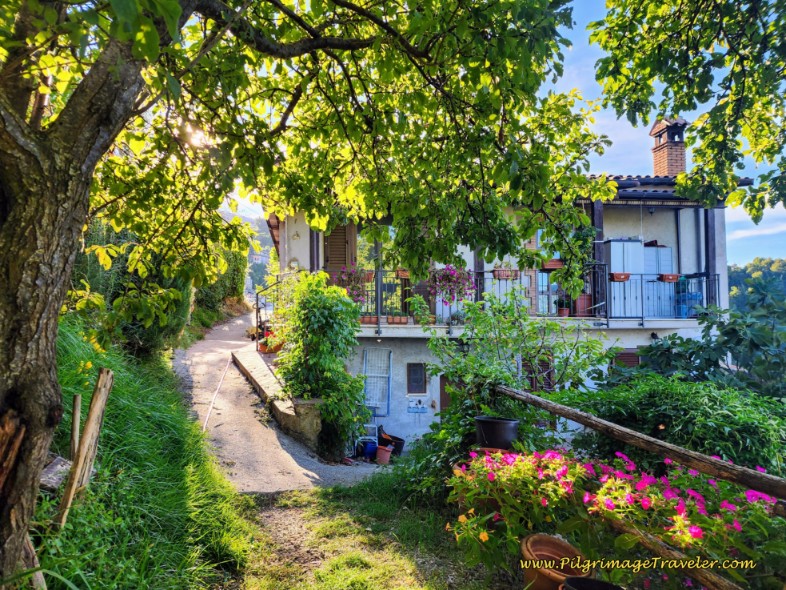 Path Ends at Edge of Cantalice
Join a paved road by the house, the Via Carducci. Follow this road as it winds steeply down the hill. As you descend, you will see fantastic views of the medieval town on the opposite side across the valley.
Unfortunately, the sun was not yet up and over the mountain behind the town, so my photos of the medieval center are very much in the shadows! But I think it still looks impressive!
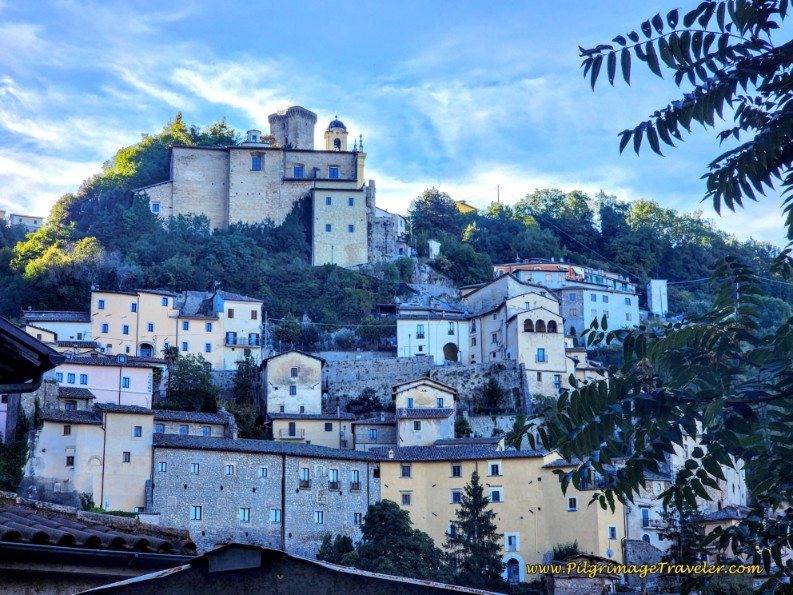 Medieval Cantalice on the Opposite Hill
About 1/3 kilometer later, the descent is over at a T-intersection in the center of town, where the Way turns left and into a large open plaza, the Piazza della Repubblica. There is a bar here at the far end of the plaza if you need one, and the medieval part of town looms overhead. Look upward and see your next destination!
There is another bar down the street a few more meters with an attached alimentari deli shop. This bar is a few steps beyond the turn off for the official route.
There are no accommodations in Cantalice.
From the plaza, continue along the street southward for a few steps and take the first left, up the pedestrian stairway, following the brown sign toward the "Centro Storico," historic center.
You will now be climbing on very steep stairs all the way up to the ruined castle on the top. This short steep climb will take you by three historic churches, through archways and tunnels and under roofs of buildings as it switchbacks and climbs up through town. It is a wonderful medieval step-back-in-time walk!
The first church you will pass after about 150 meters of climbing is the 16th century Chiesa Santa Maria del Popolo, not pictured.
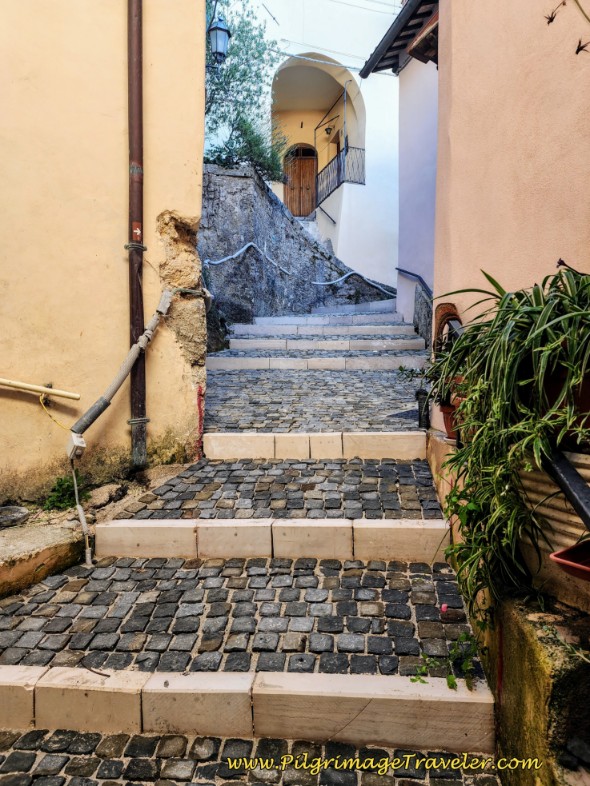 Steps Through Cantalice
Climb higher to the 2nd church honoring the Madonna della Misericordia. Below is a photo looking back down the stairs to this church.
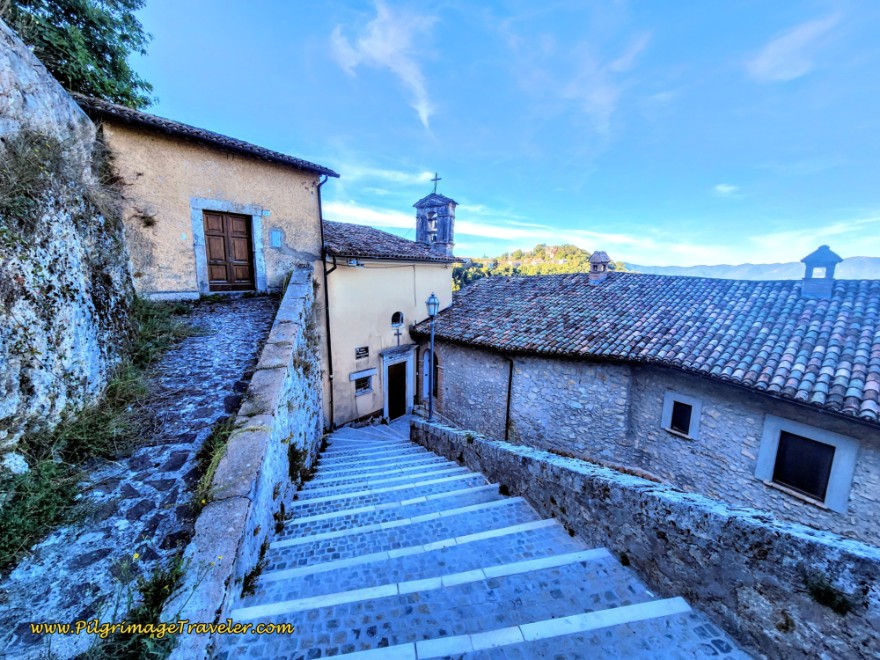 Steps Up from the Madonna della Misericordia Church
After these steps, arrive at a small plaza, the Piazza Antonio D'Angeli, not pictured. Take a breath. You are almost at the top of the climb, with only a few steep stairs remaining.
After only about a total of 1/3 kilometer of stair climbing and 100 meters of total altitude gain, arrive at the plaza of the 18th century, baroque Basilica di San Felice da Cantalice, below, after a total of 6.5 kilometers for the day. The major work of the day is essentially over!
The sign next to the church explains that it was built on the 16th century birthplace of St. Felix, who was the principal saint of the Cappucine order. Unfortunately, the church was closed.
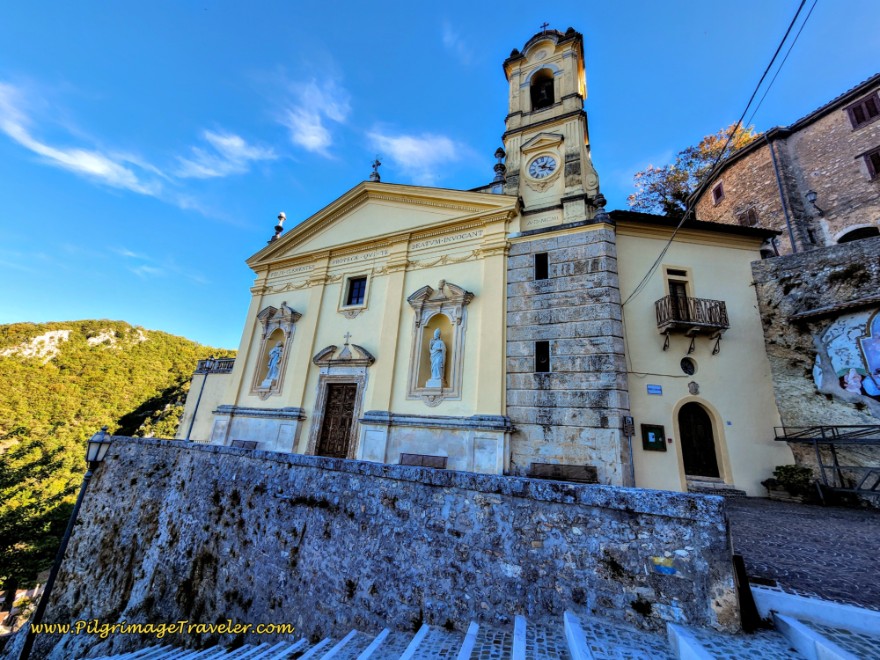 Basilica di San Felice da Cantalice
The plaza is decorated with frescoes, and an ancient fountain, below. And above you, at the very top is the Torrione del Cassero, the watch tower and fortress, dating from the 11th century.
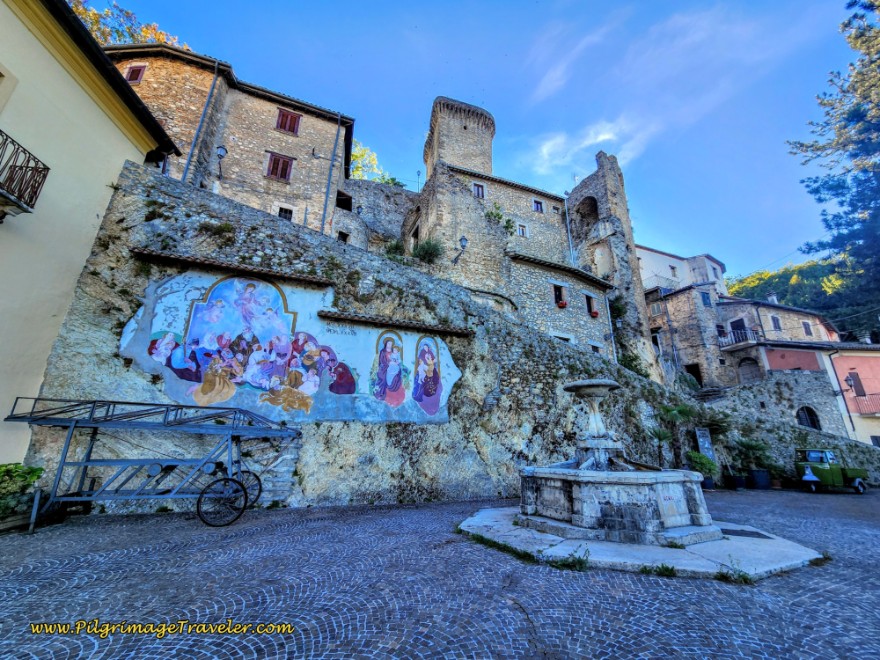 Torrione del Cassero and Ramparts Above
These buildings are literally perched on the side of the mountain! A very dramatic place, with dramatic views. It was too bad there was no real place here to relax and enjoy the view. There are a few benches at least, but no café.
Walk through the plaza and continue onward along the narrow street to where it widens into the Via del Castello. This "castle street" allows you to take in the views one more time as you walk along.
There is no public access to the castle ruins, so there is no reason to attempt a climb to the top for a closer look.
Along Castle Street you will soon encounter a painted red pedestrian walkway. You will also pass by a conveniently located Alimentari if you need food or need to stock your pack.
After the alimentari, come to an intersection by the backside of the Chiesa Madonna della Pace. Turn to the right to continue along the Via del Castello, now lined on both sides with wonderful oak trees.
When the oak trees end a few meters later, look for an ascending, narrow road leaving the Castle street to the left. Take this street called the Via San Gregorio. You will be walking along this high ridge road for the next 1.1 kilometers.
But first, as you make the turn, look back to see a nice view of Cantalice for the last time! I took a photo, but the sun was still not favorable for a terrific shot.
Along the way on this quiet and narrow paved road, after approximately one kilometer, pass a church-turned-museum called the Chiesa di San Gregorio after 8.0 kilometers into day eighteen on the Way of St. Francis from Poggio Bustone to Rieti.
While the museum was not open when we passed, there are many unmissable and interesting signs here explaining the purpose of the church museum. This is a place honoring humanity and how it came together after the tragedy of the Belgian Sabena DC6 airplane crash in 1955.
The plane crashed high on Mt. Terminillo (the high mountain due east of Cantalice) during a winter storm, taking the lives of the entire plane full of 29 passengers. This included the famous actress and beauty icon, Marcella Mariani, "daughter" of Rome and Miss Italy in 1953. The rescue/recovery effort has been memorialized in this church museum. So very sad.
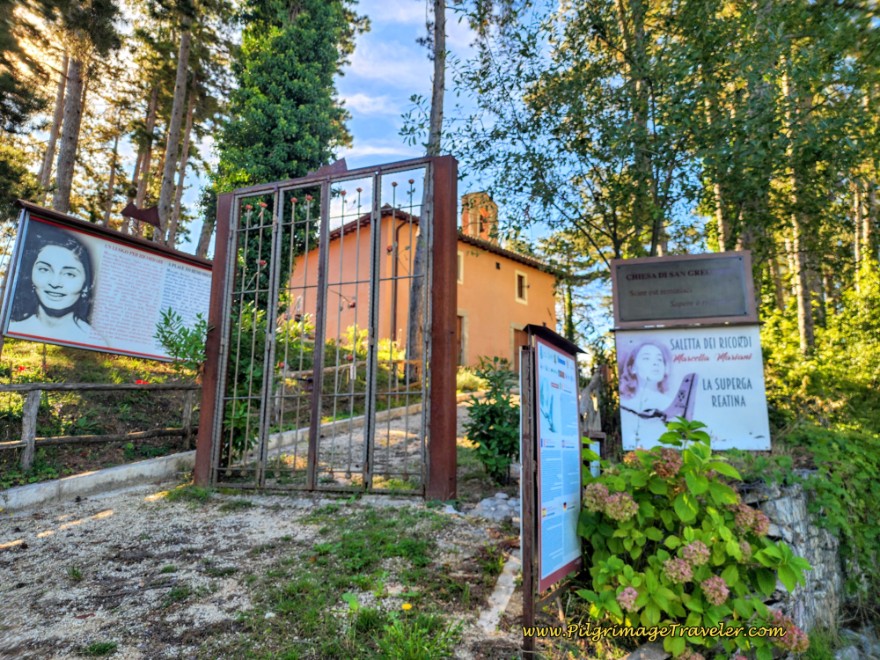 Chiesa di San Gregorio
From the Chiesa di San Gregorio, you are beginning a nice long downhill jaunt over the next 3.3 kilometers.
A few paces after the church museum, come to an intersection and continue straight onward and onto the Via Giovanni Pascoli. There is a water fountain on the right at this intersection.
From here you will remain on the Via G. Pascoli for the next 1.75 kilometers, continuing your high walk along the ridge. As you walk onward, notice the grand views of Poggio Bustone on the slope behind you.
Pass a dilapidated wayside chapel on your left, after about 1/2 kilometer. Pass a water fountain about 400 meters after the wayside chapel, also on your left.
Here is a Way of St. Francis sign with distances on it, stating it is 2.5 kilometers to the Santuario della Foresta, one of the four sanctuaries established in the Rieti valley by St. Francis.
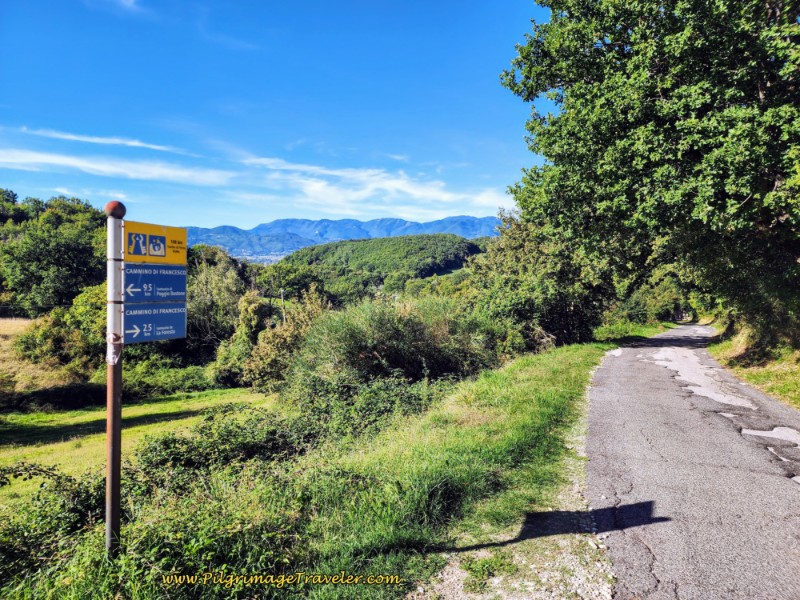 Along the Via Giovanni Pascoli Toward the Santuario della Foresta
But first, come to the Santuario di San Felice all'Acqua a few meters later and about 9.76 kilometers total. Again, this sanctuary was closed when we walked by.
According to legend, at this site, St. Felix performed a miracle when he struck a rock and caused water to spring from the earth, to supply the farmer and the shepherds.
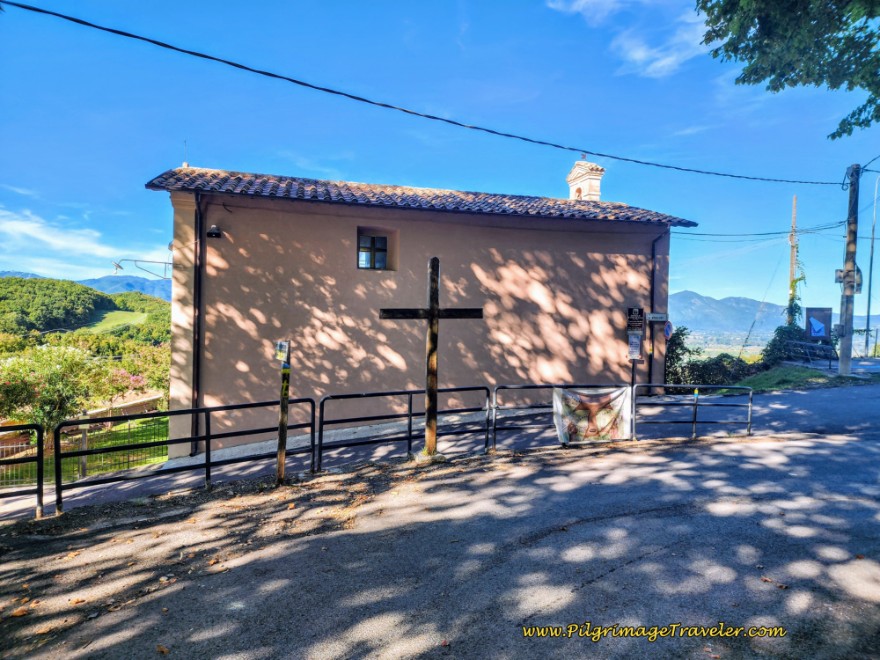 Santuario di San Felice all'Acqua
There are two donation-based pilgrim accommodations next to the Santuario di San Felice all'Acqua, the Ostello San Felice all'Acqua (+39 338 778 2930 and +39 347 086 9032) with seven beds in two rooms and the Casetta Mariani, (+39 349 463 9384) with 12 beds in four rooms. Please give them advanced notice if you plan to stay here. This is in the middle of nowhere!
There are public restrooms in a separate building by the church for you to take advantage if needed!
About 200 meters after the San Felice sanctuary, and after a large hairpin turn, you will come to a Y-intersection, and the Way leaves the Via G. Pascoli by taking the left option.
The next 2.2 kilometers to the Santuario della Foresta will be essentially along cool forest lanes that are quite steep to descend upon. Take great care here if it is wet or raining!
Walk about 1.2 kilometers through the forest until you see an opening ahead. Just before the forest lane ends at an intersection, pass by an accommodation called Il Rifugio nel Bosco on the right, after about 11.2 kilometers total for the day. You are now at the bottom of the long downhill at this place.
Walk past the rifugio and take a left at the intersection with the Via Acquamartina, following the signs toward La Foresta.
It is about 1/4 kilometer that you will walk along this road, next to a small creek. Then you will turn right onto the signposted Via Torre Chiavelloni, below, and cross the creek on a bridge.
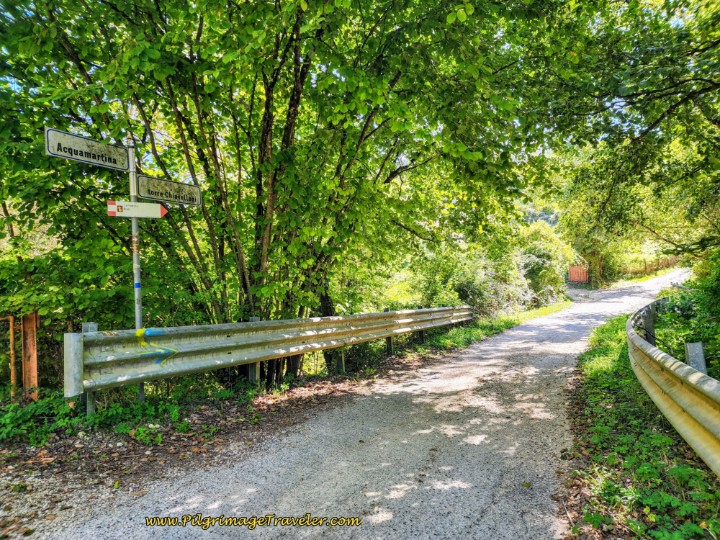 Cross Bridge on the Via Torre Chiavelloni
Only a few steps later, turn right onto another forest lane, the appropriately named Via Foresta. You are now about to complete the final climb of the day, up to the Santurario della Foresta. It is only 3/4 kilometer away and an ascent of less than 100 meters.
The forest lane is steep enough that you will encounter sections of corrugated concrete to help you with your footing.
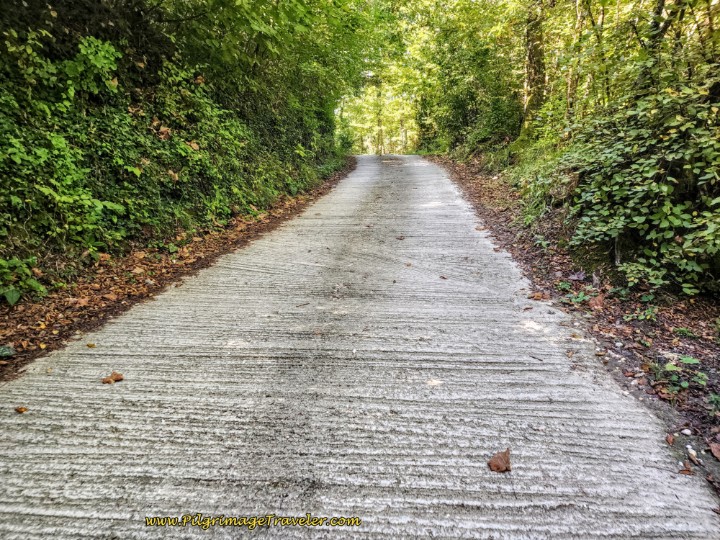 Corrugated Concrete Along the Via Foresta
After about 450 meters, you will leave the Via Foresta to the right, for a more rugged path into the woods, see next photo. This will be a rockier and steeper path for the final meters to the sanctuary.
Notice there are two paths. Take the one farthest to the right.
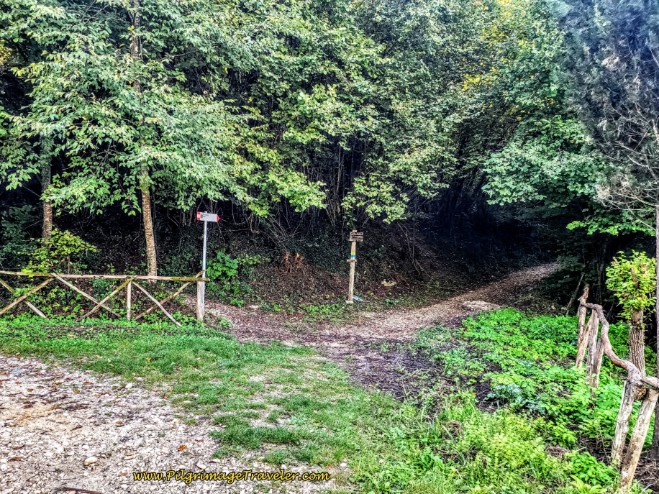 Leave the Via Foresta for Path
You are almost there when you pass a water fountain and a covered bench across from it.
And then the stairway to the sanctuary appears to aid you on your final steps to the top.
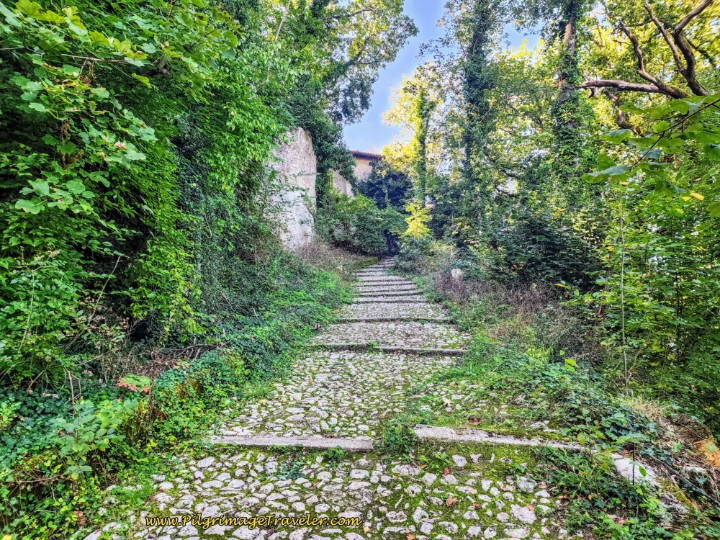 Stairway to the Santuario della Foresta
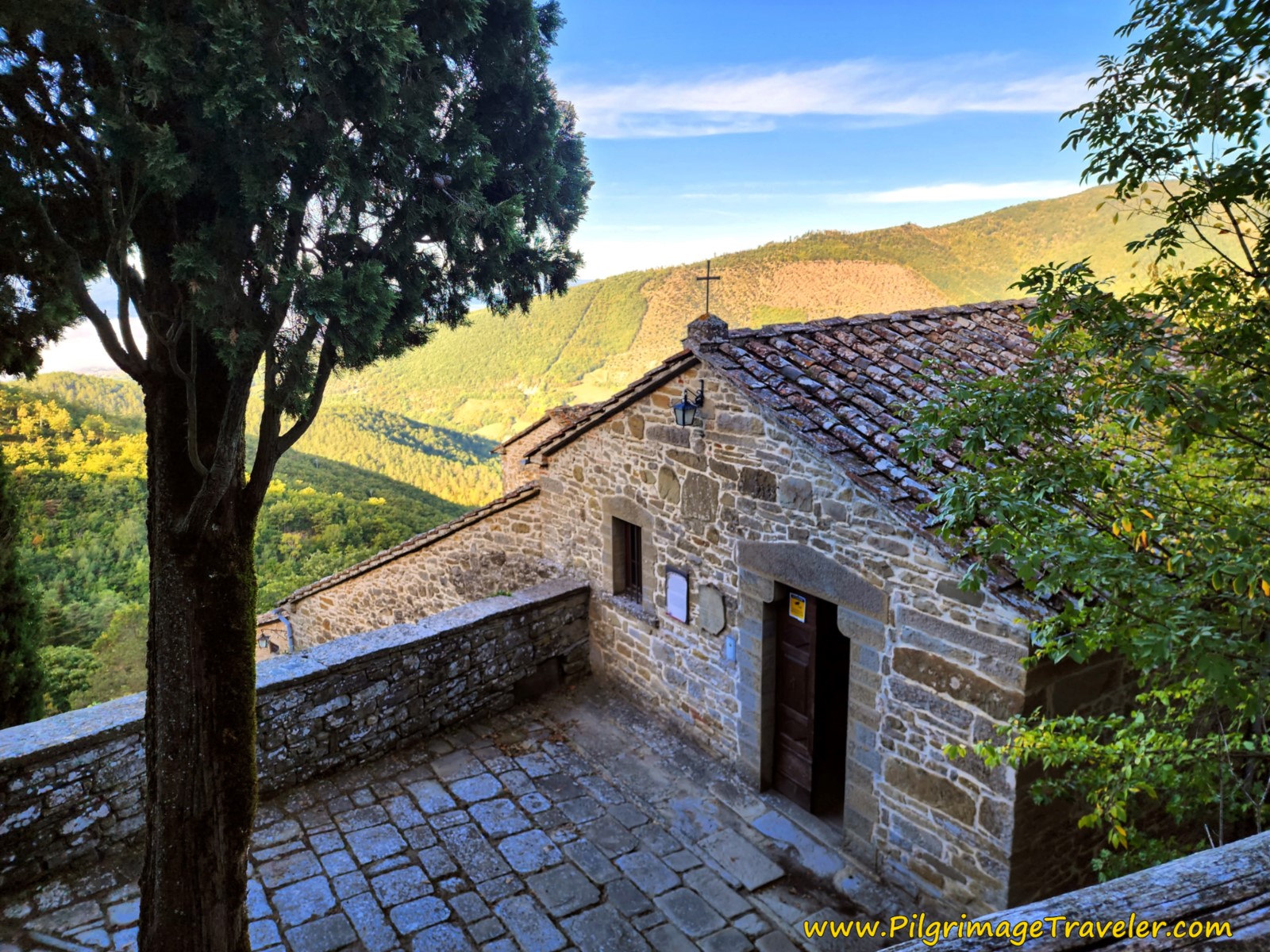
After 12.2 kilometers, reach the summit of the climb and the Santuario della Foresta, shown below. The sanctuary has 5 bedrooms for pilgrims (+39 0746 200727 or +39 0746 210125), on a donation-basis if you wish to stay here.
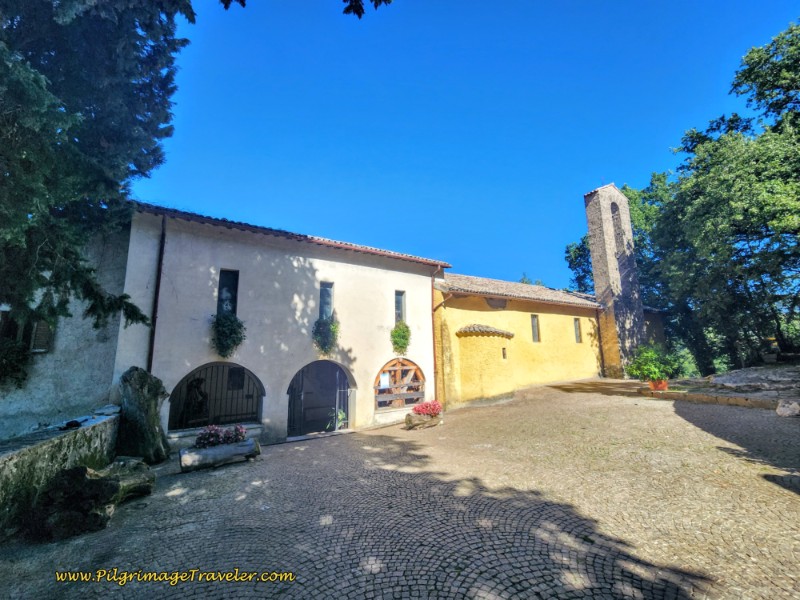 Santuario della Foresta, Way of St. Francis: Poggio Bustone to Rieti
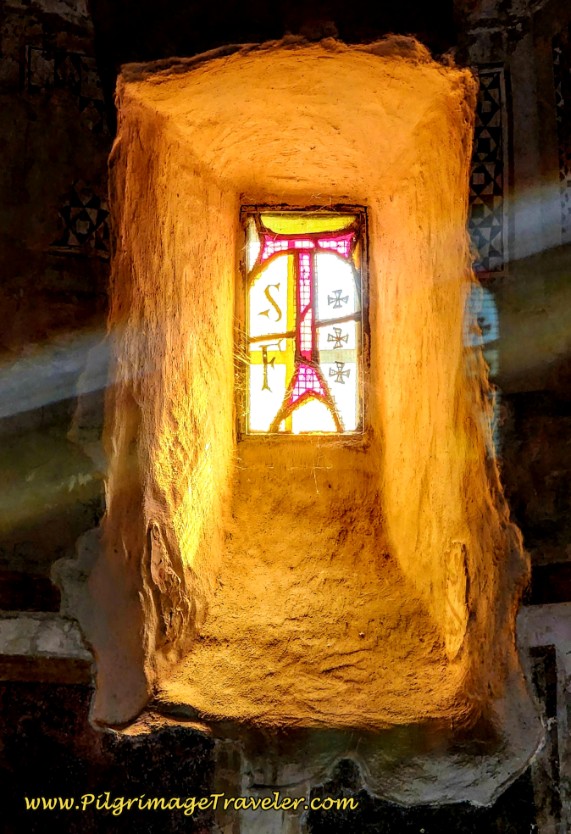 Stained Glass Tau
The structure itself is not that impressive and neither is the interior of the chapel. It is the location and the grounds that are inspiring, for me at least. Not to mention the history.
There was one small stained-glass window that caught my eye, with the simple yet striking Tau and the SF. The light streaming through it was gorgeous!
With only about five kilometers left to go, we spent time on the grounds, having a serene lunch by this sculpture, below, of St. Francis preaching.
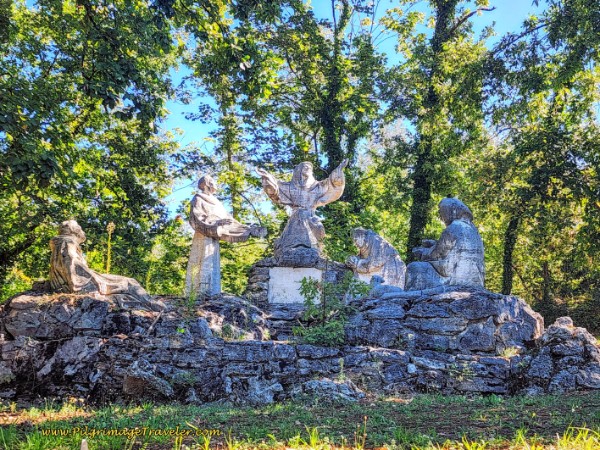 Sculpture of St. Francis Preaching
And then it was time to move on. We walked down the incredible tree-lined lane in front of the complex, and picked up the Via Foresta once again.
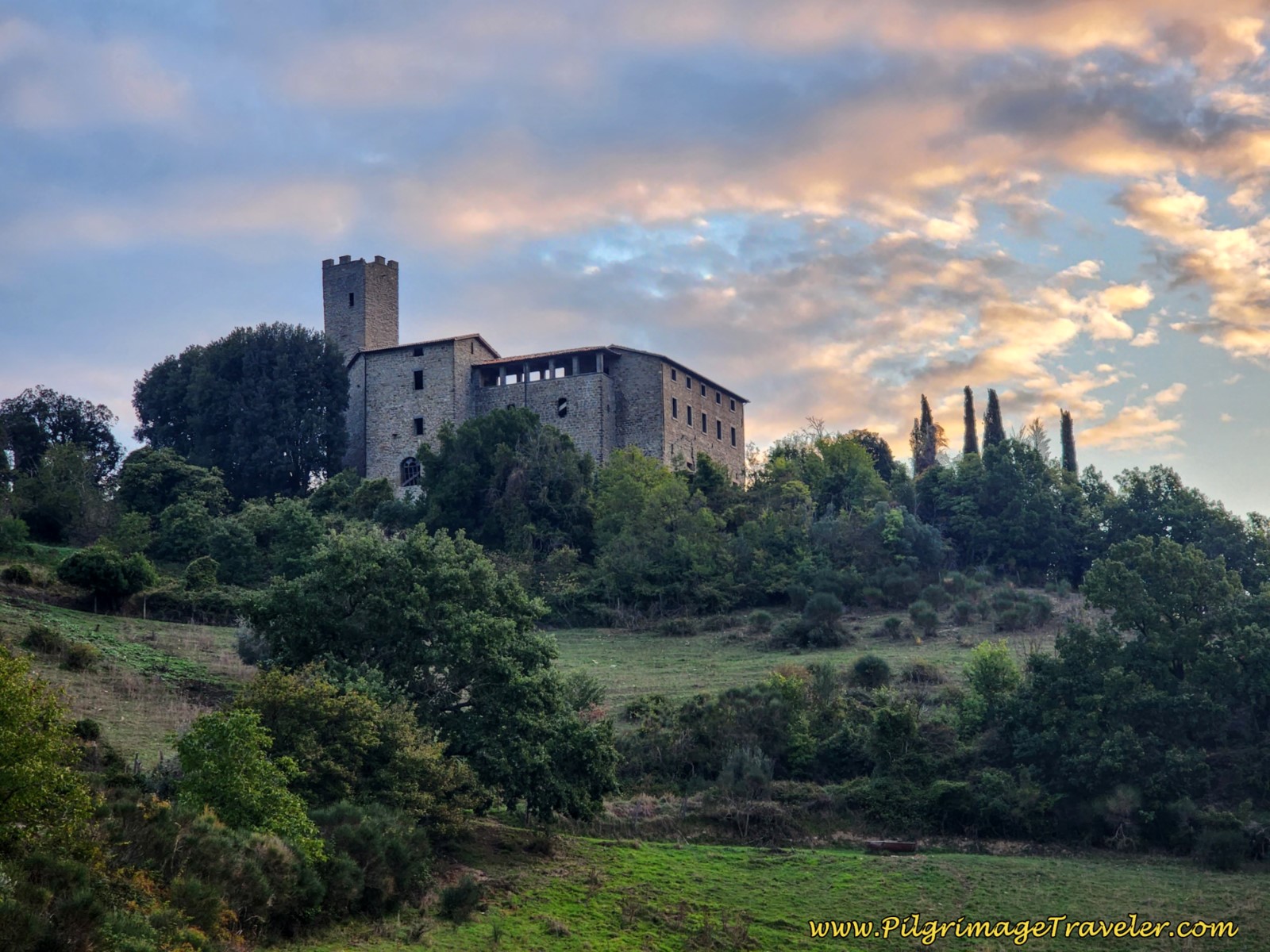
The paved road makes a long bend to the right, circling a small valley. As we walked on the other side of the valley, the views of the Santuario were more impressive from this side, below. You can see the whole structure and its impressive gardens and a mountain view as well.
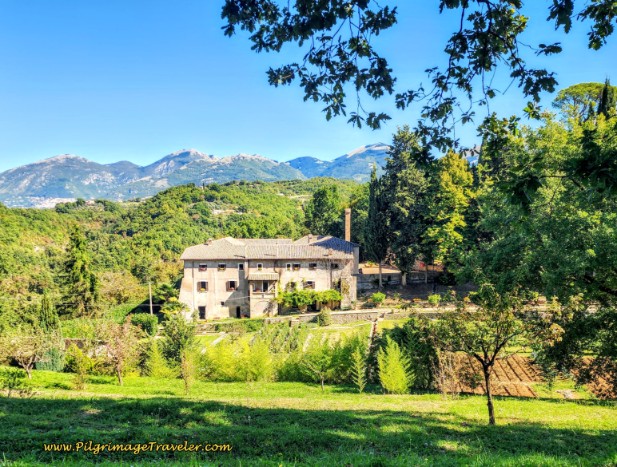 Leaving the Santuario della Foresta
You will now descend along the Via Foresta for the next three kilometers, except for a 1/2 kilometer shortcut, all the way into the outskirts of Rieti.
There is a separate walkway along the Via Foresta, for some of the way. And you will get amazing views of the urban sprawl of Rieti. I didn't realize it was such a big place!
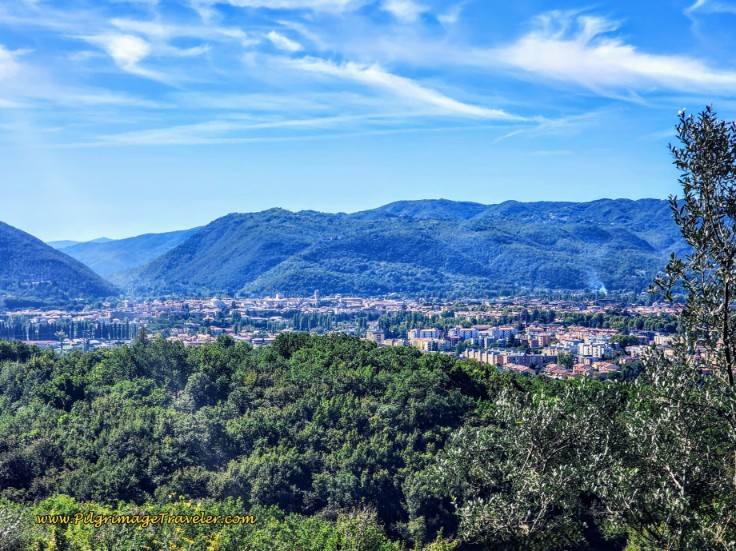 Views of Rieti Along the Via Foresta
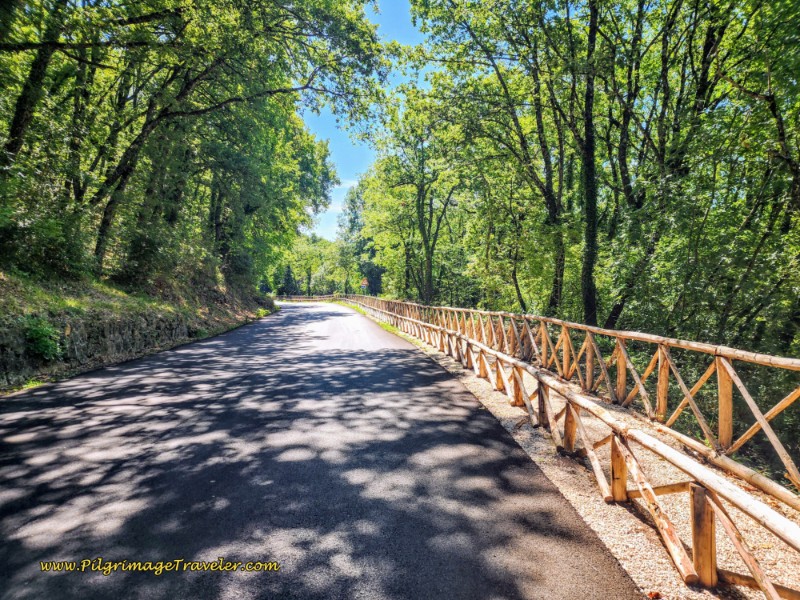 Pedestrian Way Along the Via Foresta
There are some sections of this pedestrian way that are taped off, preventing entry. In places, this path along the steeper sections are eroding and have been deemed unsafe.
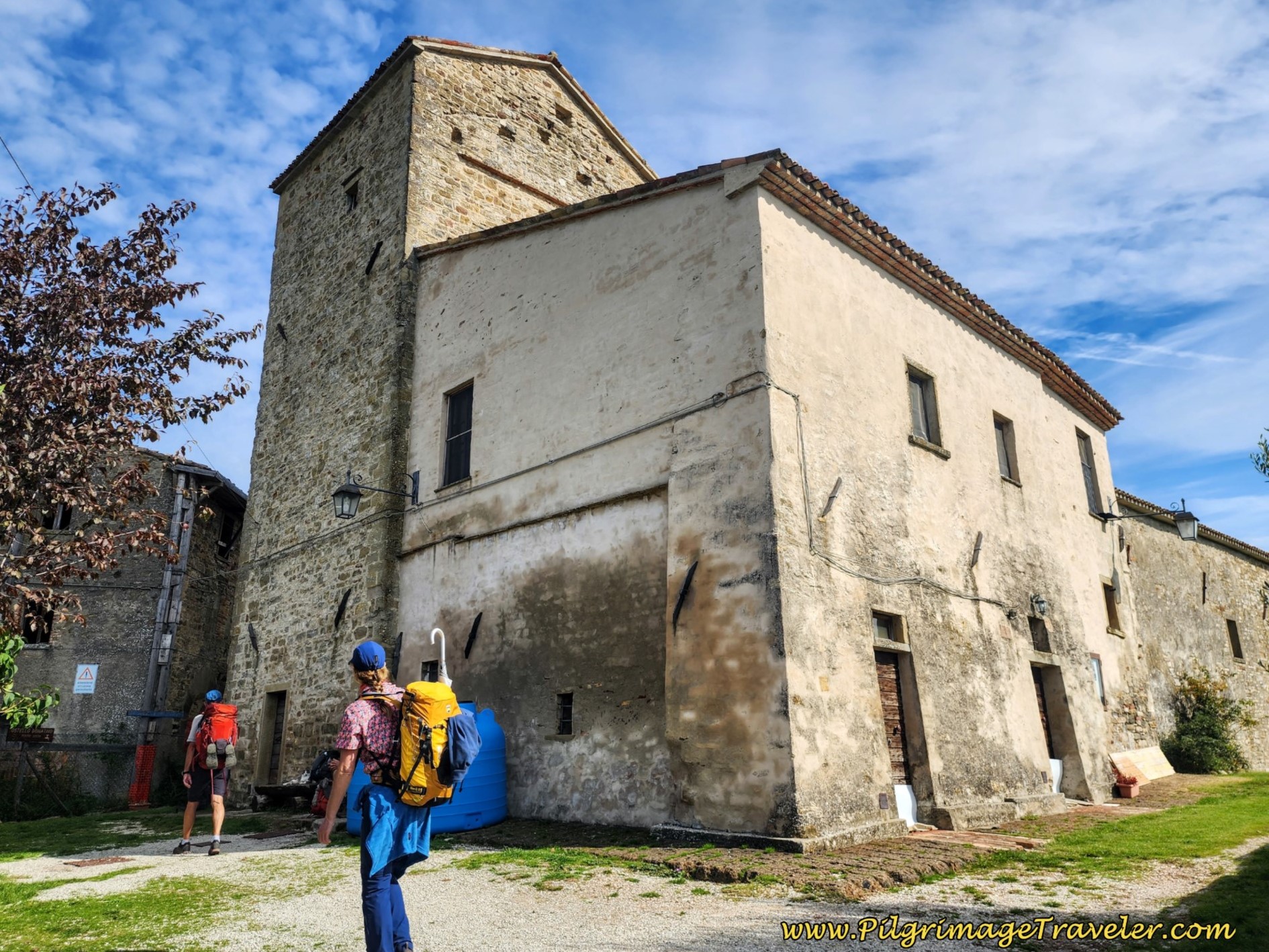
After about 1.1 kilometers along the Via Foresta and 13.6 total kilometers, you may notice a sign on a pole that appears to be a waymark for the Via di Francesco, signaling a turn to the left, see photo below, and onto a steeply descending path. This is not the way to go, but is the Way of St. Benedict, a different pilgrimage route. That is the meaning of the sideways "tb" lettering you see on the pole. You can also recognize this intersection by the curved yellow gate on the house just beyond the turn.
We were almost fooled into turning here, when two cyclists came by and turned as we were considering what to do!
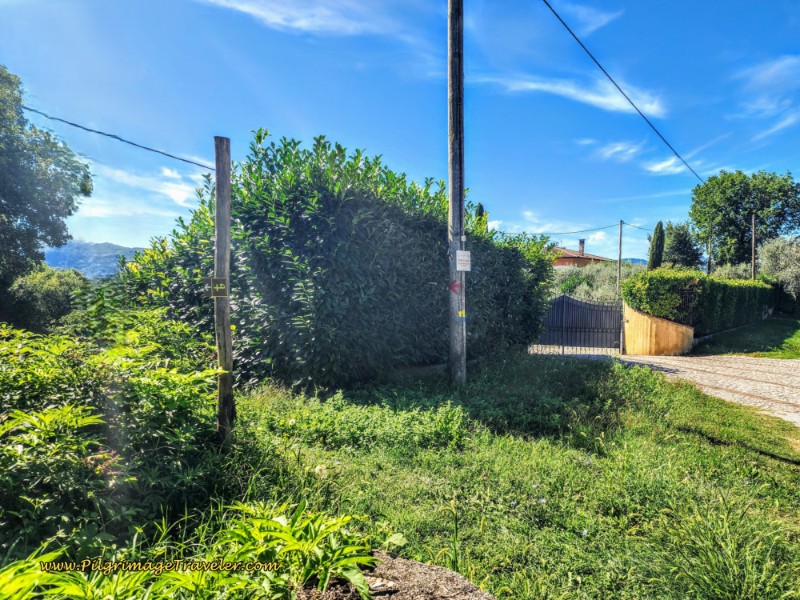 Turn Off for the Way of St. Benedict
Instead, stay on the Via Foresta for about another 1/2 kilometer, along the continuing pedestrian way with split-rail fencing on each side, seen below.
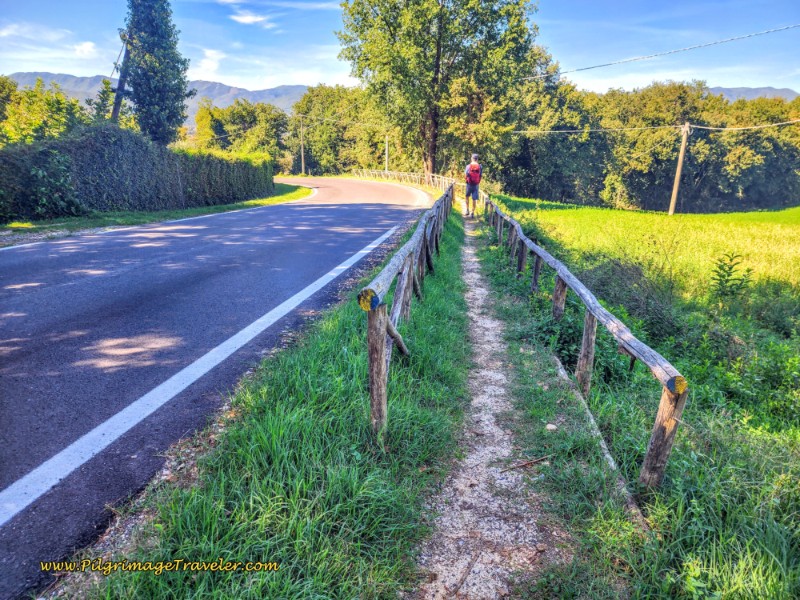 Continue Along the Via Foresta on Pedestrian Path
When this split railing ends, look for the next turn to the right, onto a paved road that soon turns to gravel. This is the 1/2 kilometer short cut, away from the bending Via Foresta.
In the past, the route stayed along the Via Foresta, and you could still easily continue this way. However the shortcut will shave off a few meters and is more pleasant than walking along the road.
After a few meters walking on the shortcut, you will come to a striped road barrier. Walk through this gate and continue as the road becomes more of a path and takes you through your final forested area for the day.
After the full 1/2 kilometer, rejoin the Via Foresta by turning right.
Very quickly after the turn the first buildings appear and you are entering the northern fringe of Rieti.
By 15.2 kilometers into the stage, arrive at a very large roundabout. Stay to the left and continue straight through.
Almost immediately after this first roundabout and after about 15.4 kilometers total, come to a second and smaller roundabout, shown below. There is still at least two kilometers left of urban walking.
We had difficulty finding any waymarking at this second roundabout intersection. If you look carefully, there is a yellow and blue painted waymark on a pole on the left side at the southeast corner. There is also a tb, Way of St. Benedict sticker on the opposite side across the street, on the south east corner. These waymarks are on each side of the only cars in the photo below.
I checked my GPS tracks and the way to go, according to the official Italian Via di Francesco is to the right at the roundabout, picking up the Viale Giulio de Juliis, a busy, divided highway.
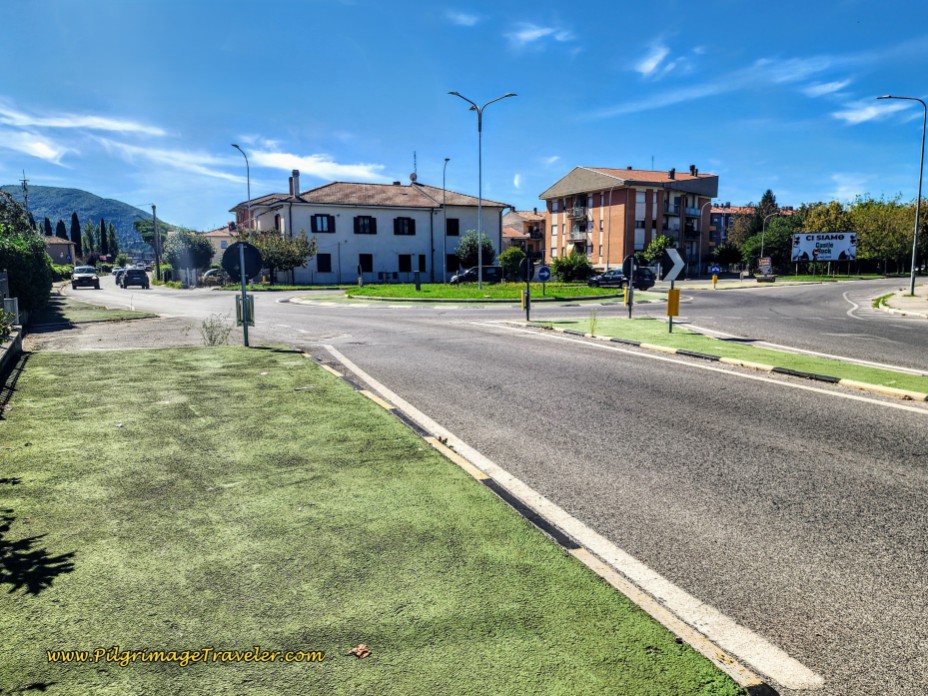 Decision Point at Roundabout
However, if you were to continue straight through the roundabout and stay southward, this "alternative" is officially waymarked!
The pilgrimage trails are always changing it seems, and when I checked the GPS tracks from other sources, many use the "official" route I have in blue, and still others use the now-waymarked "alternative" in red.
I actually saw no waymarks on the blue route, so it is my opinion that the red route may just be the official one now.
The alternative red route is about 400 meters shorter than the blue route. It may be the better choice, since you will walk through a quieter part of the northern side of the city. Farther along, this route also walks by the medieval wall for 1/4 kilometer, which is nice and once in the center, walks through four major plazas, the Piazza Giuseppe Mazzine with a historic church, the Piazza Guglielmo Oberdan and the main square of Piazza Vittorio Emanuele II and ending in the Piazza Cesare Battisti by the Duomo, the Cattedrale di Santa Maria Assunta.
You have an important decision to make at this second roundabout! I will describe both routes below, and you can make your own educated choice.
Standard, Older Route into Central Rieti
After turning right at the roundabout, continue along the busy Viale Giulio de Juliis, staying on the left side (my recommendation) for about 3/4 kilometer, where you will turn left at the next (first) roundabout.
There is a large gas station on this corner on the south side, which you can cut through to shave off a few steps, still staying on the left side of the street.
You are now walking along the more pleasant and less busy Viale Emilio Maraini, below, bordered by parks and lined with stately oak trees for most of the way.
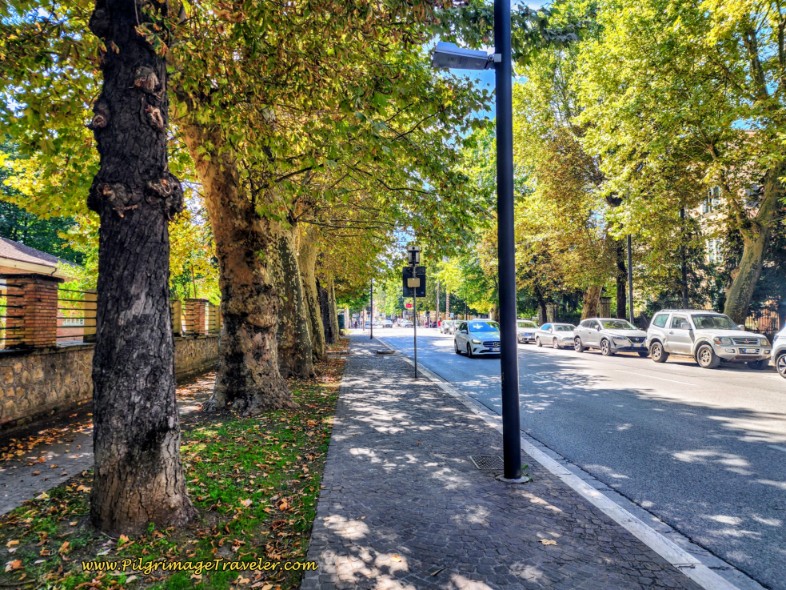 Viale Emilio Maraini Lined with Oak Trees
Within a few meters, pass the Supermercato Tigre, conveniently located if you are planning to cook any meals in Rieti. There are many other services along this stretch if you need anything.
After not quite one kilometer, cross a set of railroad tracks. About 150 later, arrive at a large roundabout with a fountain in the center, and notice the impressive medieval wall across the street.
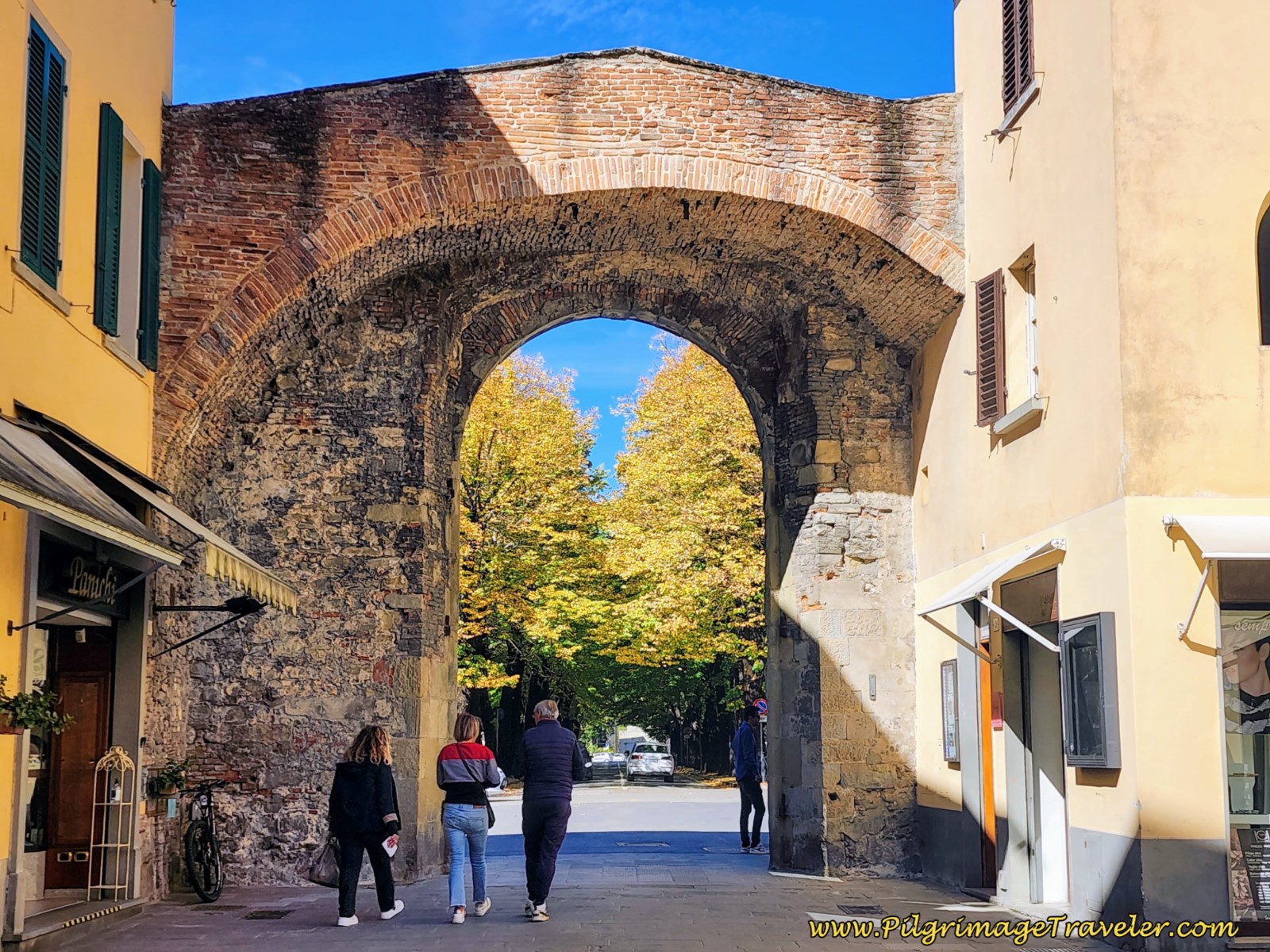
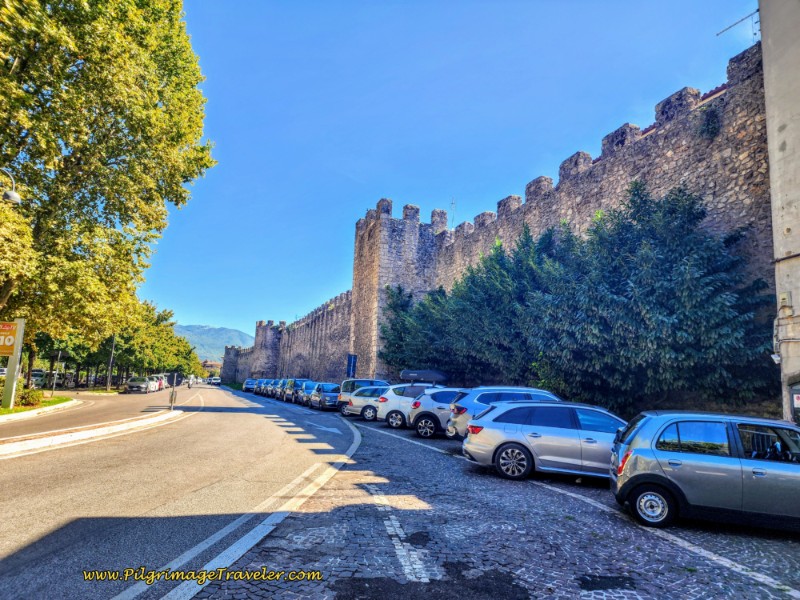 Dramatic Medieval Walls of Rieti
Carry on straight through the roundabout following the sign toward the "Centro." You are now walking into the heart of the city by taking the Via Cintia.
You will walk only a few more steps along the Via Cintia as it bends to the left, and walks up the hill to the Duomo, the Cattedrale di Santa Maria Assunta.
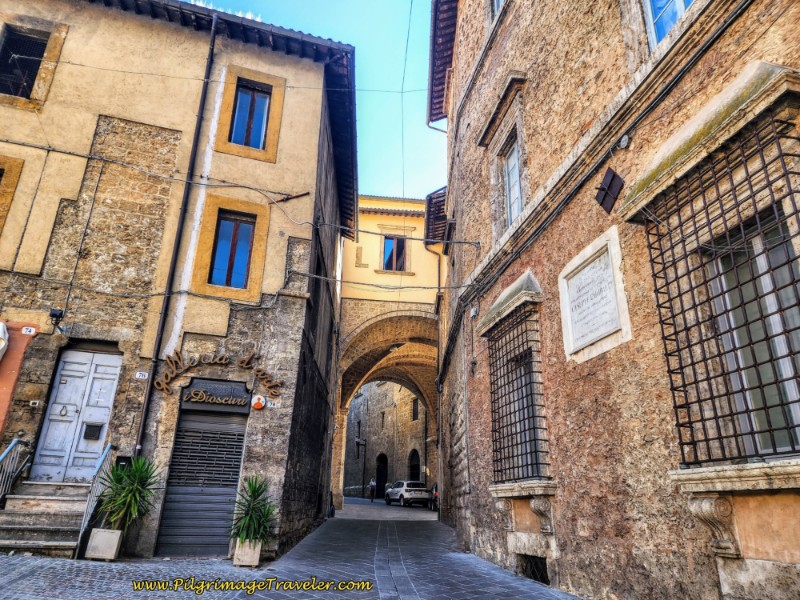 Along the Charming Via Cintia, Way of St. Francis: Poggio Bustone to Rieti
This charming street is filled with medieval architecture, like the double archways, below.
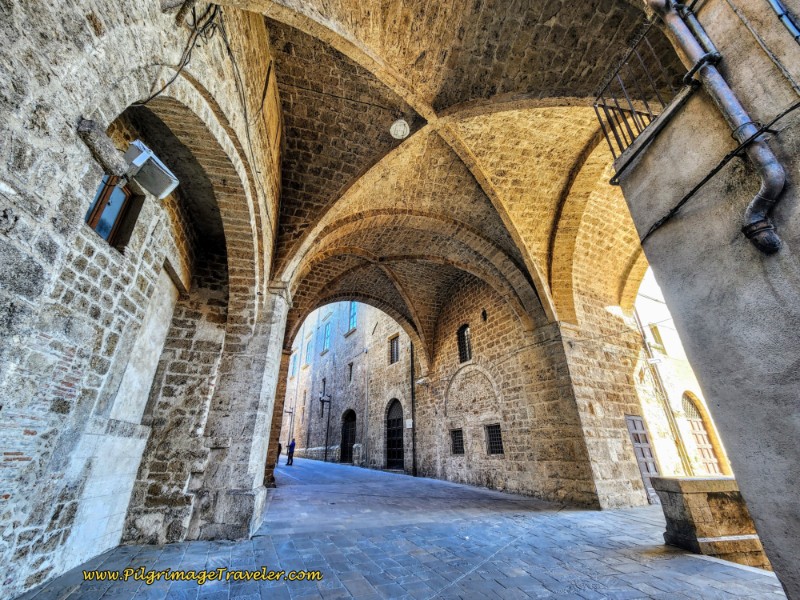 Double Archways of the Via Cintia
Just before reaching the destination, pass by the 13th century Palazzo Papale, the former palace residence of several Popes in Rieti during medieval times. It is now a museum.
And connected to the Papal Palace is the crown jewel of Rieti and its duomo, the Cattedrale di Santa Maria Assunta. The cathedral is in the Piazza Cesare Battisti, at the end of this stage.
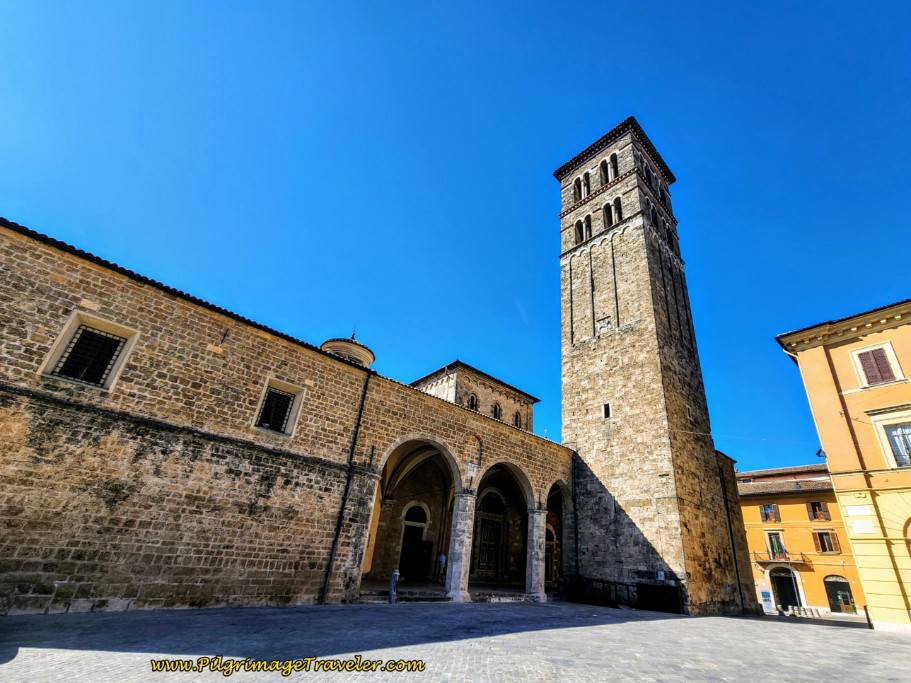 Cattedrale di Santa Maria Assunta
Alternative, Waymarked Route to Central Rieti in Red
If you make the decision to continue straight at the second roundabout described above, along the Via Angelo Maria Ricci, you will walk south for the next 1/3 kilometer. When you see a cemetery entrance on your left (think cypress trees and crosses on the gate), look across to the other side of the road for a Way of St. Francis sign, pointing to the right to continue along the Via Angelo Maria Ricci.
After the right turn, continue walking south for the next 2/3 kilometer, staying to the left at a Y-intersection, crossing a one-lane street, and coming to railroad tracks. Cross the railroad tracks and one block later you will arrive at a T-intersection with the Viale Tommaso Morroni and the medieval wall of Rieti, below. Turn right.
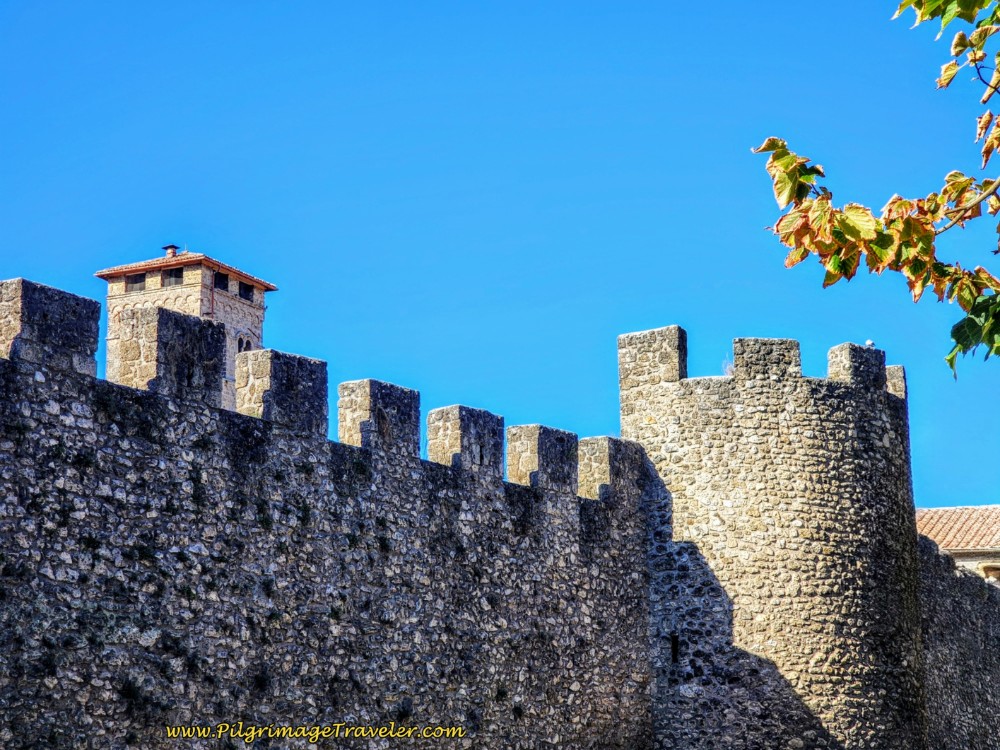 Viale Tommaso Morroni Along the Medieval Wall
Continue walking next to the medieval wall along the Viale Tommaso Morroni for less than 1/3 kilometer, passing a Carrefour supermarket on the right. You will come to one of the main plazas in Rieti, the Piazza Giuseppe Mazzini. You will immediately know the plaza when you see this WWI war memorial sculpture, the Monumento ai Caduti, below.
They were having some sort of interesting flea market in the plaza when we arrived here!
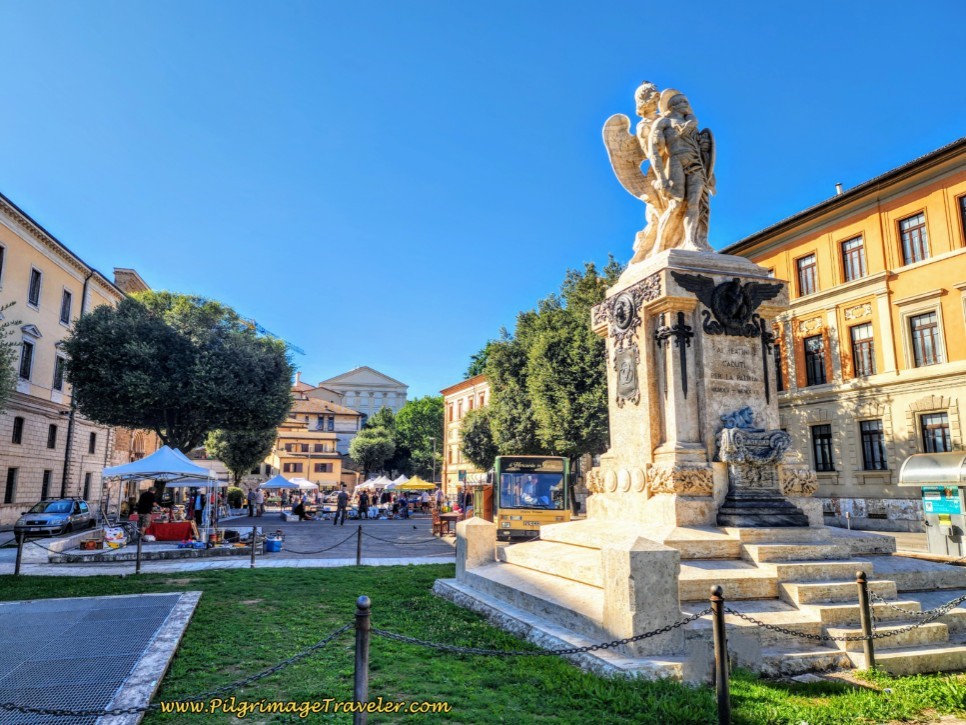 Piazza Giuseppe Mazzini, Way of St. Francis: Poggio Bustone to Rieti
Cross the street and turn left into the plaza, and walk south through it, passing the town hall on your right and educational buildings.
On the far end, pause at the Basilica di Sant'Agostino, a 13th-century Gothic-Romanesque style church, featuring 14-16th century medieval frescoes. The exterior is plain and simple, but the beautiful mosaic over the doorway will catch your eye!
Unfortunately, we did not see the interior frescoes, as the basilica was closed during our visit.
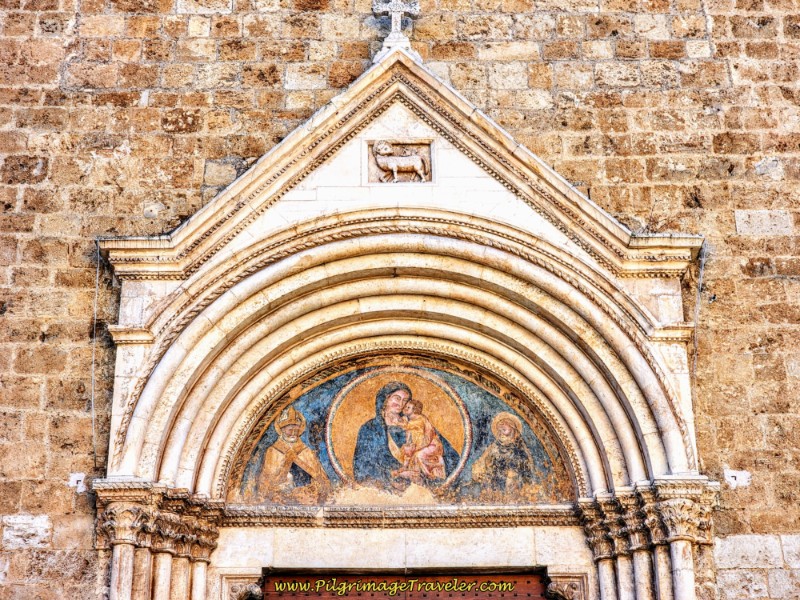 Basilica di Sant'Agostino Doorway Mosaic
Staying to the right of the main plaza, notice that it connects with another plaza, the Piazza Guglielmo Oberdan. This is more of a park-like plaza with a wonderful cluster of trees.
You can either walk diagonally across this park, or head straight south toward the imposing Teatro Comunale "Flavio Vespasiano," Rieti's historic theater, not pictured. There is an interesting criss-crossing pedestrian ramp up to this theater.
After turning to the right in front of the theater, join the Via Pescheria on the far corner by the wonderful-looking Hotel Miramonti.
Walk two blocks to a T-intersection and turn left onto the Via Pennina.
Walk another block up the hill and into the Piazza Vittorio Emanuele II and its distinctive fountain, the Fontana dei Delfini, pictured below.
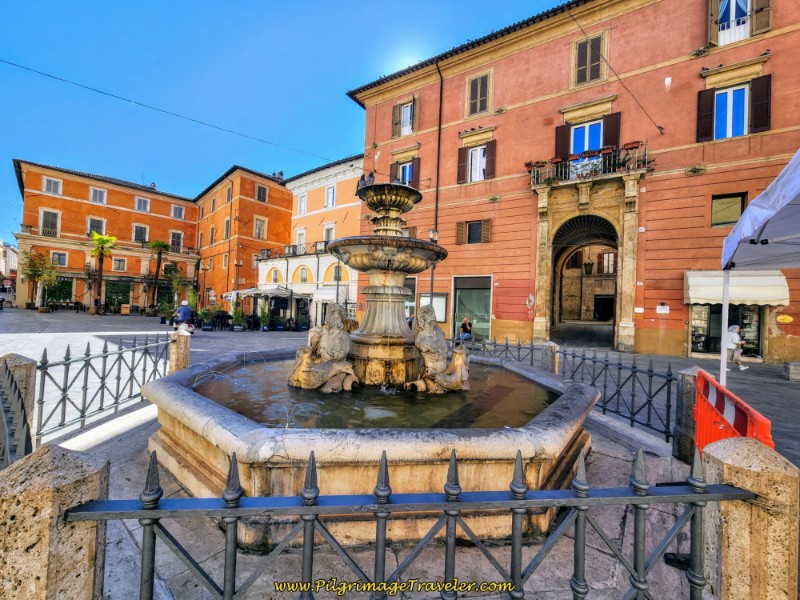 Piazza Vittorio Manuele II and Fountain
Turn right at the fountain and immediately enter the next piazza, the Piazza Cesare Battisti.
You have the choice now to go either straight and around the restaurant in the center of the plaza or to the left, and around, to the end of the stage, arriving at the Cattedrale di Santa Maria Assunta on the other side.
This cathedral, initially built in the 12th century and mostly in the Romanesque style, has had many renovations over the centuries, including the current one after the earthquake of 2016.
For more information on the cathedral, see my article on Rieti, Italy. I leave you with a close-up of the iconic 13th century Romanesque bell tower, 39 meters tall and featuring two levels of paired mullioned windows (two-light windows separated by a column) that open into the bell chamber.
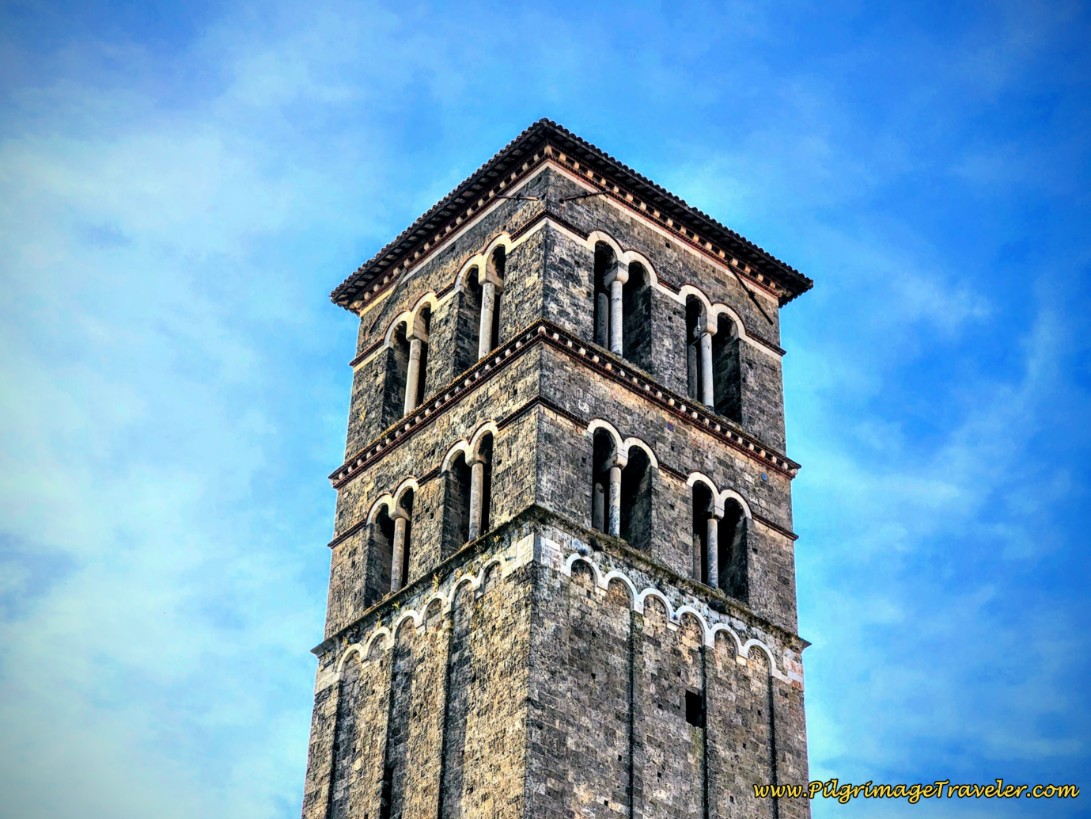 Bell Tower, Cattedrale di Santa Maria Assunta
We walked to our accommodation, the ultra pilgrim-friendly and economical La Terrazza Fiorita in the center of town, a mere stone's throw from the cathedral. Rita, an author and tour guide, who speaks perfect English will ensure your every need is met. They have a kitchen where you can cook, and breakfast is included. I highly recommend you stay here.
Rita guides subterranean tours of Rieti, called "Rieti Underground," Rieti Sotterranea. The engineering history of this town is fascinating, with underground remnants of the Roman viaduct built to prevent the Via Salaria, the ancient salt road, from becoming silted up. I would highly recommend taking this tour if you spend any additional time here. See my article on Rieti,Italy for photos and more information.
Of course there are many more places to stay in Rieti. According to my research, here are some of the more economical ones to try, (but none as economical as La Terrazza Fiorita): Clarissa Guest House, in the center, the Hotel Miramonti, mentioned above, which you pass by as you walk in and Il Capitello, steps from the cathedral.
Or you can always do a search on Rieti on Booking.com to see what deals are current. Make sure you sort by price to see the offers.
Reflections, The Way of St. Francis, Poggio Bustone to Rieti
This shorter day went without a glitch. It was nice to relax and take it easier than many other days along the Via di Francesco. As St. Francis says, "simple joys are holy."
Pausing and connecting to his spirit, through the simplicity of the pilgrimage walk itself, enjoying a picnic at the Foresta Sanctuary and climbing the stairs of Cantalice were all simple and holy joys for us.
The best was that we were going to spend another day here in Rieti, exploring the vast history in the vibrant hub of the Sacred Valley.
Salutation
May your own Way of St. Francis from Poggio Bustone to Rieti require "few things" of you, and provide you with many simple joys that are holy! There are a lot of simple joys here in one of the three "homes" of St. Francis!
Way of St. Francis EBook Guides
Walk smarter with our ad-free, beautifully formatted Way of St. Francis eBook Guides, in PDF format ~ perfect for offline use in mountainous and remote areas along this Way. Includes daily stage details, alternative routes and stunning photos. Our eBook Guide is unique because we also immerse you with our story.
Don't carry a heavy paper book, but use our digital eBooks on your mobile device instead! You can walk with clarity and confidence, deeply connect to nature, following in the footsteps of St. Francis, through the Italian countryside!
📲 Instant download. 💸 Money-back guarantee. 🔄 Free updates for 1 year.
👉 Click here for more information! OR BUY NOW ~ La Verna to Assisi, OR BUY NOW ~ Assisi to Rome. OR BUY BOTH HERE
Way of St. Francis Stages
La Verna to Assisi
Assisi to Rome
Please Consider Showing Your Support
Many readers contact me, Elle, to thank me for all the time and care that I have spent creating this informative website. If you have been truly blessed by my efforts, have not purchased an eBook, yet wish to contribute, I am exeedingly grateful. Thank you!
Search This Website:
The Pilgrimage Traveler Digital Guides
Our Guides Help You:
~ Know what to expect each day!
~ Locate historic sites along the Way!
~ Know where you are in your journey!
~ Discover a quote from the sages, for your daily reflection on the journey!
Click on a Photo Below to Get Your Copy.
A most popular alternative on the Central Route of the Camino Portugués!👇
The Portuguese Routes are rapidly gaining in popularity, especially the section from Lisbon! Plan to walk this one soon, before it is no longer a quiet experience!👇
Our most popular Portuguese guide! 👇
The most historic of the Portuguese Caminos ~ not to be missed!👇
The spiritual adventure of a lifetime, following in the footsteps of St. Teresa of Ávila!👇
The amazing mountain route alternative, the Camino Sanabrés, from Granja de Moreruela on the Vía de la Plata!👇
The most incredible mountain scenery on this camino from Leon to Oviedo!👇
The shortest of the caminos, but not easy!👇
The very first, Original Way from Oviedo to Santiago!👇
The pilgrimage to the "End of the World" ~ The perfect add-on to your camino!👇
All Banners, Amazon, Roamless and Booking.com links on this website are affiliate links. As an associate of these companies, the Pilgrimage Traveler website will earn from qualifying purchases when you click on these links. We have used and love all of our product recommendations and believe you will too! We sincerely thank you!

🙋♀️ Why Trust Us at the Pilgrimage Traveler?
We’re not a travel agency ~ we’re fellow pilgrims! (See About Us)
We've trekked Pilgrimage Routes Across Europe since 2014!
💬 We’ve:
- Gotten lost so you don’t have to. 😉
- Followed waymarks in the glowing sunlight, the pouring rain and by moonlight. ☀️🌧️🌙
- Slept in albergues, hostels & casa rurals. Ate and drank in cafés along the way. 🛌 😴
- Created comprehensive and downloadable GPS maps and eBook Guides, full of must-have information based on real pilgrimage travels. 🧭 🗺️
- Shared our complete journeys, step by step to help YOU plan your ultimate pilgrimage and walk with your own Heart and Soul. 💙✨
Every detail is from our own experiences. Just fellow pilgrims sharing the Way. We have added a touch of spirituality, heartfelt insights and practical guidance from the road ~ offering a genuine connection to the spirit of pilgrimage. Tap into the wisdom of seasoned pilgrims!
Ultreia and Safe Pilgrimage Travels, Caminante! 💫 💚 🤍
Follow Me on Pinterest:
Find the Pilgrimage Traveler on Facebook:

Shroud Yourself in Mystery, along the Via de Francesco!
Walk in the Footsteps of St. Francis, and Connect Deeply with the Saint and to Nature in the Marvelous Italian Countryside!
Need suggestions on what to pack for your next pilgrimage? Click Here or on the photo below!
Carbon Trekking Poles ~ My Favorites!

Carbon fiber construction (not aluminum) in a trekking pole makes them ultra lightweight. We like the Z-Pole style from Black Diamond so we can hide our poles in our pack from potential thieves before getting to our albergue! There are many to choose from! (See more of our gear recommendations! )
Gregory BackPack ~ My Favorite Brand


Do not forget your quick-dry microfiber towel!