- ~ Home
- The Way of St. Francis
- The Way of St. Francis, Piediluco to Poggio Bustone, Day Seventeen
Jump to Way of St. Francis Stages
Day Seventeen on the
Way of St. Francis ~
Piediluco to Poggio Bustone, 21.1 Kilometers (13.1 Miles)
The Way of St. Francis from Piediluco to Poggio Bustone on day seventeen is another day where you will dig deeply into your physical capabilities.
"My dear son, be patient, because the weaknesses of the body are given to us in this world by God for the salvation of the soul. So they are of great merit when they are borne patiently." ~ St. Francis of Assisi
🙋♀️ Why Trust Us at the Pilgrimage Traveler?
We’re not a travel agency ~ we’re fellow pilgrims! (See About Us)
We've trekked Pilgrimage Routes Across Europe since 2014!
💬 We’ve:
- Gotten lost so you don’t have to. 😉
- Followed waymarks in the glowing sunlight, the pouring rain and by moonlight. ☀️🌧️🌙
- Slept in albergues, hostels & casa rurals. Ate and drank in cafés along the way. 🛌 😴
- Created comprehensive and downloadable GPS maps and eBook Guides, full of must-have information based on real pilgrimage travels. 🧭 🗺️
- Shared our complete journeys, step by step to help YOU plan your ultimate pilgrimage and walk with your own Heart and Soul. 💙✨
Every detail is from our own experiences. Just fellow pilgrims sharing the Way. We have added a touch of spirituality, heartfelt insights and practical guidance from the road ~ offering a genuine connection to the spirit of pilgrimage. Tap into the wisdom of seasoned pilgrims!
Ultreia and Safe Pilgrimage Travels, Caminante! 💫 💚 🤍
We stayed the previous night in a wonderful B&B called La Cannucciola, where the proprietor warned us that today's walk would be "Duro, Duro!" And indeed, he was correct, it was hard, hard!
However, we were up for the challenge, and with one step at a time, we conquered the climb and the "weaknesses of the body."
So much of a walking pilgrimage is mental preparedness, and St. Francis' words are applicable when he says, the body's weaknesses are a "great merit when they are borne patiently." And while on pilgrimage, perhaps this will indeed, lead to the "salvation" of your soul. However you perceive that to be!
Maps and Stats, The Way of St. Francis, Piediluco to Poggio Bustone
Here is the fully interactive Google map for the day, created from our GPS tracks, for the blue route. For the orange route, the tracks are from the Italian Via di Francesco website. Out of courtsey, I have given you the orange route for reference and comparison if you are considering this Way instead. I do not describe this route below, only the blue route that we took.
As you can see, both routes are equally mountainous and duro! There is no escaping the strenuousness of this day seventeen, regardless of the route you choose.
Referencing the elevation profile below, from Piediluco to Poggio Bustone, the bulk of the work for the day is between about 3.8 kilometers, just before the town of Labro, and 13 kilometers when the top is reached near the sacred beech tree of Il Faggio di San Francesco. This is an elevation gain of about 695 meters (2280 feet) over a long distance of 8.8 kilometers.
The total elevation gain, with all the smaller ups and downs for day seventeen is 1103 meters (3619 feet). Duro indeed!
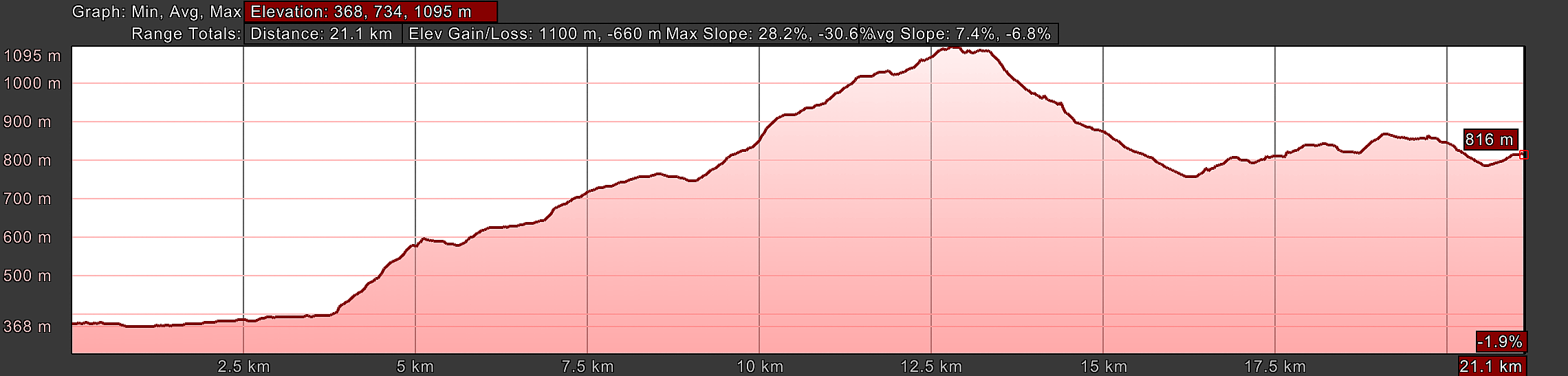 Elevation Profile, Way of St. Francis, Piediluco to Poggio Bustone, Day Seventeen
For comparison purposes, next I have included the elevation profile for the Terni variation on day seventeen, from Terni to Greccio. (To see all two-and-a-half stages of this variation, click on my Entire Way of St. Francis Map.)
For this stage from Terni to Greccio, there is an initial climb of 268 meters (879 feet) over about 5.5 kilometers in the first part of the day. Not horrible.
After a nice downhill section, the serious climb is from 9.2 kilometers to 20 kilometers, with a hefty gain of 644 meters (2113 feet) over a distance of 10.8 kilometers. Definitely not a cake walk.
On this stage, there is a halfway point in Stroncone for a nice break, just beyond the beginning of the long climb, and after about 10 kilometers from Terni. The work of the day is mostly after Stroncone.
With all the little ups and downs, the stage totals a whopping 1239 meters (4065 feet) of elevation gain! Definitely not for the faint-hearted.
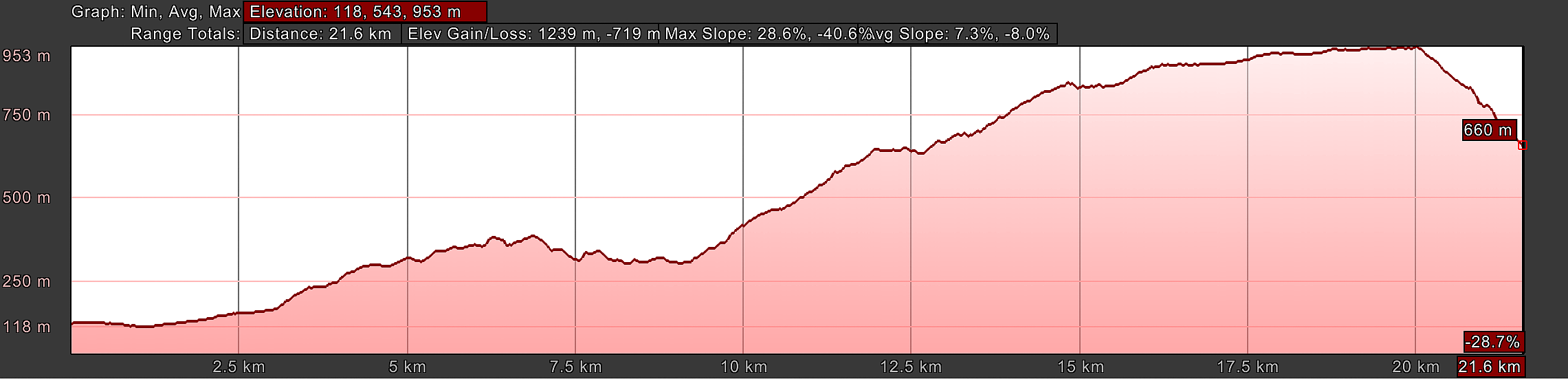 Elevation Profile, Way of St. Francis, Terni to Greccio, Day Seventeen
Both routes described above are about the same total length, not enough to be a significant difference at a bit more than one-half kilometer. The orange variation from Terni is the longer of the two.
The total elevation gain of the orange route from Terni, is about 136 meters (446 feet) more than the blue route from Piediluco. Not that big a deal. From Terni, not only is the longer, more significant climb of the day less high, it is over a longer distance of two more kilometers. Therefore, it shouldn't feel as steep as the blue route.
Regardless, there is no doubt that either route you choose will be a route that is significantly duro! Maybe choose to do both in a loop?? I wish that is what we had done!
Photo-Rich Travelogue, The Way of St. Francis, Piediluco to Poggio Bustone
Day seventeen begins from the church of San Francesco in the western part of Piediluco. See day sixteen for a photo of it and scroll to the end of the day.
Here is how the street in the front of the church, the Corso Quattro Novembre, appeared in the early morning. It is a lovely walk along the waterfront on this road, for the next 3/4 kilometer.
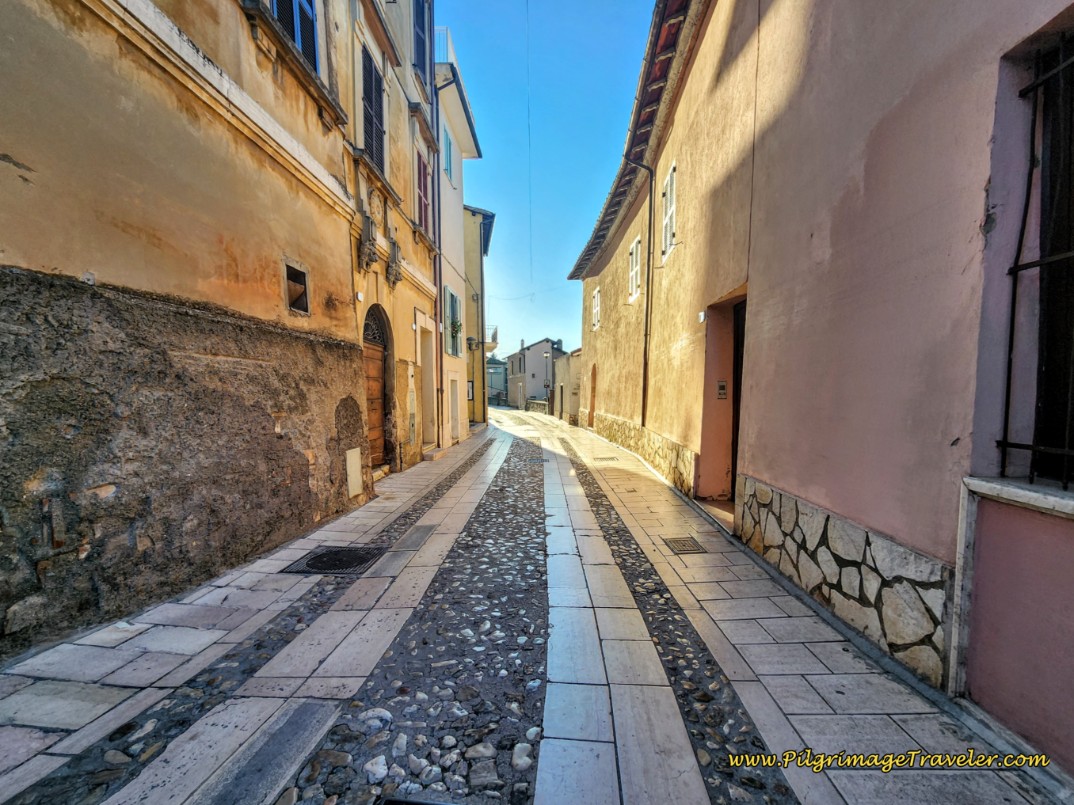 Corso Quattro Novembre Along the Waterfront in Piediluco
After not having had much of a supper the night before (see the story at the end of day sixteen), we were anxiously looking for anything open to get something to eat. We had already had a few danishes and coffee with milk at our accommodation, La Cannucciola. On an ordinary day, this type of food is barely sufficient for a few hours, but on a day with no real supper, we were eager for something more substantial.
Plus, we knew that this day would not have a lot of services, so we were even more anxious about finding food for the day. The only possible place beyond Piediluco to find meaningful food was perhaps in the very small town of Labro, five kilometers down the road. We didn't want to have to walk even that far if we didn't have to!
If you have no food and are walking early in the morning and/or a Sunday or a holiday, look carefully on the left side of the road for an unmarked self-service vending machine along the lakefront road. It is in building number 65, see the photo below. There is an alimentari (small food/deli shop) a few more meters beyond the vending machines, but we knew it was too early to be open.
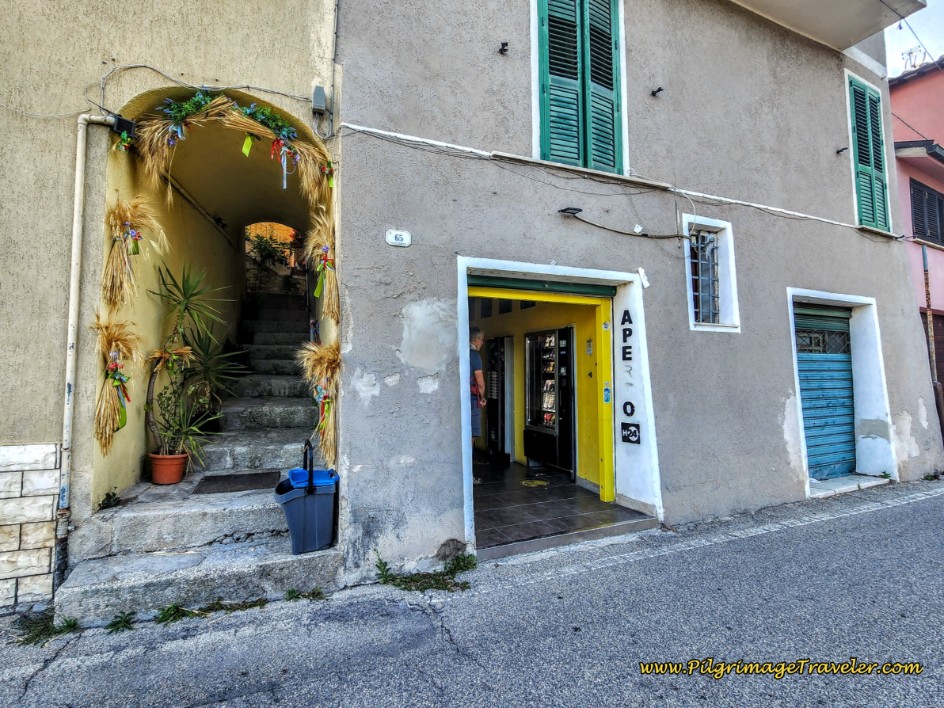 Self-Service Vending Machine
When we stumbled across this self-service we were ecstatic to see nuts, coffee, snacks and even sandwiches! Yay! We could secure food for our day. Machine-delivered food is not ideal, but it would suffice. Anything is better to a pilgrim than an empty belly! I am the type to get hangry (hunger + angry = hangry) if I don't have enough food!
However, much to our chagrin, when we put money into the sandwich machine, nothing returned! What?? Ok, I was willing to give it a second try - again, nothing!
Oh dear, I went to another machine and it was able to properly vend a nut mix and some chips. I suppose that would have to do.
I decided to give the sandwich machine one more try. This time I was smart enough to choose another sandwich, but one I was less fond of. And success! I even took the chance to get two, which worked. Now at least we had sandwiches and snacks for the road.
If you need a water fountain, a few steps beyond the vending machines, on the lakeside, in the next parking area, there is one.
Sure enough, the alimentari was closed when we walked past it a few meters later, just before a big bend in the road, to the left. At least the amazing and serene view of the lake to the right was open.
However, much to our delight, around the bend we spied the tell-tale cafe umbrellas outside, and sure enough, the Bar Turismo was open! Double yay! This was after about only 1/2 down the road from the start at the church.
The bar did not have anything other than more danishes and coffee, but I wasn't choosy. Even though we already had a similar breakfast only 3.5 kilometers back, we ate again. I fill my belly when I can!
After our break we continued the pilgrimage past the flamboyant Hotel Miralago, on the right, which you can't even see at the street level. Look for an open viewing plaza of the lake with colorful tall, vertical sculptures. This is the roof of the hotel!
Only a few meters beyond the plaza of the Hotel Miralago, when the road bends away from the water, look for a large parking lot on the right, after about 3/4 from the church. Before the parking lot, the Way makes a turn to the right onto a pathway, by a water fountain, photo below. The Via di Francesco sign states that Labro is 4.6 kilometers away.
This pathway will lead you back to the waterfront, to continue along it for a few more meters.
 Turn Right Onto Pathway to Stay on the Lakefront
You are now entering a lovely park with sculptures, a par course, picnic tables and farther along a children's playground. There is even the Spiaggia Velino, which in Italian means Velino Beach! The "beach" is a nice lawn by the waterfront with chairs and umbrellas.
After passing the beach, the path crosses a small wooden footbridge. Pay attention here, because you will arrive at a yard with boats along the shore. The path/asphalt abruptly ends as you can see in the photo below. There was an orange barrier fence ahead, forbidding onward passage along the lake.
We were confused here on what to do. As we looked around, Rich spied a small, wooden yellow and blue painted sign on the fenceline, with a Tau on it. In the photo, he is standing right beside this sign, barely discernable.
There was a faintly-worn pathway to the left of this fenceline. This is what you have to take to continue onward. You can see the rowing sculls behind the fenceline.
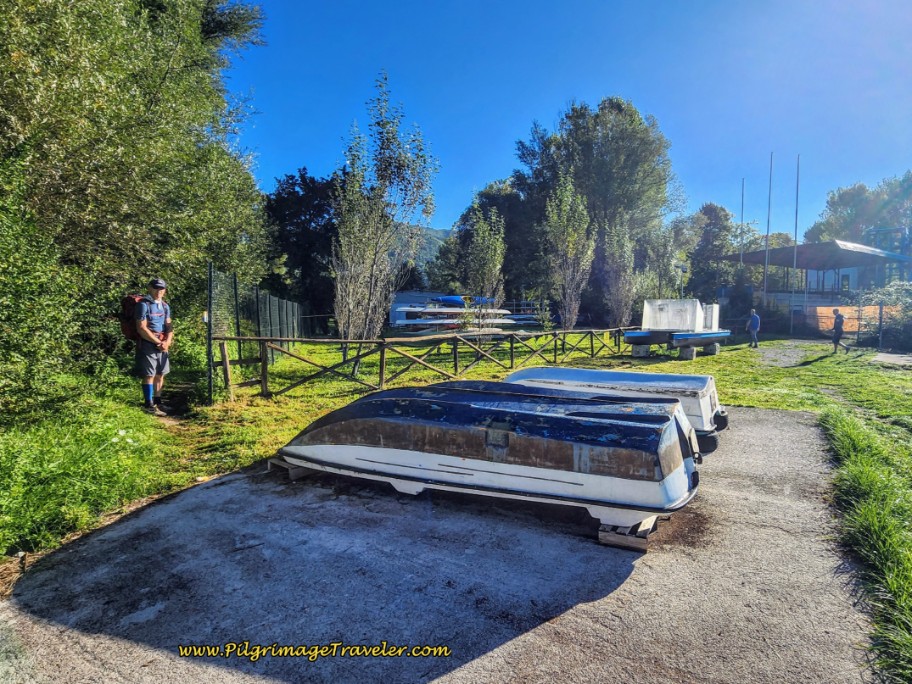 Leave the Lakefront Here to Take Path
Walk along the fenceline, for a short way, a bit more than 100 meters, passing the rowing establishment, and come to a T-intersection with a paved road.
Turn right onto the paved road and notice the sign that says "Centro Paolo D'Aloja."
As you walk along this wide road, you are passing a large nautical center, and then the Olympic Sculling Center.
After the Olympic Center, the Way comes to a large intersection, by the Camping Lago di Piediluco after 1.6 kilometers total.
You will walk toward the camping area and continue straight eastward.
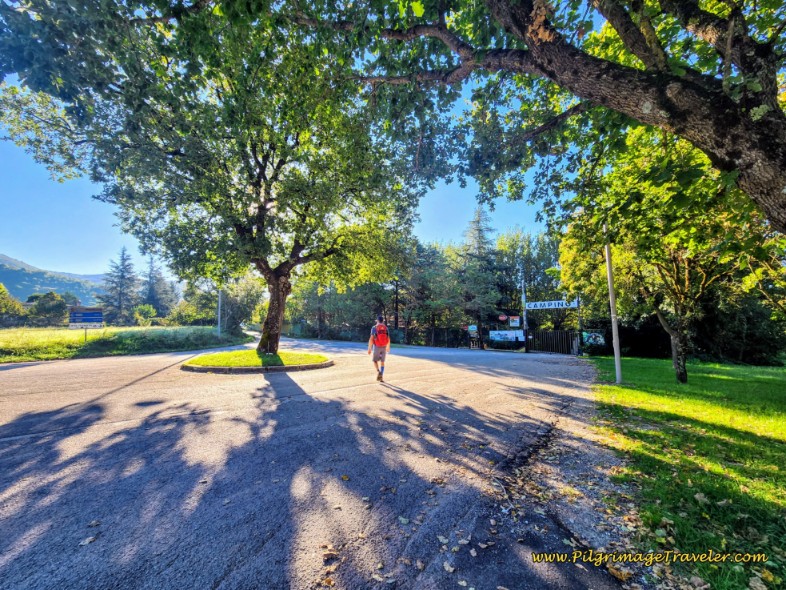 Piediluco Lake Camping Area
After about 1/4 kilometer along this quiet, single-lane paved road called the Vocabolo Valle Spolentina, pass the Residence Cardinale Albornoz on your left.
A few steps past the Residence, arrive at a T-intersection with the SR79. Turn right.
As you walk along the familiar highway for the next 1/2 kilometer, look up on the hill top in front of you to see the next destination: Labro. Its castle watchtower sticks up high into the skyline.
Looks like a steep climb to get there, doesn't it? In actuality, it's a 3K walk with about 200 meters (650 feet) of elevation gain. This is the first climb of the "duro" stage!
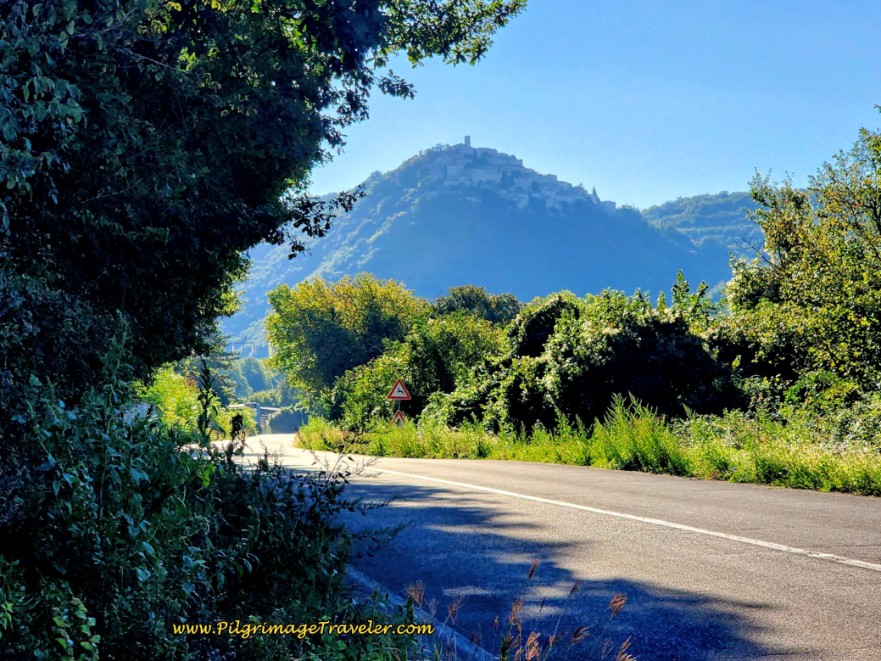 Labro Ahead on the Hilltop
After the 1/2 kilometer walk on the highway, and after approximately 2.4 kilometers into the day, turn left onto the Località Valle Spoletina, by a historic water fountain with potable water. This road is gravel.
Stay to the right at the first intersection, several hundred meters later, where the Via di Francesco sign states that Labro is 2.3 kilometers away.
Continue onward on this gravel lane, that is now a two-track, sometimes in the shade and sometimes not.
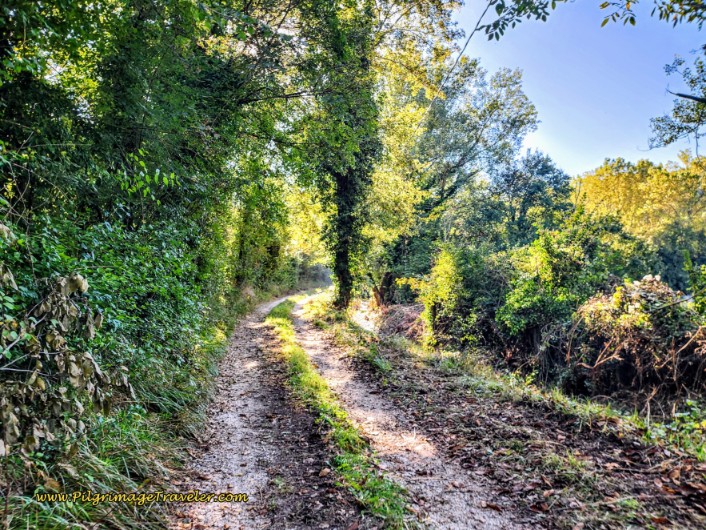 Along the Two Track Toward Labro
When the two-track joins a narrow paved road, soon you will be walking under this power line, below. You will continue to get views of the hill climb to Labro ahead.
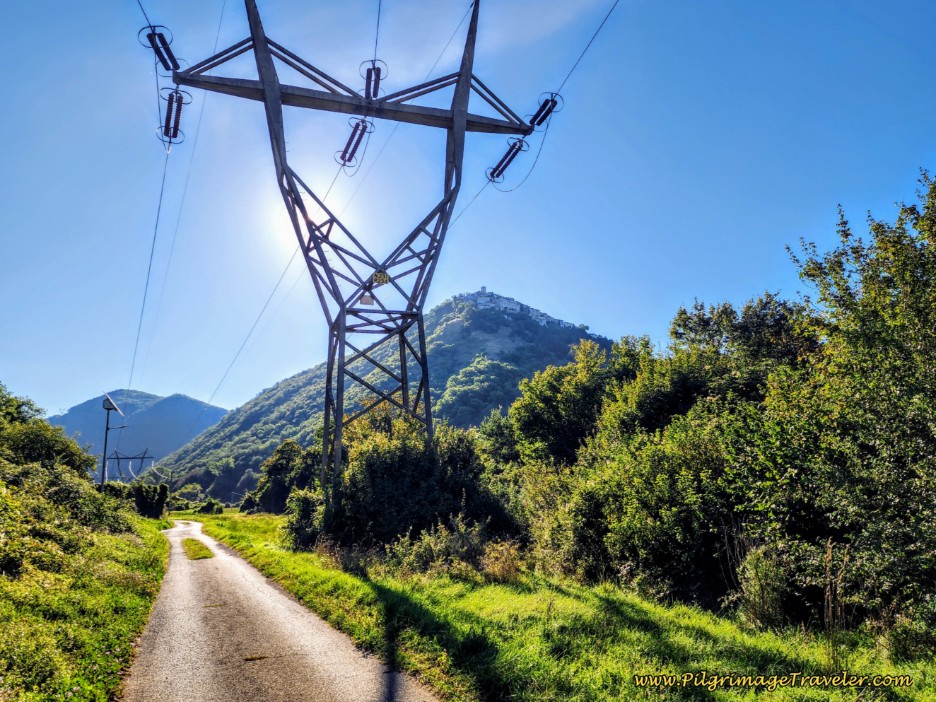 Labro, on the Hill, Getting Closer
A few steps beyond the power tower shown above, look for a right turn onto another narrow paved lane, called the Vocabolo Valle Avanzana.
In this area you are crossing over from the region of Umbria, now into Lazio. Goodbye Umbria!
Within a few meters, come to a small bridge crossing a drainage and turn left toward a homestead and white wall.
Just beyond this wall, the Way turns to the left and onto a trail into the forest, after 3.8 kilometers total from Piediluco. This is now where the real climb begins. The next 1.2 kilometers into Labro, along what looks like it was once a road, will be steep.
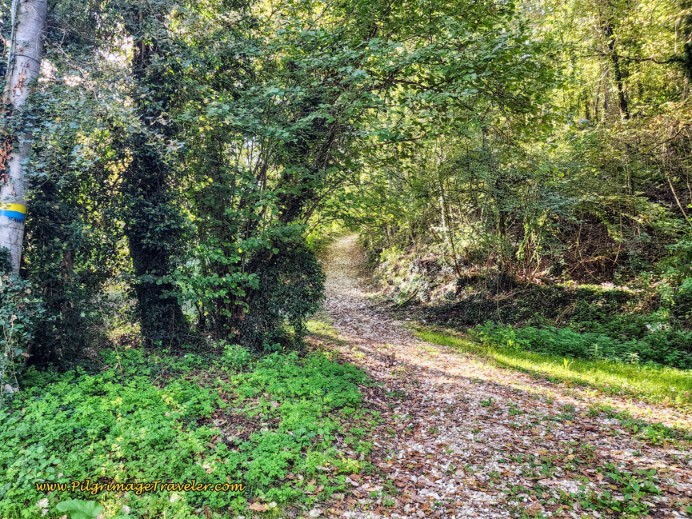 Left Turn at Homestead, Into the Forest
The steep climb up the ravine through the forest is not even one kilometer. Along the way you will come to an opening at a large switchback where you will see the buildings of Labro ahead. The climb is almost over.
Continue until you arrive at a T-intersection with the Via Ciro Menotti. Turn left.
After only a few meters along the now-paved road, pass this historic Fontana Monumentale del 1642 (Monumental Fountain), below.
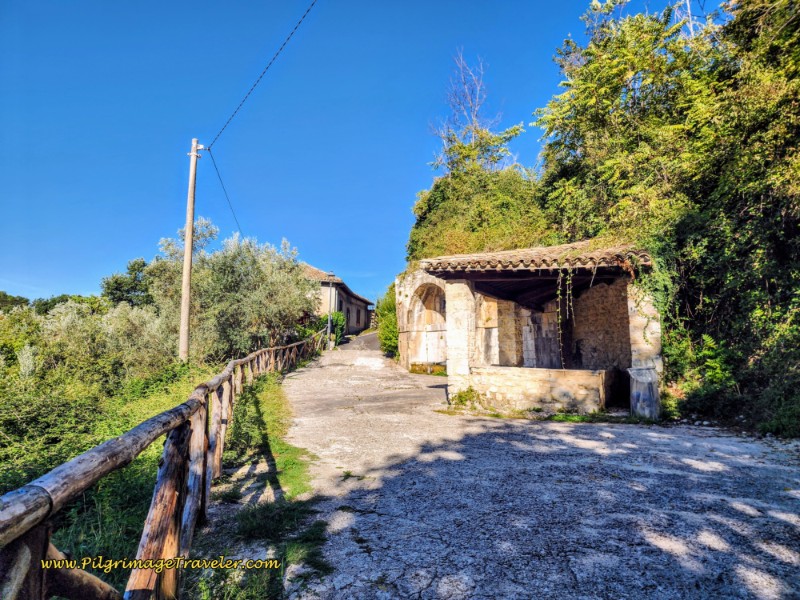 Left Turn Onto the Paved Via Ciro Menotti
Still climbing on the pavement, about one hundred meters later arrive at the medieval gate to Labro, the Porta Cavour, below.
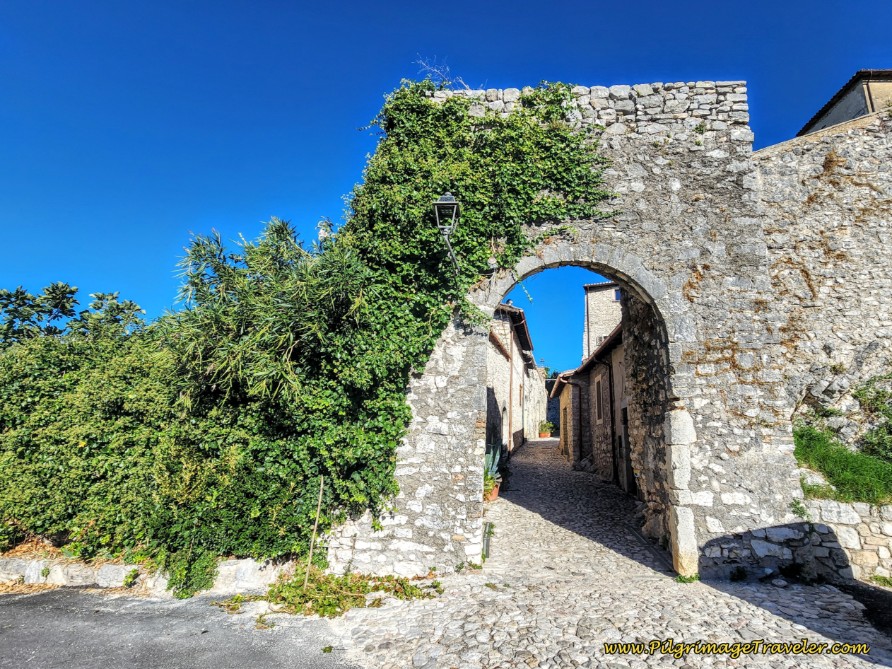 Porta Cavour, Labro
Labro is a fascinating little medieval town, one of the few whose streets are pedestrian only. If you have some extra time, in addition to walking through on the Way of St. Francis, you may wish to tour the church and the castle on the top of the hill.
I stumbled on this lovely YouTube tour of Labro, if you want to get a taste of what is to see here. I wish we had spent more time looking around!
The Way goes through the Porta Cavour, continuing straight along the Via Ciro Menotti.
Pictured next is a wonderful look up the hill, a perfect depiction of all the side pedestrian ways.
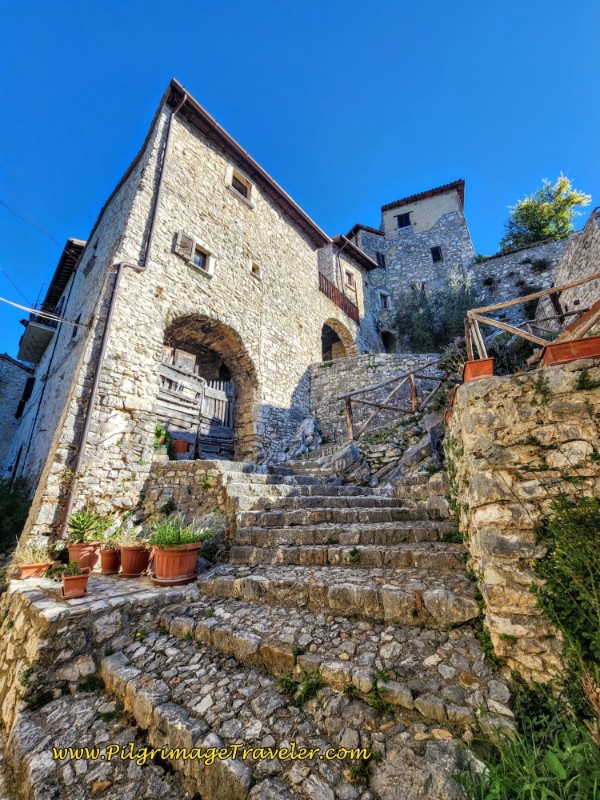 View Uphill Along the Via Ciro Menotti
Continue along the Via Ciro Menotti until it ends and makes a horseshoe bend to the right.
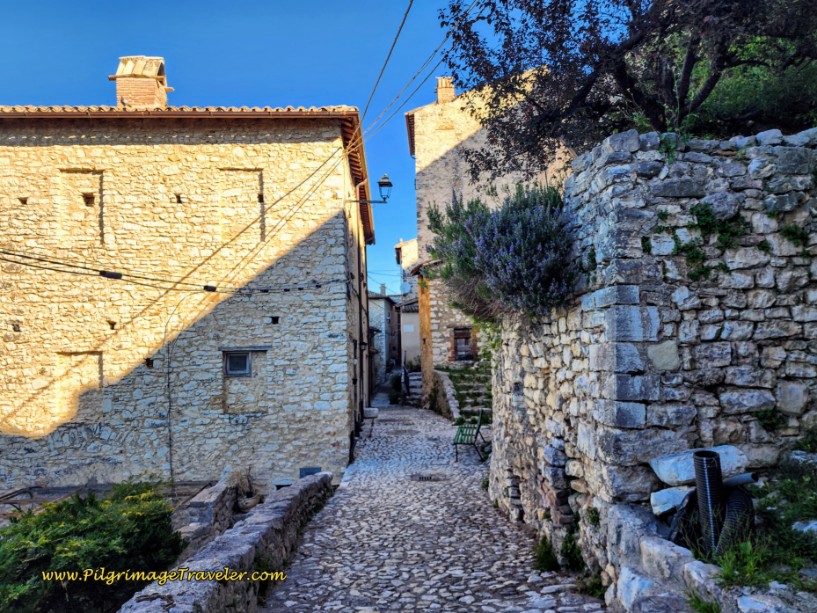 Continuing Along the Via Ciro Menotti
Continue climbing up a series of steps through the pedestrian passageway to join the Via Vittorio Emanuele. You can see the Porta Reatina gate ahead.
At the Porta Reatina, you are now at the top of the first part of the long climb of the day, after about 5.0 kilometers into day seventeen on the Way of St. Francis from Piediluco to Poggio Bustone.
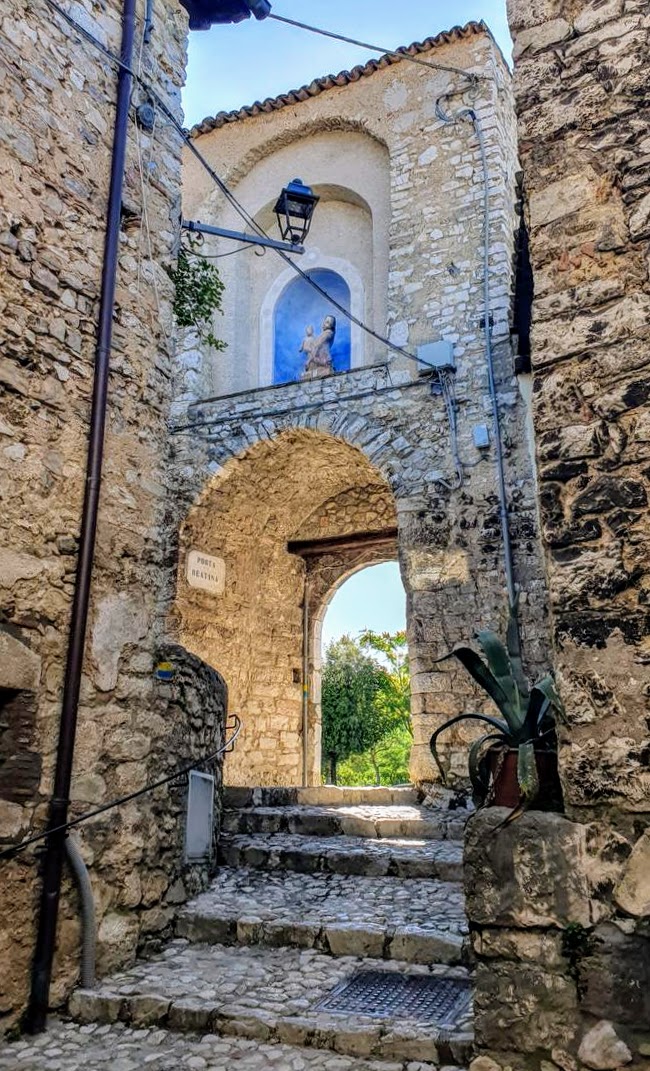 Porta Reatina
Walk through the gate and into the large open plaza. You will see a nice bar to refresh yourself if needed. You can also sit on a bench in the plaza and enjoy the views over the valley and the climb you just completed.
From the plaza, walk straight and eastward, toward the road, the Via Santa Maria Maggiore. Stay to the right, along the downhill side of the road.
Follow the Via Santa Maria Maggiore downhill until it takes a wide bend to the right, at the "Arrivederci" exit sign for Labro. Continue past the police station to your left and come to a T-intersection with the SP5. Turn left.
Immediately after the turn look for a gravel lane ahead, turning off the roadway to the right. Take this lane, returning into the forest. Your nice downhill jaunt has now come to end.
The climb through the forest feels mild. After a bit more than 1/3 kilometer, the lane comes to a T-intersection with a narrow paved country road, and turns left, shown below.
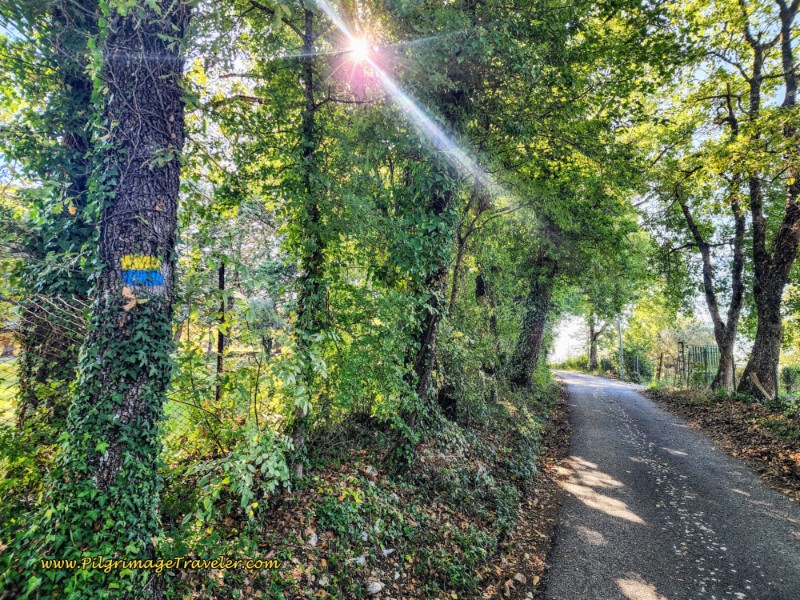 Paved Country Road
It is approximately 1/2 kilometer walk along this country road when it arrives at another T-intersection, once again with the SP5 and turns to the right. There is a water fountain and a picnic table on this corner. After 6.5 kilometers from Piediluco, we decided to take a quick break here.
The Ways continues along the SP5 roadway, without much of a shoulder for pilgrims, for a short 400 meters, and then takes a left turn onto a gravel lane.
You will notice after this turn, that the grade becomes more steep once again.
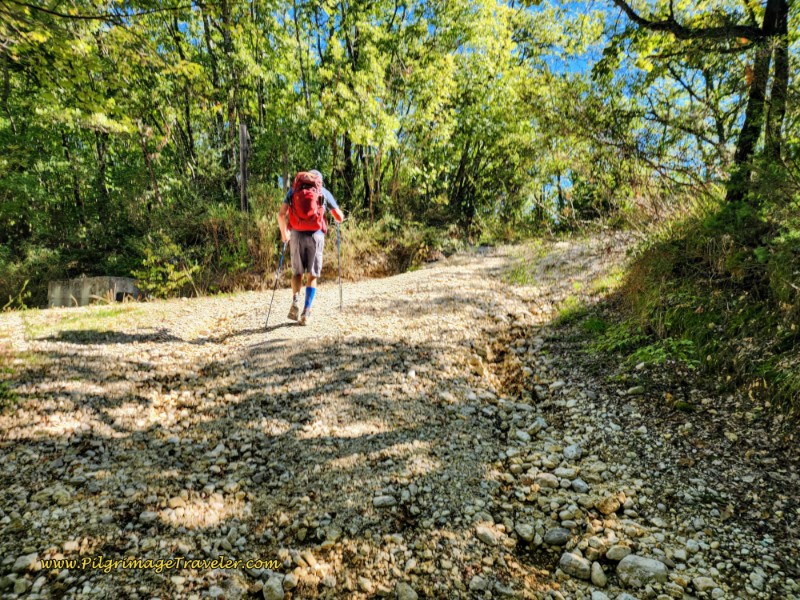 Grade Steepens on Gravel Lane
After a bit more than 1/3 kilometer, arrive at a T-intersection, and turn right onto an improved lane.
After another 1/3 kilometer, come to another T-intersection and turn right again. You are now joining the pavement and will be on it for the next several kilometers, going through the towns ahead.
Continuing the climb on pavement, a few minutes later, about 1/4 kilometer this time, you will arrive at yet another T-intersection. It is about 8.0 kilometers total into the day at this intersection. Turn right and head toward the next towns of La Croce-le Casette-Torricella. I suppose this is a 3-in-1 kind of place!
This is a narrow paved road and about 1/4 kilometer later, note the tell-tale Italian cypress trees ahead, signaling that you are arriving at the community cemetery, the Cimitero Comunale Le Casette, a large high-walled structure on your right, not pictured.
The cypress trees continue as you walk some steps onward, and pass more community venues on your left; a children's playground and a soccer field, pictured next.
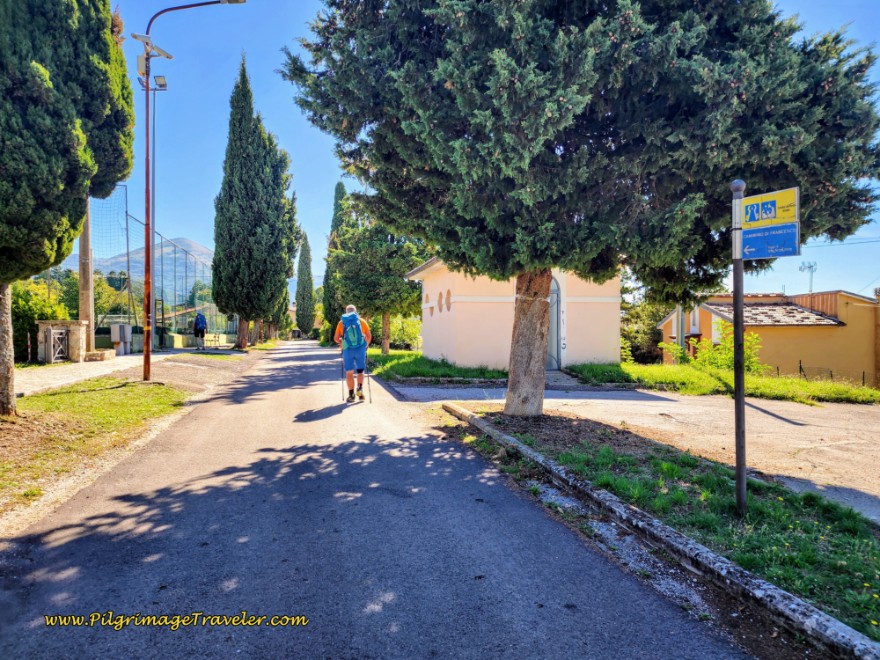 Community Venues of Le Casette
Several meters after the soccer field, come to a T-intersection with the SR521, the two-lane strada regionale, or regional road. You will only walk on the SR521 for a few meters.
Leave the SR521 as it bends to the left toward the town of Morro Reatino, and continue straight along the Via delle Casette, below. Over the next few meters it will be a nice downhill. Enjoy it!
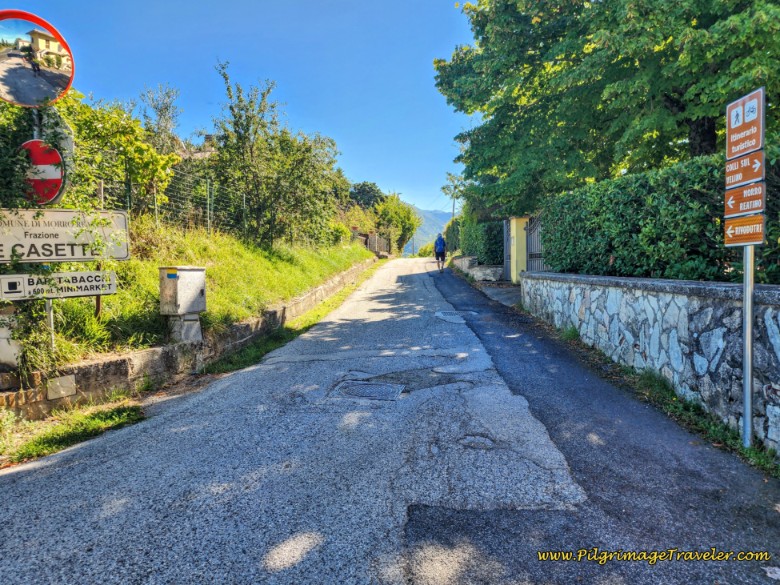 Leave the SR521 for the Via delle Casette
Along the Via delle Casette, notice the high mountain ahead. I believe this is Monte Fausola, but I can't be sure. I forgot to check with the locals. You will be seeing this mountain throughout the remainder of the climb. It is your companion for close to the next four kilometers. Yes - that's how much climbing is left!
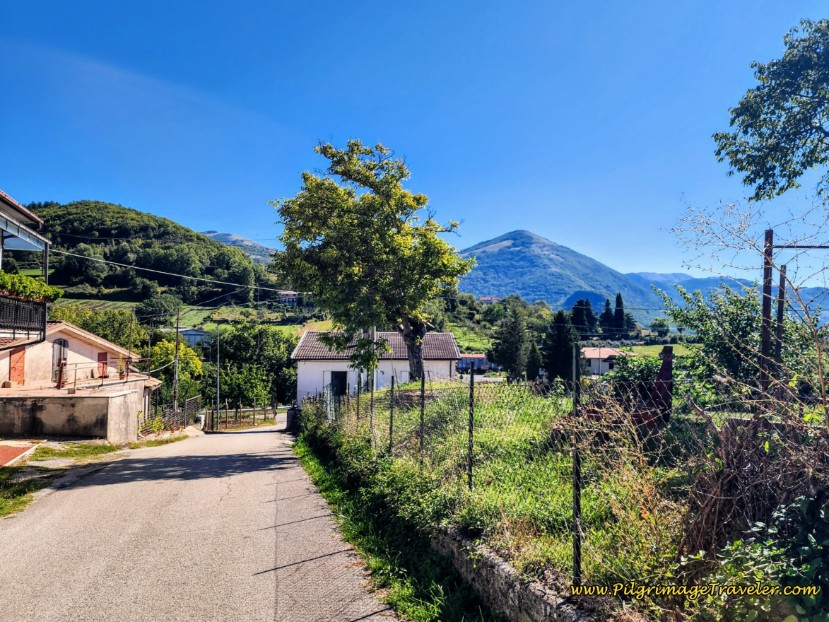 Heading Toward a High Mountain
The Via delle Casette ends at a T-intersection with the SR521 once again when it loops back from Morro Reatino. The Way turns right onto the wider highway for only a few steps, when it comes to this next intersection with the SP3, below.
There is a restaurant on the right just before this intersection, not pictured, which was closed and for sale. Perhaps it will open in the future. It would be a convenient place to stop if/when it opens again, after about halfway into the climb of the day.
Turn right here, but look straight ahead, where Rich's body is facing in the photo, and the Way forward is straight ahead onto the smaller, paved road.
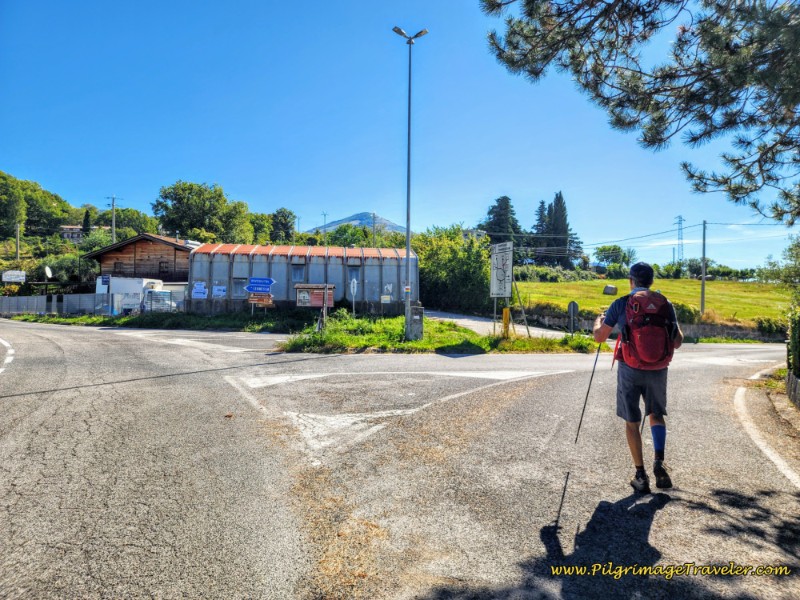 Straight Through Intersection
From the time you hit this quiet, paved road, the very steep uphill climb begins in earnest once again. After about 1/3 kilometer, pass a water fountain that has non-potable water.
A few steps past the water fountain, the Way turns to the right, where the road is still paved for a few more meters. Then the pavement ends and joins a tractor lane past a few boarded up and fenced buildings on your left.
And a few meters later, clear views of the same high mountain can be seen ahead as you steeply climb. The view of the mountain is made possible by the vineyard to your right.
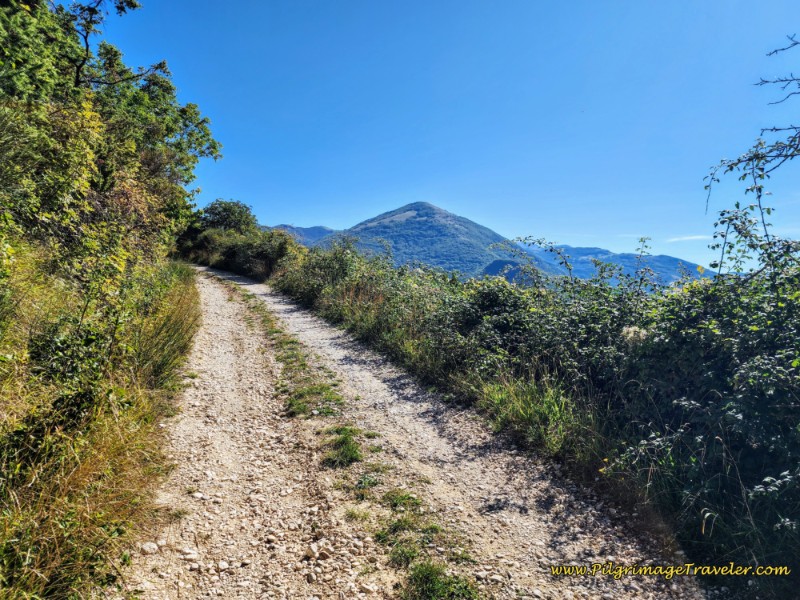 Steep Climb along Tractor Lane
When you come to the end of the open vineyard, there is a fork in the road, and the Way stays to the left.
The lane becomes quite steep at times, so much so that there are sections paved with graded concrete to assist in your footing, and perhaps aid with any runoff from the rain.
After about 3/4 kilometer walk along the lanes, there is a split rail fence that now graces the side, shown below.
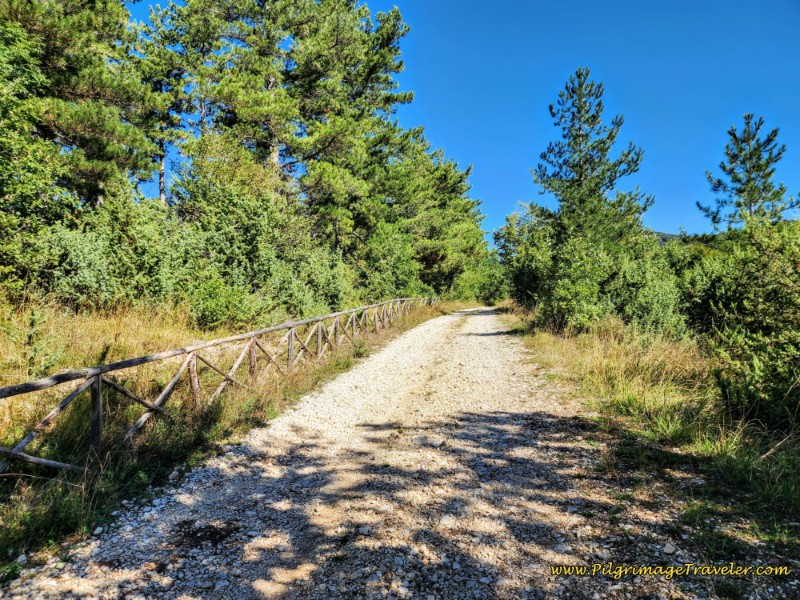 Walking Along the Split Rail Fencing
After about 10.5 kilometers, just after the split railing ends, you will arrive at an area that feels like a top, when the lane intersects with another lane that you see on the left. There is a trash can on this corner and a single bench, but I did not see any picnic tables, nor did I explore this lane. It felt like it should be a park, but I saw no signs, so we kept walking onward. And it is not much of a top, more like a leveling of the grade.
After about another 1/2 kilometer's walking along the lane, and 11 kilometers total, arrive at another fork - this time staying to the right to continue the climb along the high ridge, below.
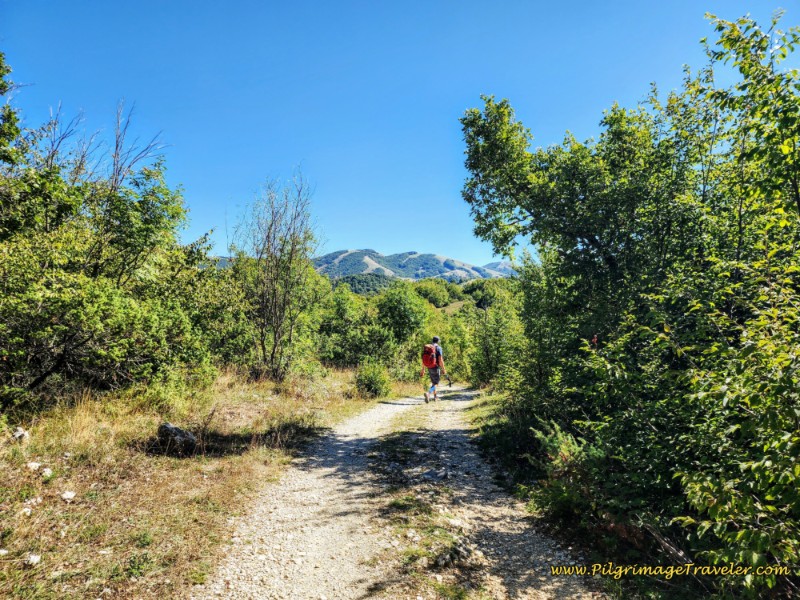 Slopes of Monte Fausola Above
At times, this lane is quite rocky and rough. When the lane takes a dip downhill, followed by a big bend to the right, look carefully for a trail, leaving the lane to the left, pictured below. This trail is after about 12 kilometers into the day. The top is close.
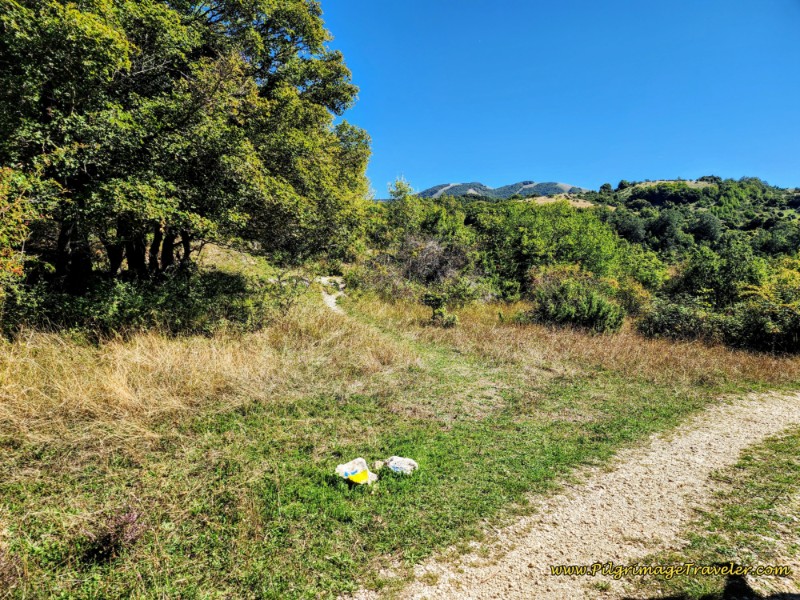 Trail Leaves Lane at Ridge Top
You will follow this trail for the next 1/2 kilometer, when you will notice a parallel trail coming up the hill to your right and pictured below. This is the trail that you will take to return and go down the mountain.
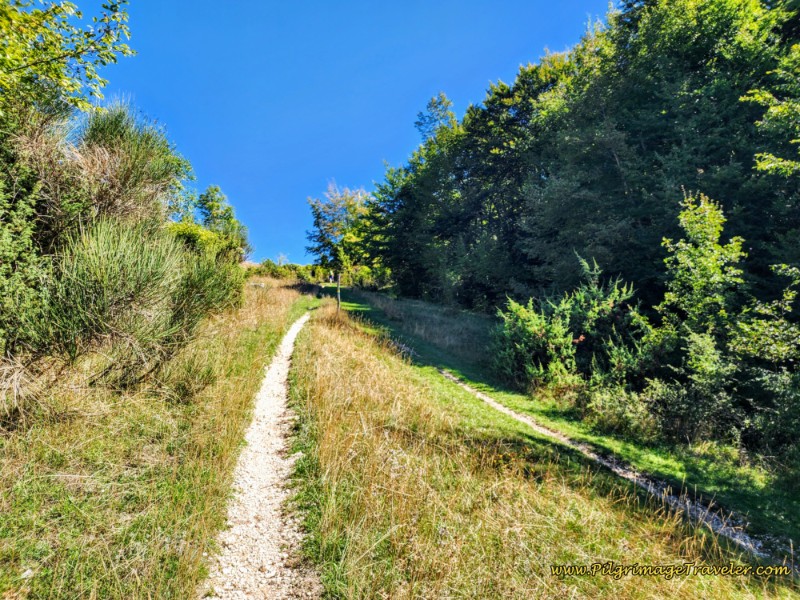 Parallel Paths
And a few meters onward, you will arrive at the juncture with the paved road that came up the mountain, but from the town of Cepparo directly from the south. There are wooden signs directing you towards the Faggio di San Francesco to the left (and the Chiesa di San Francesco) or to the towns of Cepparo/Rivodutri to the right.
We went left because of course we wanted to see the sacred Faggio di San Francesco.
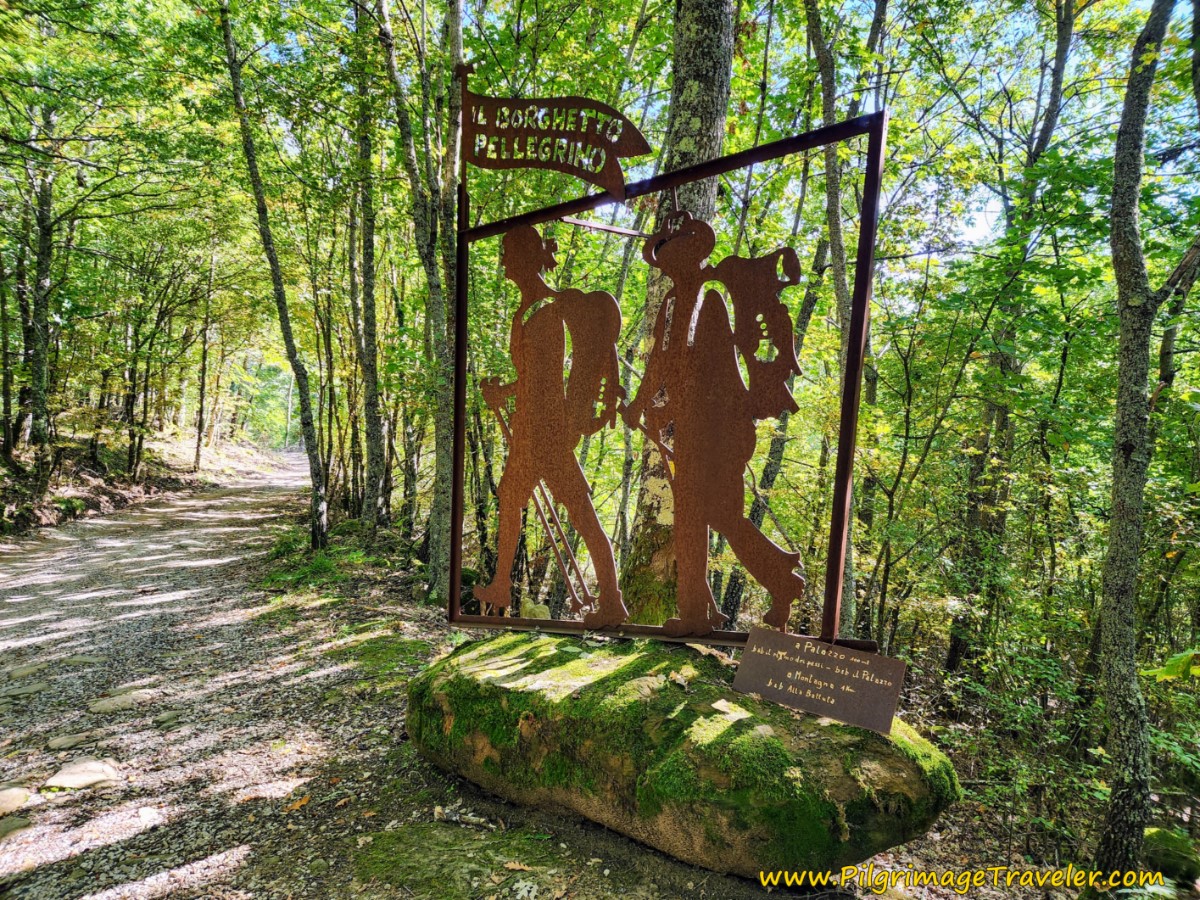
Right beside the directional signs, to the left of the paths, you will see this metal pilgrim's statue. Here is yours truly, posing for the rare photo op, below. It is here that you are essentially at the top of the long climb.
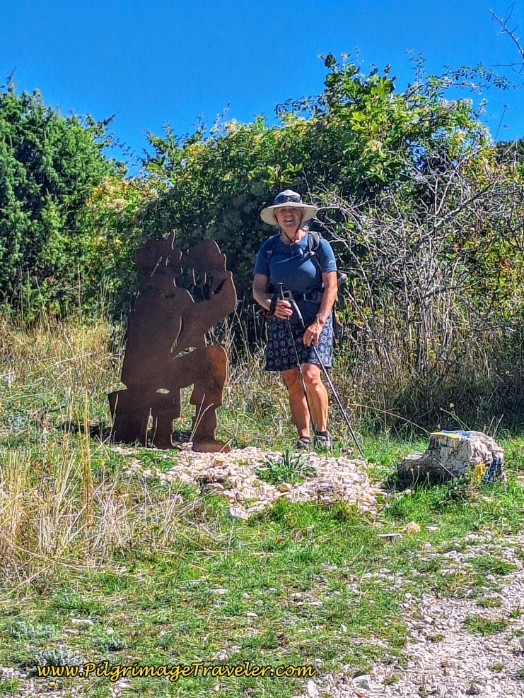 Pilgrim Sculpture at the Top of the Climb
From the intersection with the paved road, you have the choice of going along the road to see the small chapel to St. Francis first, then go to the sacred beech tree afterwards, returning to this juncture.
We chose to go to the Faggio di San Francesco first, because we thought that was a little harder. But as it turned out, either way to go is about the same.
A few paces onward you can see this second metal pilgrim's sculpture. The road is to the right in the photo, and the trail to the beech tree is down the hill to the left, just beyond the sculpture.
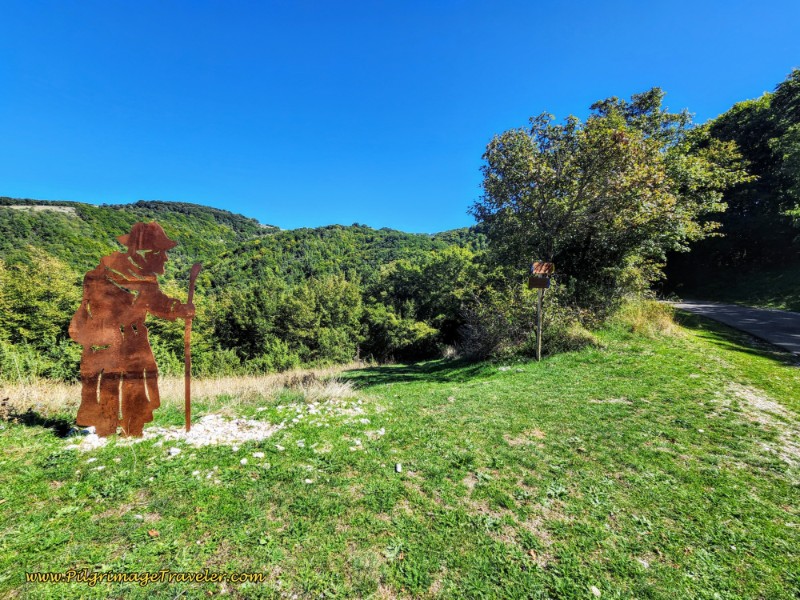 Trail Meets the Road to the Chiesa di San Francesco
The walk from this sculpture above, to the Faggio di San Francesco is a well-developed path of only about 1/4 kilometer.
The trail drops down into the trees and is delineated by a charming split rail fence.
Below is your first view of the tree, with its striking umbrella shape. Normally the branches of beech trees grow upward.
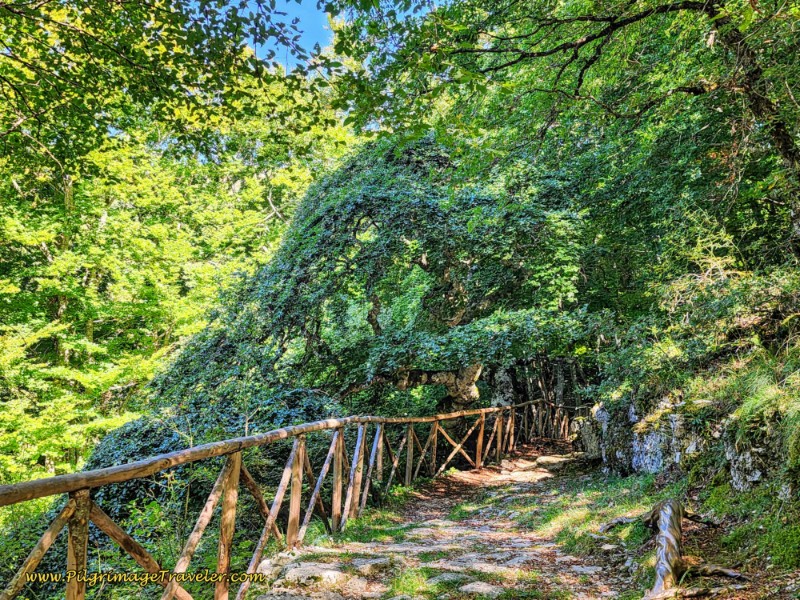 Trail to the Faggio di San Francesco
According to legend, while St. Francis was traveling through these mountains, he was caught in a heavy storm. He took shelter under the beech tree, which miraculously spread and bent its branches downward to shelter him.
Here is a view of the fantastically shaped beech tree from the far side, near the picnic area. It is very incredible and apparently this is one of only two specimens in the entire world shaped like this.
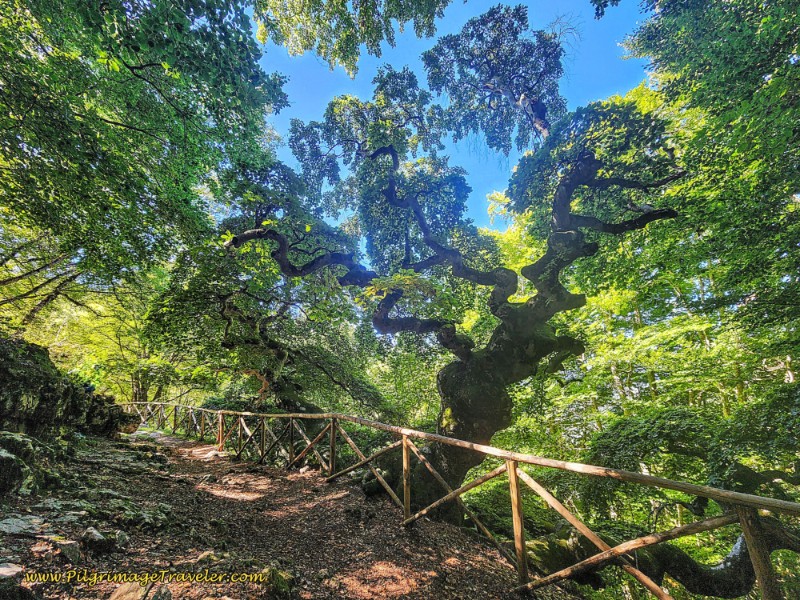 Faggio di San Francesco
It is a beautiful and cool place to take a break.
After our visit to the sacred beech tree, we took the path up and to the left, first on steps and then along a switchbacking trail toward the chapel at the ultimate top of the climb.
It is only a few meters when you first see the back of this shrine, below, (but shown from the front), and the small chapel behind it.
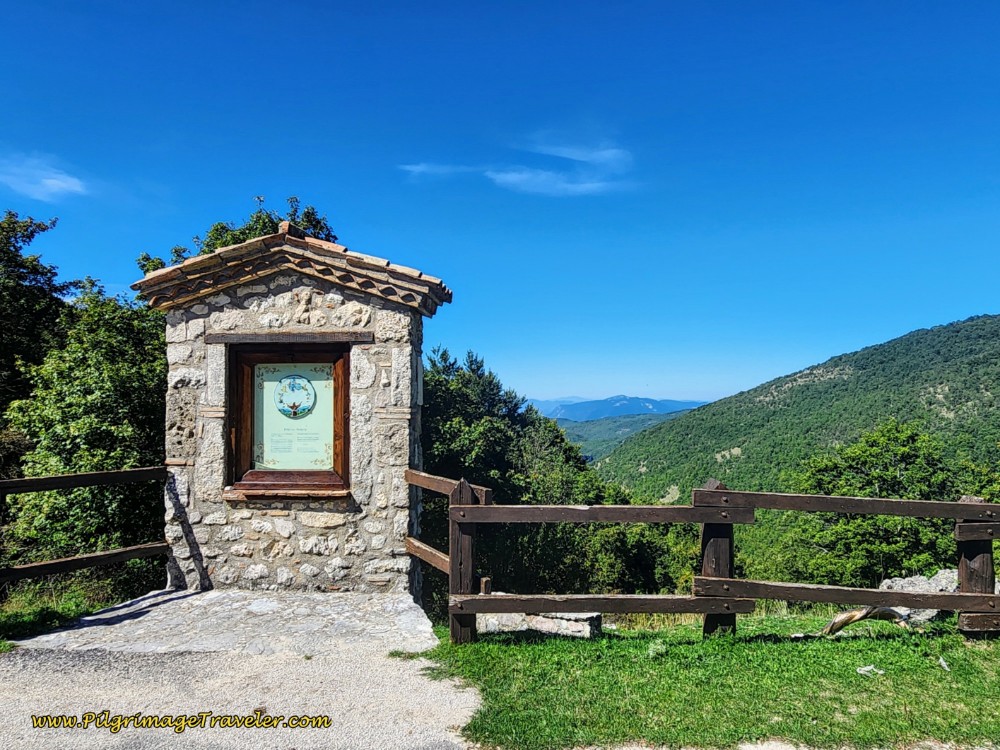 St. Francis Shrine
We did take a lunch break at the chapel, the Chiesa di San Francesco, sitting on the bench in the shade, after the work of the day was finished, after 13.0 kilometers for day seventeen on the Way of St. Francis from Piediluco to Poggio Bustone.
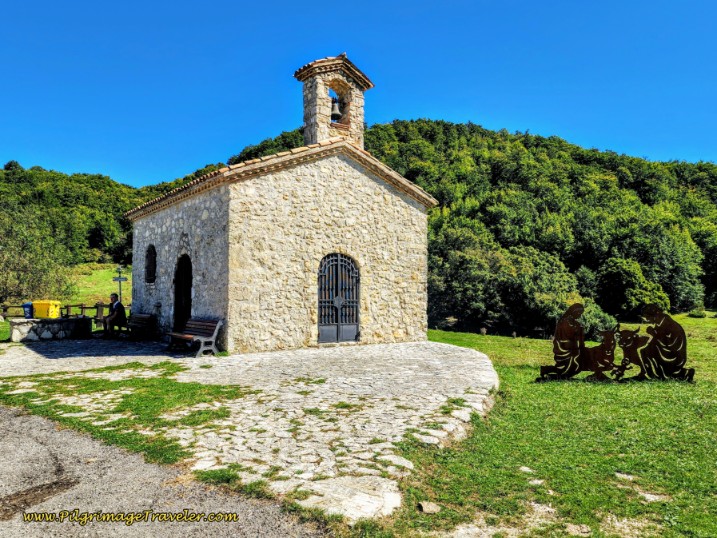 Chiesa di San Francesco at the Top of the Long Climb
Appropriately, there is a manger scene at the front of the little chapel. St. Francis loved the Presepe, the manger scene and they are scattered all over Italy. The views across the road towards the shrine are very nice.
Then, we followed the paved road, back toward the direction we came, to walk a bit more than 1/4 kilometer, to arrive at the junction with the trail once again.
This time we are taking the route to Cepparo/Rivodutri, along the parallel trail downhill and to the left. The trail descends steeply for only about 150 meters, but shortcuts a big loop in the road.
There are two more pilgrim sculptures to greet you at the intersection with the road to Cepparo, one on each side of the road as you cross it.
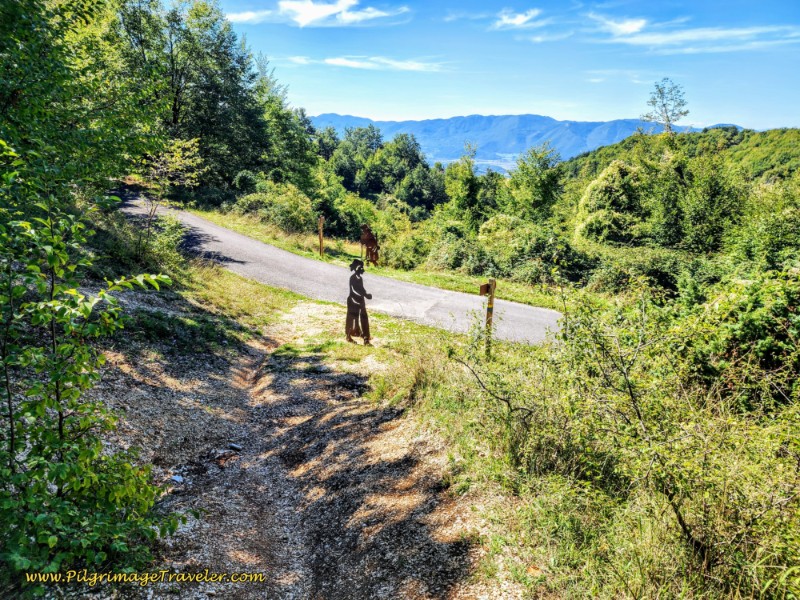 Descending Shortcut Trail
This next section of trail also shortcuts the hairpin turns on the road and lasts for about 1/2 kilometer. At times the trail is a single track and at times it is wider. The tracks are well-worn and sometimes you have more than one choice, but they all go in the same direction - down the mountain.
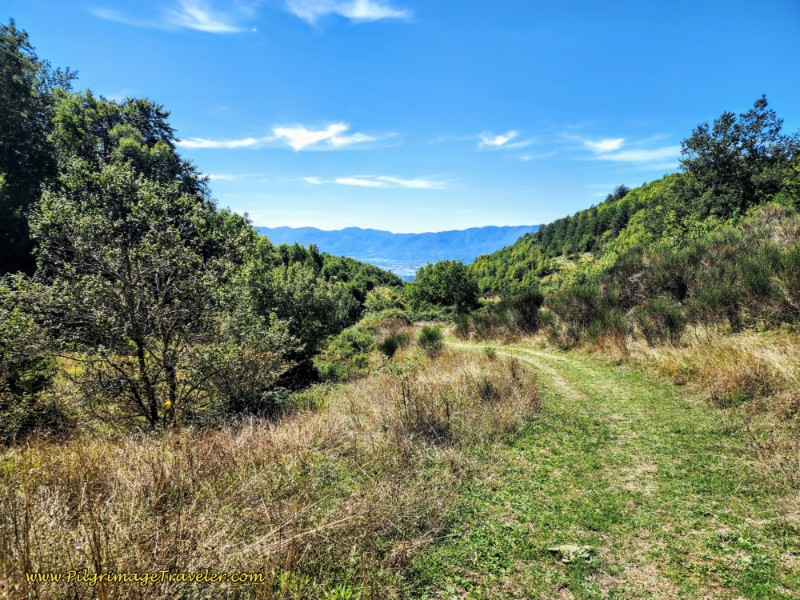 Ongoing Trail Down the Mountain
Follow this trail until you meet the Cepparo road again, turning left onto it. You will stay on the road for only a few meters, leaving it again to the left.
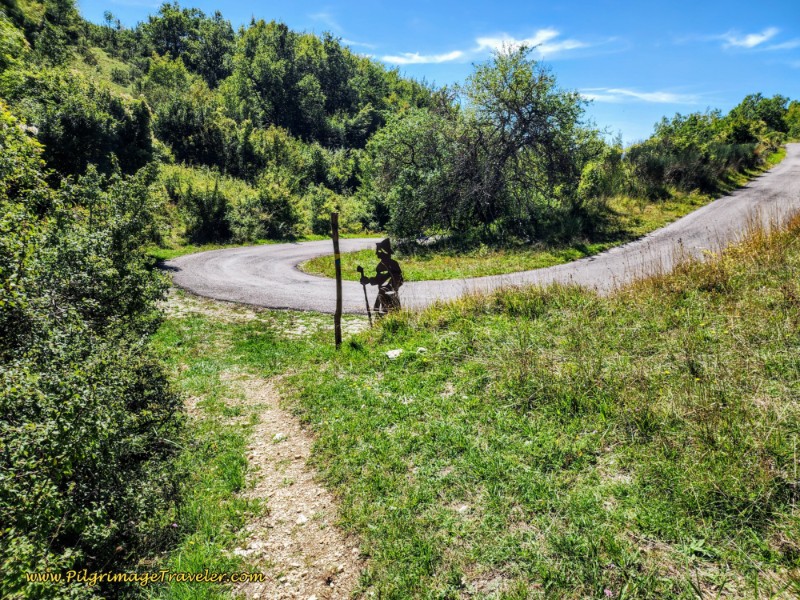 Join the Road to Cepparo Again
This section of trail is very steep and rocky for the next 1/2 kilometer.
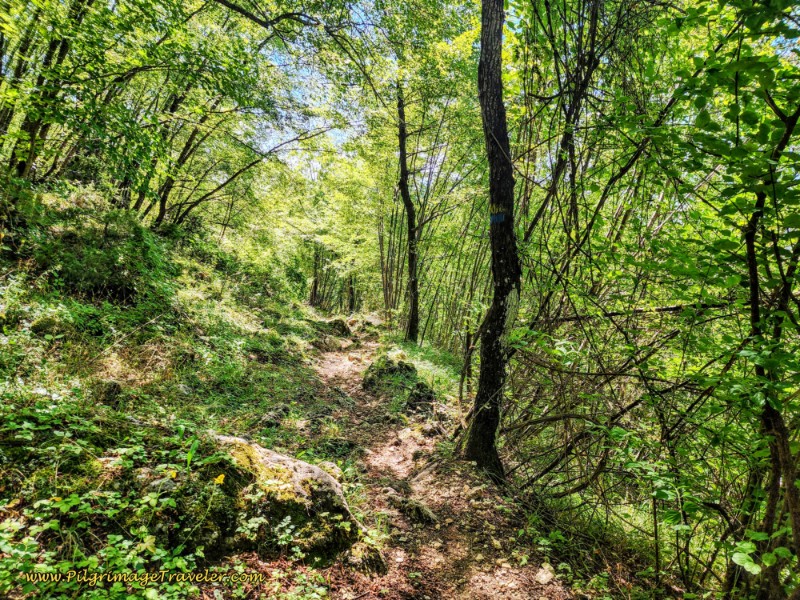 Steep, Rocky and Rough Trail
I was actually happy to get back onto the paved road, when the trail meets it again and turns left onto it, below.
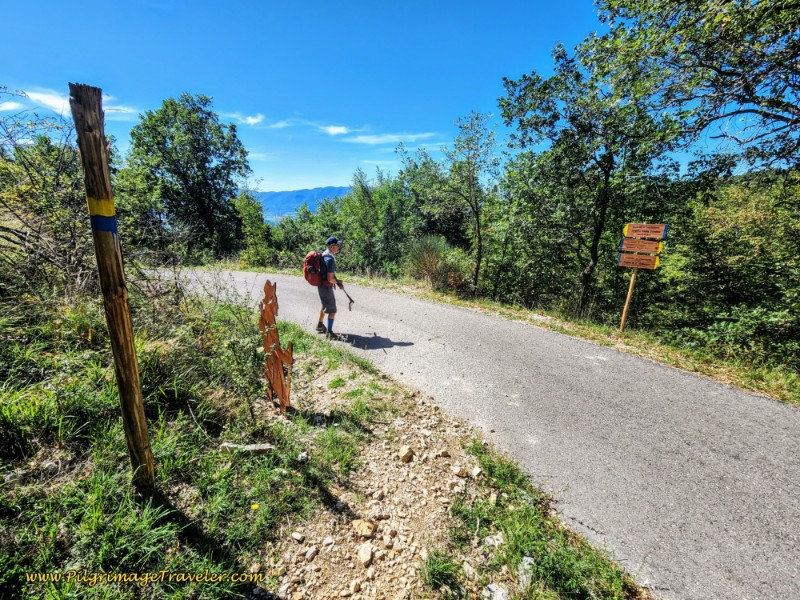 Meet the Road to Cepparo Once Again
The Way descends down the mountain on the pavement, for the next 1.7 kilometers, passing through the town of Cepparo (not pictured) along the way, after 15 kilometers. The town has no services.
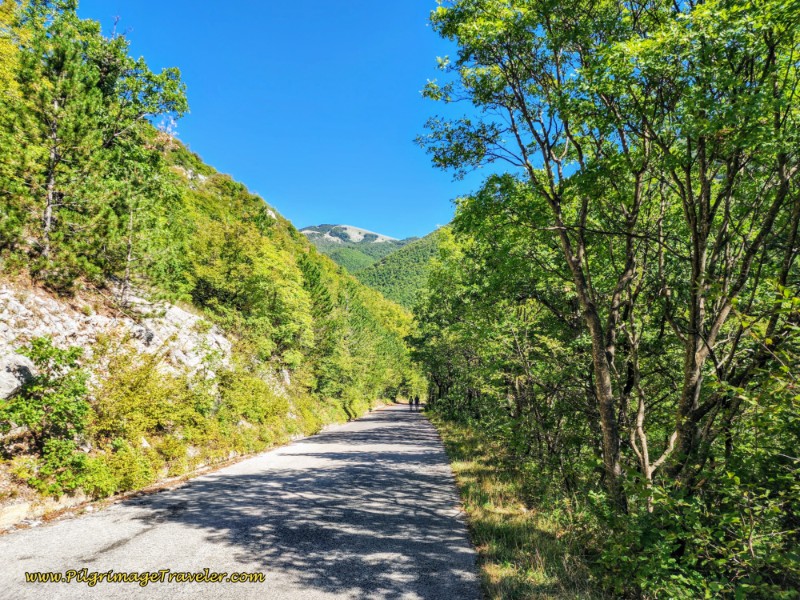 Descent on the Pavement
By 16.3 kilometers the roadway takes a huge hairpin turn to the right. You will see another metal pilgrim sculpture, and a lane that heads straight into the forest. This is the Way. And this is the last nice metal pilgrim sculpture!
There is a newer wooden Cammino di Francesco sign also directing you towards Rivodutri by staying on the pavement. But the shortest and best way to Poggio Bustone is to leave the pavement and take the lane into the forest.
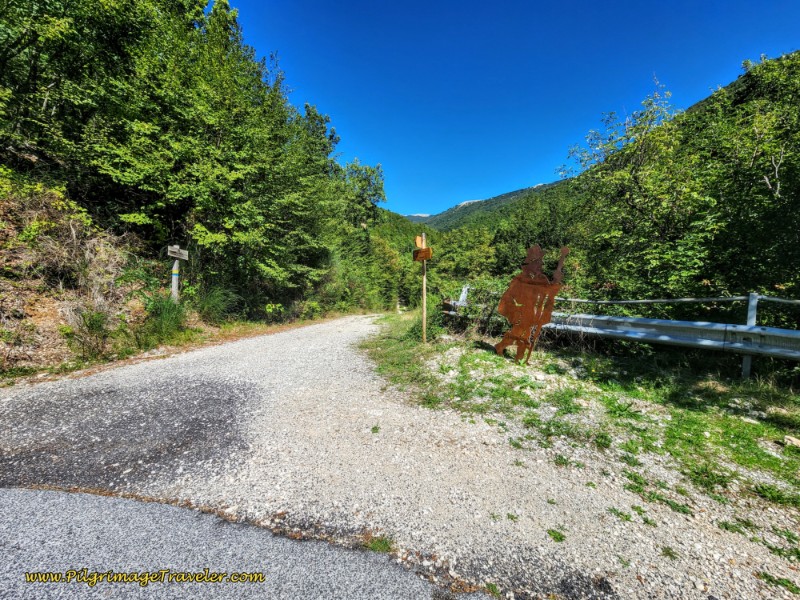 Leave Roadway at Hairpin Turn
The long descent has ended and as you walk into the forest on the lane you will be making a slight ascent again. You will be walking on gravel lanes for the next 3.5 kilometers, almost all the way into Poggio Bustone.
This nice, wide lane will be very rocky at times as it ascends into a ravine, crosses a drainage and takes a huge hairpin turn of its own.
There are ups and downs during this 3.5 kilometers. After about 2.5 kilometers on this section, there is a trail that splits off to the right, from the lane. Stay on the wider lane, up the hill and to the left.
About 1/4 kilometer later, the lane splits into two lanes. Again, stay uphill and to the left.
You know you are getting close to the end of the lane section when you notice a farm and walk around it to the left.
After the farm, you will take the final, brutal climb uphill, in a more open area.
By 19.8 kilometers the gravel lane ends and comes to a T-intersection with the paved road, the Via delle Casetta into town. Turn right for the coming downhill cruise.
And after only a few meters walk the buildings of Puggio Bustone finally appear.
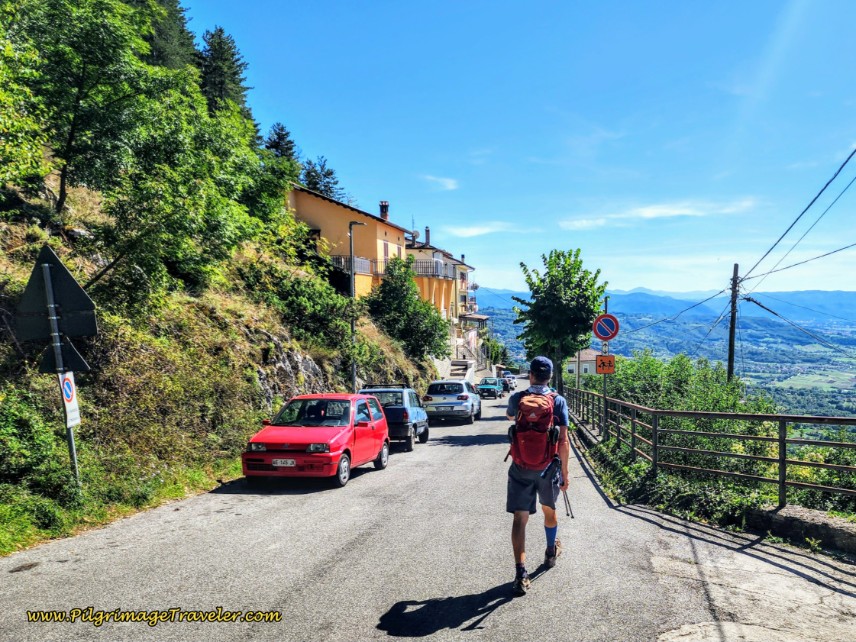 Entering Poggio Bustone Along the Via delle Casetta
After an 800 meter walk, the Via delle Cassetta ends at a T-intersection with the Via Francescana, after 20.5 kilometers total. Turn left here for the final 1/2 kilometer to the Santuario Poggio Bustone and the end of day seventeen on the Way of St. Francis, Piediluco to Poggio Bustone.
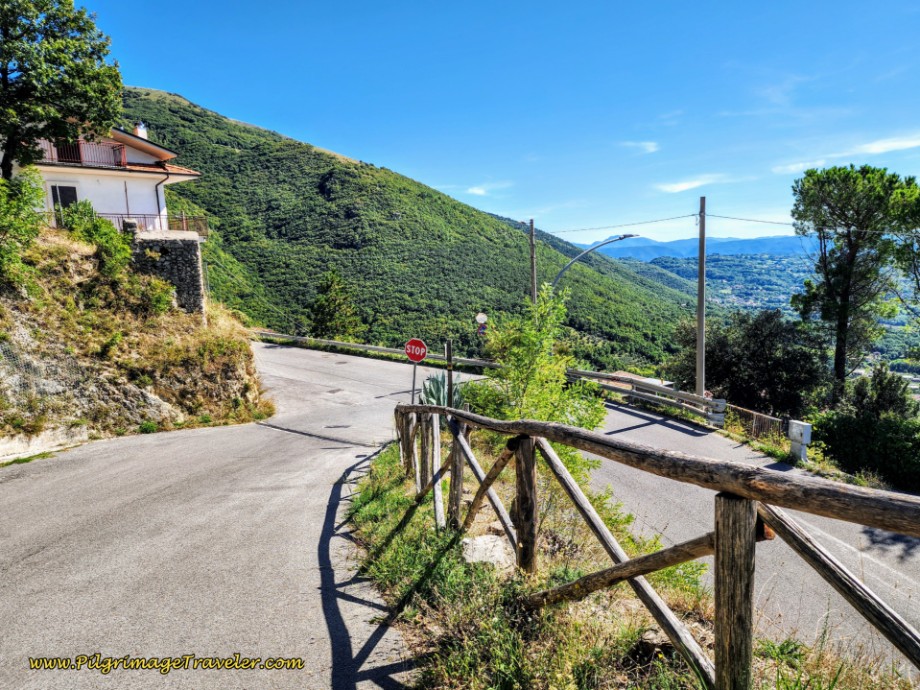 Left Turn Onto the Via Francescana
If you are not staying at the santuario, you may be turning right here, or a bit farther along the Via Francescana, like we did. We stayed at La Casetta dei Desideri as our preference is staying in small apartments. La Casetta is centrally located, farther down the hill.
As you can see below, the town is perched on the side of the hill at the foot of a mountain. Fabulous!
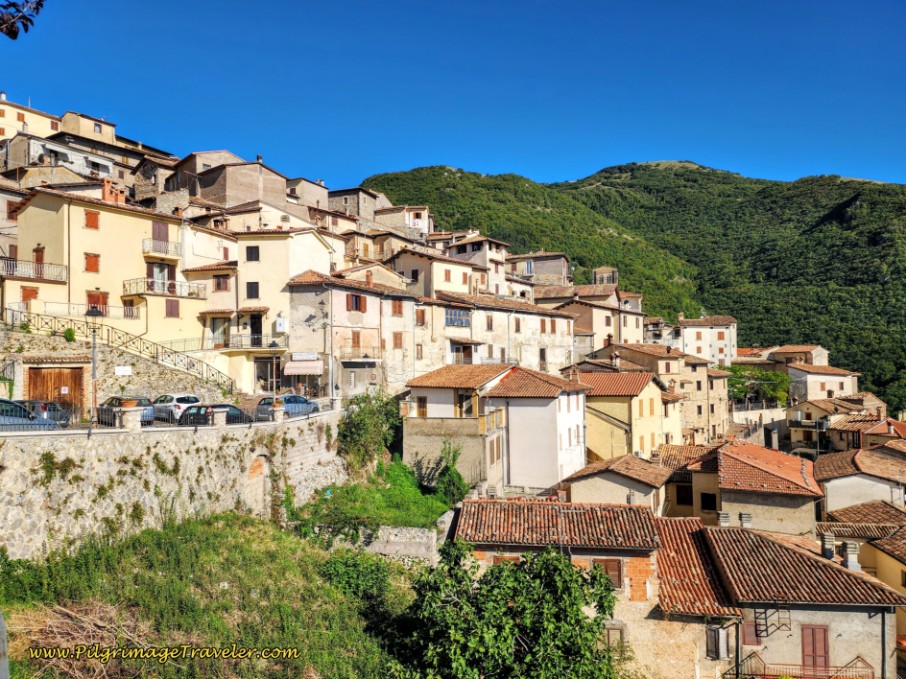 Poggio Bustone on the Side of the Hill
The Convento San Giacomo, also known as the Santuario Poggio Bustone, takes pilgrims for a donation and a two-day advanced notice. There are 20 beds in four rooms, shared bathrooms and a kitchen.
We did visit the sanctuary, shown below, later in the evening hours. It is a sight to behold, high in the mountains and with an unmeasurable sense of peace.
You must take some time here and visit the inside of the sanctuary. There are wonderful frescoes, stained glass windows, prayer niches used by the saint and his followers, and a serene interior courtyard.
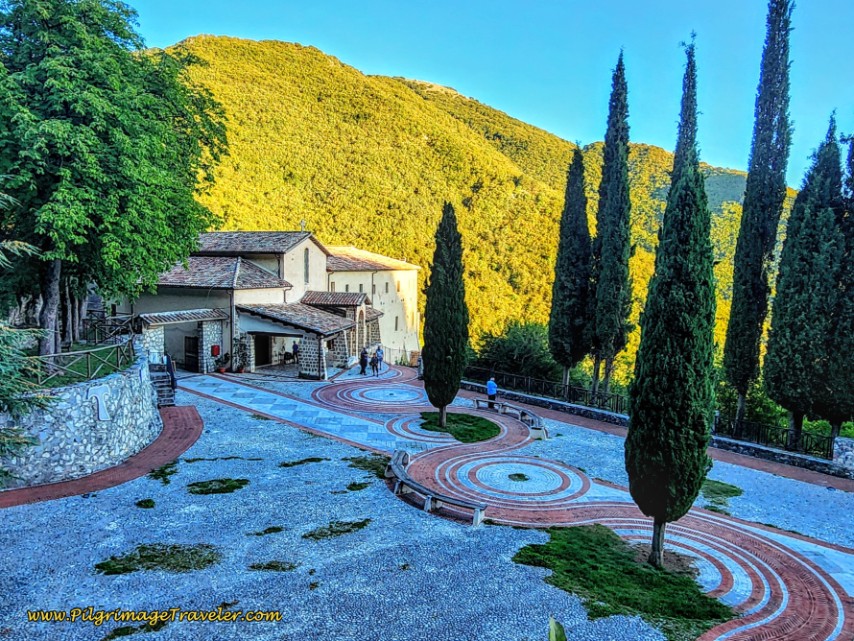 Santuario Poggio Bustone
There are also many places to explore outside, in the vicinity of the santuario. The photo above was taken from a shrine above, the Tempietto della Pace (Temple of Peace) a short walk up to the left.
From the upper road, there is a trail leading to the Sacro Speco, the site where St. Francis meditated in a cave.
And if you have plenty of time to explore, there is a steep, marked path through the woods to the 15th century Superiore Cappella delle Rivelazioni, (Superior Chapel of the Revelation). It climbs a distance of 400 meters from the santuario and features several 17th-century chapels along the way, commemorating various events during the saint's life. The climb takes about 30 minutes.
The view of Poggio Bustone as we walked back to town from the Santuario, was so outstanding! We couldn't have timed it better. Our apartment was just by the church steeple that you see in the photo below.
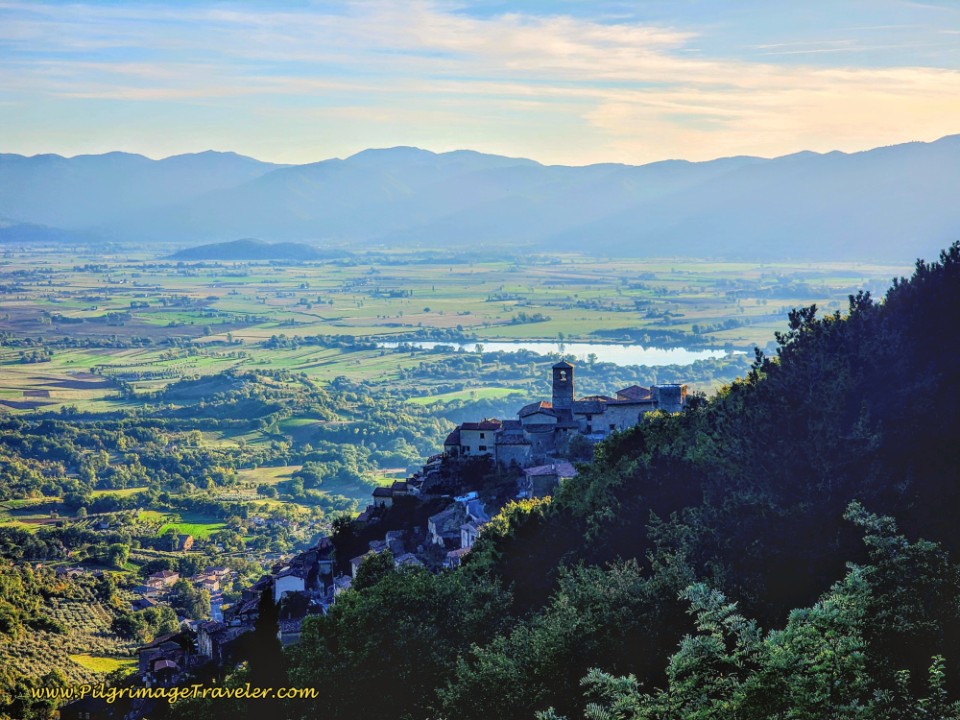 Poggio Bustone and View over the Rieti Valley
More Accommodations in Poggio Bustone
In addition to the Santuario Poggio Bustone, there are two more donation-based pilgrim accommodations; the Casa del Pellegrino "Da Dina" (+39 347 513 3030), farther down the hill with six beds and the Accoglienza Casa dei Nonni Frate Jacopa, (+39 366 90 29 139 or +39 380 890 4231), right along the Way and also down the hill, with eight beds.
Of course, there are many more private places, if you prefer. Click the Booking.com link for Poggio Bustone to see them and to see who is offering the current deals. Sort the results by price.
We really liked the location and economy of the apartment at La Casetta dei Desideri. Three more consistently economical choices are the Musica e Poesia da Battisti Ida, the Giardini di Marzo and the San Francesco Suite.
Reflections, The Way of St. Francis, Piediluco to Poggio Bustone
We had successfully completed the stage that was "duro!" We personally didn't feel that it was any harder than quite a few previous stages! It is just the classic up the mountain and down the mountain stage that is typical of this pilgrimage!
The highlights for me were the gem of Labro, and the sacred beech tree, the Faggio di San Francesco. And one just cannot refute the beauty of the mountain views, once again.
We suffered no blisters, no hardships, and ended up with plenty of food afterall. It was good to end in a town where we could once again cook for ourselves and restock our packs with plenty for the road. And the Happy Hour at the local watering hole is always nice as well.
There was absolutely nothing to complain about on this day!
Salutation
May your own Way of St. Francis from Piediluco to Poggio Bustone be "borne patiently" and without any suffering of the "weaknesses of the body!" And may this patience bring you "great merit" for the "salvation of the soul!" Ultreia!
Way of St. Francis EBook Guides
Walk smarter with our ad-free, beautifully formatted Way of St. Francis eBook Guides, in PDF format ~ perfect for offline use in mountainous and remote areas along this Way. Includes daily stage details, alternative routes and stunning photos. Our eBook Guide is unique because we also immerse you with our story.
Don't carry a heavy paper book, but use our digital eBooks on your mobile device instead! You can walk with clarity and confidence, deeply connect to nature, following in the footsteps of St. Francis, through the Italian countryside!
📲 Instant download. 💸 Money-back guarantee. 🔄 Free updates for 1 year.
👉 Click here for more information! OR BUY NOW ~ La Verna to Assisi, OR BUY NOW ~ Assisi to Rome. OR BUY BOTH HERE
Way of St. Francis Stages
La Verna to Assisi
Assisi to Rome
Please Consider Showing Your Support
Many readers contact me, Elle, to thank me for all the time and care that I have spent creating this informative website. If you have been truly blessed by my efforts, have not purchased an eBook, yet wish to contribute, I am exeedingly grateful. Thank you!
Search This Website:
The Pilgrimage Traveler Digital Guides
Our Guides Help You:
~ Know what to expect each day!
~ Locate historic sites along the Way!
~ Know where you are in your journey!
~ Discover a quote from the sages, for your daily reflection on the journey!
Click on a Photo Below to Get Your Copy.
A most popular alternative on the Central Route of the Camino Portugués!👇

The Portuguese Routes are rapidly gaining in popularity, especially the section from Lisbon! Plan to walk this one soon, before it is no longer a quiet experience!👇
Our most popular Portuguese guide! 👇
The most historic of the Portuguese Caminos ~ not to be missed!👇
The spiritual adventure of a lifetime, following in the footsteps of St. Teresa of Ávila!👇
The amazing mountain route alternative, the Camino Sanabrés, from Granja de Moreruela on the Vía de la Plata!👇
The most incredible mountain scenery on this camino from Leon to Oviedo!👇
The shortest of the caminos, but not easy!👇
The very first, Original Way from Oviedo to Santiago!👇
The pilgrimage to the "End of the World" ~ The perfect add-on to your camino!👇
All Banners, Amazon, Roamless and Booking.com links on this website are affiliate links. As an associate of these companies, the Pilgrimage Traveler website will earn from qualifying purchases when you click on these links. We have used and love all of our product recommendations and believe you will too! We sincerely thank you!

🙋♀️ Why Trust Us at the Pilgrimage Traveler?
We’re not a travel agency ~ we’re fellow pilgrims! (See About Us)
We've trekked Pilgrimage Routes Across Europe since 2014!
💬 We’ve:
- Gotten lost so you don’t have to. 😉
- Followed waymarks in the glowing sunlight, the pouring rain and by moonlight. ☀️🌧️🌙
- Slept in albergues, hostels & casa rurals. Ate and drank in cafés along the way. 🛌 😴
- Created comprehensive and downloadable GPS maps and eBook Guides, full of must-have information based on real pilgrimage travels. 🧭 🗺️
- Shared our complete journeys, step by step to help YOU plan your ultimate pilgrimage and walk with your own Heart and Soul. 💙✨
Every detail is from our own experiences. Just fellow pilgrims sharing the Way. We have added a touch of spirituality, heartfelt insights and practical guidance from the road ~ offering a genuine connection to the spirit of pilgrimage. Tap into the wisdom of seasoned pilgrims!
Ultreia and Safe Pilgrimage Travels, Caminante! 💫 💚 🤍
Follow Me on Pinterest:
Find the Pilgrimage Traveler on Facebook:

Shroud Yourself in Mystery, along the Via de Francesco!
Walk in the Footsteps of St. Francis, and Connect Deeply with the Saint and to Nature in the Marvelous Italian Countryside!
Need suggestions on what to pack for your next pilgrimage? Click Here or on the photo below!

Carbon Trekking Poles ~ My Favorites!
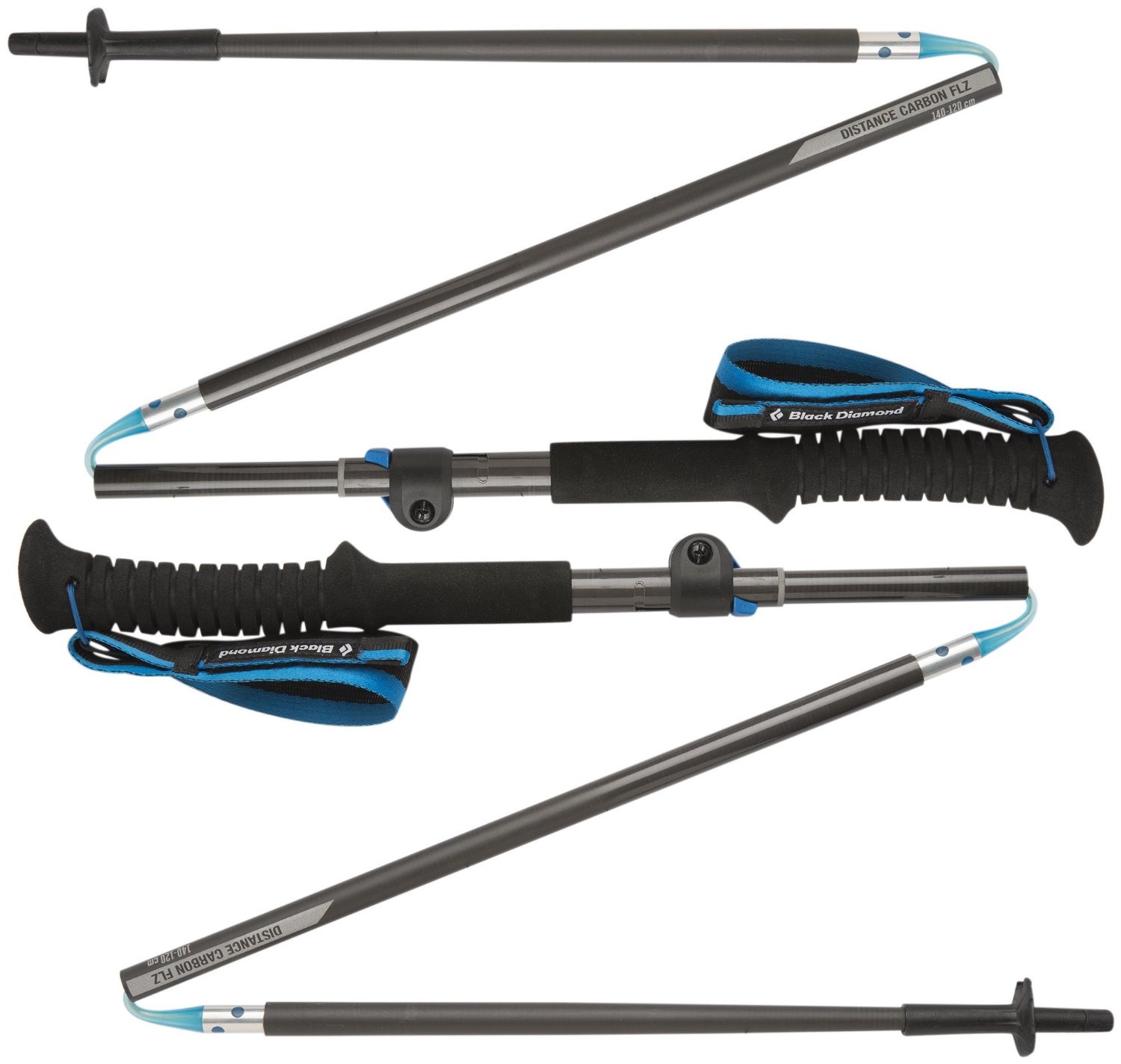
Carbon fiber construction (not aluminum) in a trekking pole makes them ultra lightweight. We like the Z-Pole style from Black Diamond so we can hide our poles in our pack from potential thieves before getting to our albergue! There are many to choose from! (See more of our gear recommendations! )
Gregory BackPack ~ My Favorite Brand


Do not forget your quick-dry microfiber towel!